Chapter 10 · Video 3
Blinding, and what the control group receives
Print layout
Slide 1


Blinding, and what the control group receives
Slide 2
Blinding (masking)
Why keep group assignment hidden?
From participants, providers, and outcome assessors
So knowledge of assignment doesn’t influence behavior or outcome measurement
Slide 3
Who is blinded under each design
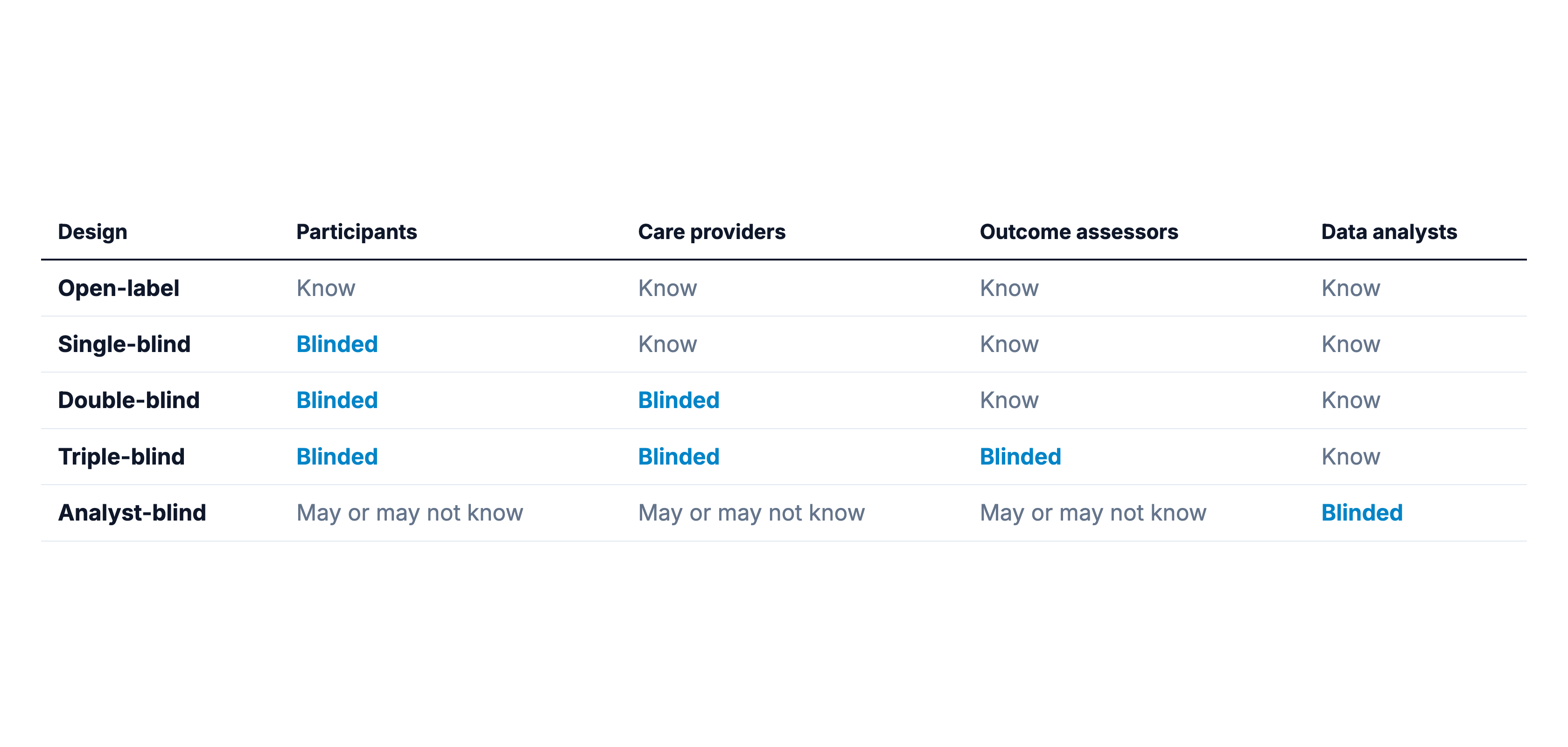
In global health RCTs, full blinding is often impossible for behavioral or community-level interventions, but blinding outcome assessors is almost always feasible. Adapted from Chapter 10.
Slide 4
When the intervention can’t be hidden from participants
Participants know whether a health worker is visiting their home
A self-reported behavior, like treating drinking water, is open to bias
An objective measure, like microbiological testing of water, is less exposed
Slide 5
Desai et al., 2015
The cholera vaccine trial used an identical-appearing placebo
Neither participants nor the clinical staff knew who received which
Expectations couldn’t influence immune response measurement or behavior
Slide 6
Blinding outcome assessors and data analysts
Blind when you can, especially for subjective outcomes
You can almost always blind outcome assessors
Analyst blinding protects the many decisions analysts make
Slide 7
The comparator defines the question a trial answers
Clearly superior against a weaker comparator
Possibly indistinguishable from a stronger one
The estimated effect is always relative to the comparison
Slide 8
Types of control condition
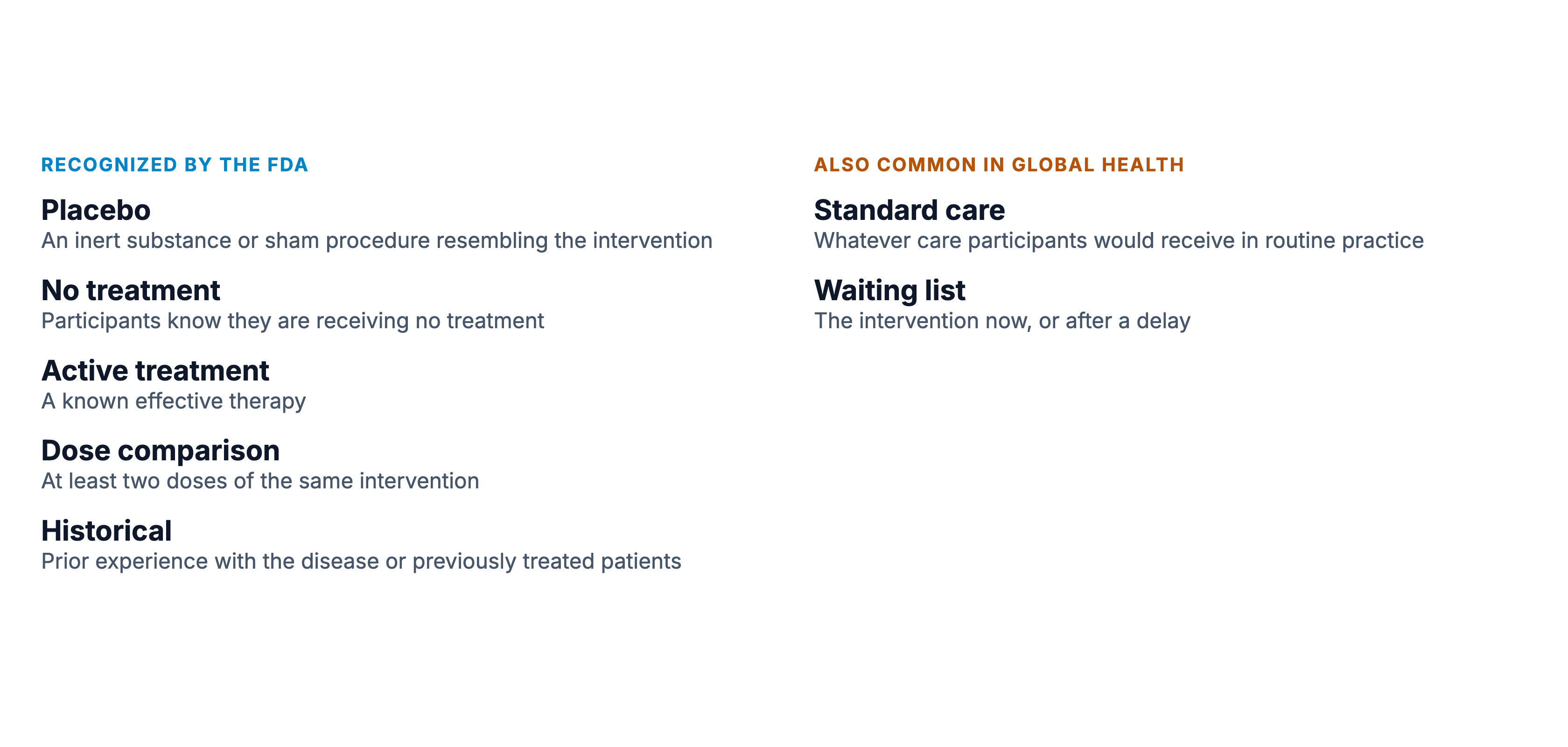
The five types of control the FDA recognizes for adequate and well-controlled trials (21 CFR 314.126), and two more that appear frequently in global health. Adapted from Chapter 10.
Slide 9
Desai et al., 2015
Placebo concurrent control
An inert substance or sham procedure that resembles the intervention
Controls for placebo effects and estimates absolute efficacy
Appropriate when no proven treatment exists, or withholding treatment is ethical
Slide 10
Zubairi et al., 2024
Active control, and the problem of similar results
A known effective therapy, when withholding all treatment would be unethical
Low-osmolarity ORS was compared with standard ORS
If both arms do equally well, did both work, or neither?
Slide 11
Mai et al., 2018
Standard care and waiting-list controls
Standard care
Routine care as usual
Common in effectiveness trials
Waiting list
Intervention now or after a delay
Nobody is completely denied the intervention
Slide 12
Matching the comparator to the question
Any effect beyond placebo: a placebo control
An improvement on current practice: standard care or an active control
A dose-response relationship: dose comparison
Slide 13
In Closing
What is this being compared against, and why?
The answer shapes everything that follows
Blinding, and what the control group receives
Slide 1Two decisions shape the comparison at the center of every randomized trial: who knows which group each participant is in, and what the control group receives.
Blinding (masking)
Why keep group assignment hidden?
From participants, providers, and outcome assessors
So knowledge of assignment doesn’t influence behavior or outcome measurement
Slide 2Blinding, also called masking, refers to keeping study participants, providers, and outcome assessors unaware of who is receiving the intervention and who is receiving the control condition. The purpose is to prevent knowledge of group assignment from influencing behavior or outcome measurement.
Who is blinded under each design
In global health RCTs, full blinding is often impossible for behavioral or community-level interventions, but blinding outcome assessors is almost always feasible. Adapted from Chapter 10.
Slide 3In a single-blind trial, participants don't know which group they're in, but providers and researchers do. In a double-blind trial, neither participants nor providers know. In a triple-blind trial, outcome assessors also don't know. And in an analyst-blind trial, the statistician analyzing the data doesn't know which group is treatment and which is control until the analysis is complete.
When the intervention can’t be hidden from participants
Participants know whether a health worker is visiting their home
A self-reported behavior, like treating drinking water, is open to bias
An objective measure, like microbiological testing of water, is less exposed
Slide 4Blinding isn't always possible in global health RCTs. Consider a community health worker program. We can't blind participants to whether they're receiving home visits from a health worker, because the intervention is inherently visible. Does that make the trial invalid? No. But it does mean we need to think carefully about how knowledge of group assignment might influence outcomes. If the outcome is a behavior that participants self-report, like whether they treated their drinking water, participants who know they're receiving the intervention might report more positive behaviors to please researchers, regardless of what they actually do. To address this, we might use objective measures, like microbiological testing of water quality, in place of self-reports.
Desai et al., 2015
The cholera vaccine trial used an identical-appearing placebo
Neither participants nor the clinical staff knew who received which
Expectations couldn’t influence immune response measurement or behavior
Slide 5By contrast, the Ethiopian cholera vaccine trial used double-blinding, with participants receiving either the vaccine or an identical-appearing placebo. Neither participants nor the clinical staff administering injections and collecting blood samples knew who received which. That eliminated the possibility that expectations about the vaccine could influence immune response measurement, which was objective anyway, or participant behavior.
Blinding outcome assessors and data analysts
Blind when you can, especially for subjective outcomes
You can almost always blind outcome assessors
Analyst blinding protects the many decisions analysts make
Slide 6Here's my practical advice. Blind when you can, especially for subjective outcomes or when there's potential for behavior change based on group assignment. But don't abandon an important RCT just because blinding isn't feasible. Use objective outcome measures when possible, and carefully assess and report the potential biases. In global health, full double or triple blinding is often impossible, but we can almost always blind outcome assessors, and that alone goes a long way. One form that's often overlooked is analyst blinding. It prevents analytical choices from being influenced by knowing which group is which, and that's a particularly valuable safeguard given the many decisions analysts make about model specification, outlier handling, and subgroup analysis.
The comparator defines the question a trial answers
Clearly superior against a weaker comparator
Possibly indistinguishable from a stronger one
The estimated effect is always relative to the comparison
Slide 7This might seem obvious. The control group doesn't get the intervention, right? But the choice of control condition is one of the most consequential decisions we'll make, because the comparator defines the question the trial answers. An intervention that looks clearly superior against a weaker comparator might be indistinguishable from a stronger one. The estimated effect is always relative to the comparison, not absolute.
Types of control condition
The five types of control the FDA recognizes for adequate and well-controlled trials (21 CFR 314.126), and two more that appear frequently in global health. Adapted from Chapter 10.
Slide 8The FDA recognizes five types of controls as valid for adequate and well-controlled trials, and the same logic applies to global health research. Placebo, no treatment, active treatment, dose comparison, and historical controls. A no-treatment control is appropriate when outcomes are objective and the placebo effect is negligible, like all-cause mortality. A dose-comparison control compares at least two doses of the same intervention, and it's useful when the dose-response relationship is itself the question. And the FDA considers historical controls the weakest of the five designs, because it's difficult to ensure that the treated group and the historical reference group are truly comparable. Two more designs appear frequently in global health: standard care, and waiting-list controls.
Desai et al., 2015
Placebo concurrent control
An inert substance or sham procedure that resembles the intervention
Controls for placebo effects and estimates absolute efficacy
Appropriate when no proven treatment exists, or withholding treatment is ethical
Slide 9With a placebo control, participants receive an inert substance or a sham procedure designed to resemble the intervention as closely as possible. This controls for placebo effects and provides a clean estimate of absolute efficacy. The Ethiopian cholera vaccine trial used this approach, and control participants received saline injections. Placebo controls are appropriate when no proven treatment exists, or when withholding treatment is ethical for the condition studied.
Zubairi et al., 2024
Active control, and the problem of similar results
A known effective therapy, when withholding all treatment would be unethical
Low-osmolarity ORS was compared with standard ORS
If both arms do equally well, did both work, or neither?
Slide 10With an active treatment control, participants receive a known effective therapy. That's appropriate when withholding all treatment would be unethical because an effective intervention already exists. The low-osmolarity ORS trials compared a new formulation against standard oral rehydration solution, and not against no treatment. A key challenge is that if the new treatment and the active control produce similar results, we can't always tell whether both worked or neither did.
Mai et al., 2018
Standard care and waiting-list controls
Standard care
Routine care as usual
Common in effectiveness trials
Waiting list
Intervention now or after a delay
Nobody is completely denied the intervention
Slide 11A standard care control gives participants whatever care they'd normally receive in routine practice. It's common in effectiveness trials, because we're testing whether the intervention improves on the status quo. The tuberculous meningitis trial in Vietnam gave participants aspirin, at a low or a high dose, or a matched placebo, all on top of standard anti-TB drugs and dexamethasone. A waiting-list control randomizes participants to receive the intervention either immediately or after a delay. That addresses the ethical concern of completely withholding a potentially beneficial intervention while still allowing a comparison, and many behavioral intervention trials use it.
Matching the comparator to the question
Any effect beyond placebo: a placebo control
An improvement on current practice: standard care or an active control
A dose-response relationship: dose comparison
Slide 12The choice among these depends on the research question, on ethical considerations, and on what we need to demonstrate. If we're trying to show that an intervention has any effect beyond placebo, we use a placebo control. If we're trying to show that it improves on current practice, we use standard care or an active control. And if we're evaluating dose-response, we use dose comparison.
In Closing
What is this being compared against, and why?
The answer shapes everything that follows
Slide 13There's no single right answer, but there is a right process, and that's to think explicitly about what comparison will answer the most important question for policy and practice in our setting. The next time you're reading a trial, or designing one, stop and ask: what is this being compared against, and why?