Chapter 12 · Video 3
Case-control studies: starting from the outcome
Print layout
Slide 1


Case-control studies: starting from the outcome
Slide 2
Understanding a cholera outbreak in Yemen during active conflict
Prospective research is nearly impossible
Waiting months to set up a cohort is not an option
Slide 3
Case-control studies
Start with the outcome and look back at exposures
Cases: people with the disease or outcome of interest
Controls: people without it, drawn from the same source population
Were cases more likely than controls to have been exposed?
Slide 4
Dureab et al., 2019
Unwashed khat and common-source water
A matched case-control study in an active conflict zone
Controls matched to cases on geographic and demographic variables
Actionable findings about cholera transmission routes
Slide 5
When a case-control study is the right choice
The outcome is rare
Answers are needed quickly
The outcome has already occurred, as in an outbreak
Several exposures might matter
Slide 6
Selecting controls
Controls should represent the population that produced the cases
If a control had developed the disease, would they have been identified as a case?
Get this wrong and we introduce selection bias
Slide 7
Selecting controls
Hospital controls for hospitalized pneumonia
Cases are pneumonia patients; controls are surgery patients
If smoking also raises surgery risk, the effect of smoking is underestimated
Community controls usually represent the source population better
Slide 8
Dureab et al., 2019
Matching controls confounding, and it has a cost
Why match
Controls confounding by design
In Yemen: similar water and sanitation
What it costs
Matched variables cannot be studied
The analysis must account for it
Slide 9
Matching on a consequence of the exposure
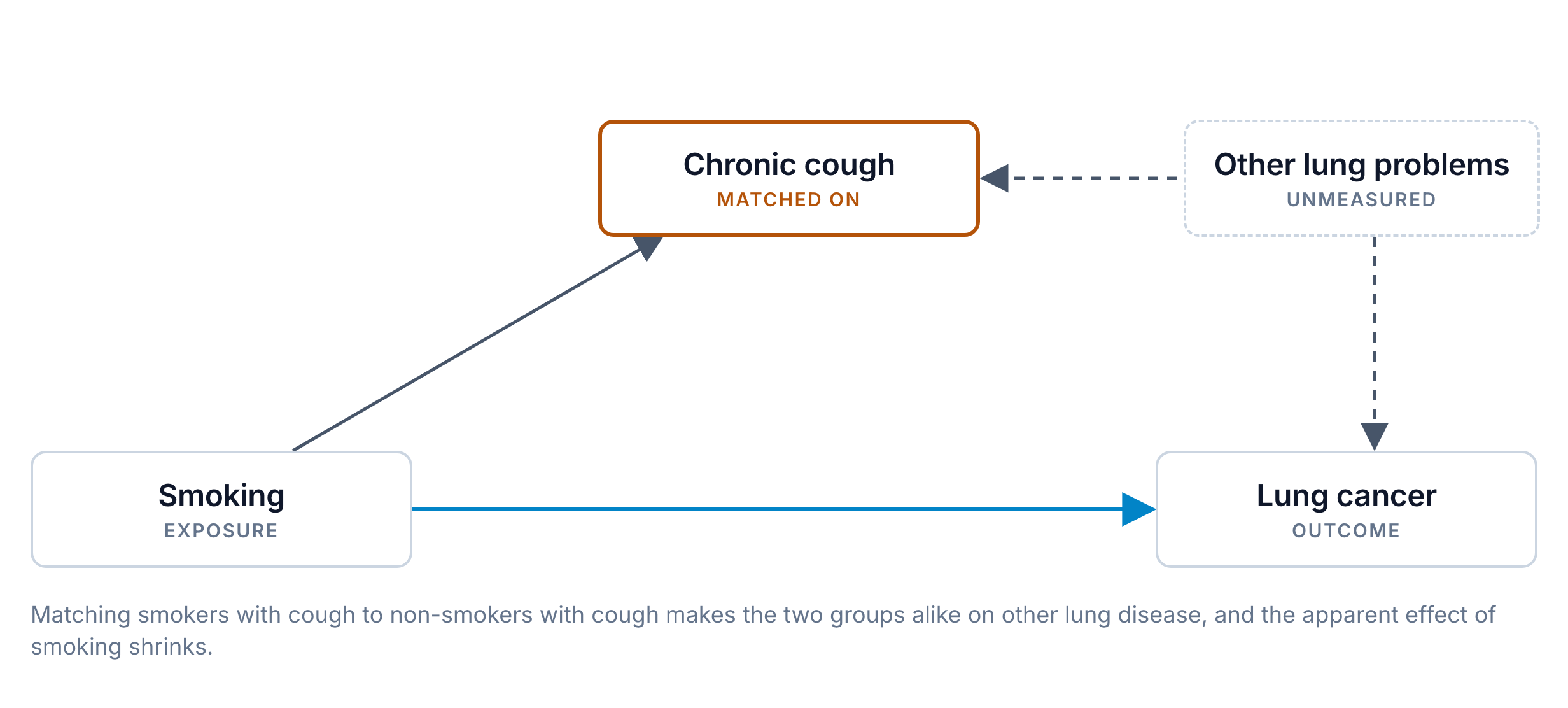
Over-matching. Matching on chronic cough, which smoking causes, makes smokers and non-smokers alike on other lung disease.
Slide 10
Match on confounders, never on anything in the causal pathway
Confounders are common causes of exposure and outcome
Mediators and colliders are not matching variables
Draw a DAG if you are uncertain
Slide 11
Cerceo et al., 2009
A matched design needs a matched analysis
Conditional logistic regression or a similar method
Reviews of published case-control studies show this is often done wrong
Slide 12
Recall bias
People with the disease may remember their exposures differently
Case-control studies ask people to remember past exposures
Differential recall can create spurious associations
Slide 13
Information bias
Objective records and blinded interviewers
Use medical, employment, or environmental records when they exist
Blind interviewers to case status when possible
Slide 14
Nested case-control studies measure exposure before disease occurs
Controls come from within an existing cohort
Exposures are often measured from stored biospecimens
No recall bias, and exposure clearly preceded outcome
Slide 15
In Closing
The hardest part of a case-control study is choosing controls
Efficient for rare outcomes and outbreaks
No denominator, so no incidence or absolute risk
Case-control studies: starting from the outcome
Slide 1Case-control studies start with the outcome and look back at exposures. They're the design of choice for rare diseases and outbreak investigations.
Understanding a cholera outbreak in Yemen during active conflict
Prospective research is nearly impossible
Waiting months to set up a cohort is not an option
Slide 2Say we want to understand what caused a cholera outbreak in Yemen, a country experiencing active conflict, where prospective research is nearly impossible. We could wait months to set up a cohort study. Or we could work backward: find people who have cholera, find similar people who don't, and ask both groups about their recent exposures.
Case-control studies
Start with the outcome and look back at exposures
Cases: people with the disease or outcome of interest
Controls: people without it, drawn from the same source population
Were cases more likely than controls to have been exposed?
Slide 3That's the logic of a case-control study. We select cases, people with the disease or outcome of interest, and controls, people without it, ideally drawn from the same source population. Then we measure past exposures in both groups and compare. The question is whether cases were more likely than controls to have been exposed.
Dureab et al., 2019
Unwashed khat and common-source water
A matched case-control study in an active conflict zone
Controls matched to cases on geographic and demographic variables
Actionable findings about cholera transmission routes
Slide 4In Yemen, researchers investigating cholera identified specific risk factors, like not washing khat before chewing it, and use of common-source water. This was a matched case-control study conducted in an active conflict zone, about as challenging a research environment as there is. By carefully matching controls to cases on geographic and demographic variables, the researchers generated actionable findings about how cholera was spreading.
When a case-control study is the right choice
The outcome is rare
Answers are needed quickly
The outcome has already occurred, as in an outbreak
Several exposures might matter
Slide 5Case-control studies shine when the outcome is rare, because we'd need enormous cohorts to capture enough cases. They shine when we need answers quickly, when the outcome has already occurred, which makes them ideal for outbreaks, and when several exposures might matter, because we can assess many risk factors at once. But they introduce some distinctive challenges.
Selecting controls
Controls should represent the population that produced the cases
If a control had developed the disease, would they have been identified as a case?
Get this wrong and we introduce selection bias
Slide 6The hardest part of a case-control study is choosing controls. Controls should represent the source population that gave rise to the cases. The test is a question: if a control had developed the disease, would they have been identified as a case? Get this wrong and we introduce selection bias, one of the most pernicious threats to case-control studies.
Selecting controls
Hospital controls for hospitalized pneumonia
Cases are pneumonia patients; controls are surgery patients
If smoking also raises surgery risk, the effect of smoking is underestimated
Community controls usually represent the source population better
Slide 7Here's a classic mistake. We're studying risk factors for hospitalized pneumonia. We select pneumonia patients as cases, and other hospitalized patients, say surgery patients, as controls. The problem is that hospitalized patients aren't representative of the population that produced the pneumonia cases. If we're studying smoking, and smoking also increases the risk of surgery, we'll underestimate smoking's effect on pneumonia. Controls should come from the same population the cases came from, which often means community controls.
Dureab et al., 2019
Matching controls confounding, and it has a cost
Why match
Controls confounding by design
In Yemen: similar water and sanitation
What it costs
Matched variables cannot be studied
The analysis must account for it
Slide 8Matching means selecting controls to be similar to cases on certain variables, like age, sex, or neighborhood. The Yemen study matched on geographic and demographic factors, which in a conflict zone meant cases and controls faced similar water infrastructure, sanitation, and access to services. We match to control confounding. But matching has a cost. If we match on age, we can no longer study whether age affects cholera risk. That information is locked away by design. Matching can be done pair by pair, or on the overall distribution, and individual matching requires conditional logistic regression.
Matching on a consequence of the exposure
Over-matching. Matching on chronic cough, which smoking causes, makes smokers and non-smokers alike on other lung disease.
Slide 9There's also a temptation to over-match, to match on too many variables or, worse, on variables that are consequences of the exposure. Imagine we're studying whether smoking causes lung cancer, and we match on chronic cough, which smoking causes. Smokers with chronic cough get matched to non-smokers with chronic cough. But non-smokers with chronic cough probably have other lung problems that might also increase cancer risk. We've made smokers and non-smokers artificially similar on unmeasured lung disease, and the apparent association between smoking and cancer shrinks.
Match on confounders, never on anything in the causal pathway
Confounders are common causes of exposure and outcome
Mediators and colliders are not matching variables
Draw a DAG if you are uncertain
Slide 10So here's the rule: never match on anything in the causal pathway between exposure and outcome. Matching variables should be confounders, common causes of exposure and outcome, and not mediators or colliders. If we're uncertain, we can draw a DAG. Matching on a variable strongly correlated with the exposure causes the same damage, and pushes the apparent effect toward the null.
Cerceo et al., 2009
A matched design needs a matched analysis
Conditional logistic regression or a similar method
Reviews of published case-control studies show this is often done wrong
Slide 11And if we match, we must account for it in the analysis, using conditional logistic regression or a similar method. Reviews of published case-control studies show this is often done wrong. Matched design, unmatched analysis is a recipe for bias. The pairs are linked by design, standard logistic regression assumes every observation is independent, and the result is wrong standard errors, wrong p-values, and misleading confidence intervals.
Recall bias
People with the disease may remember their exposures differently
Case-control studies ask people to remember past exposures
Differential recall can create spurious associations
Slide 12Because case-control studies ask people to remember past exposures, they're vulnerable to recall bias. People with a disease might search their memories more intensely than healthy controls. Did you eat unwashed vegetables before you got sick? If you have cholera, you might remember every questionable salad. If you don't, you might shrug and say, probably. That differential recall can create spurious associations.
Information bias
Objective records and blinded interviewers
Use medical, employment, or environmental records when they exist
Blind interviewers to case status when possible
Slide 13One strategy is to use objective exposure measures when possible, like medical records, employment records, or environmental measurements. But in many global health settings, especially during emergencies, those records don't exist, and you work with what you have. Case-control studies also face information bias when exposure assessment differs between cases and controls. If interviewers know who has the disease, they might probe harder with cases, which is why blinding interviewers to case status is good practice.
Nested case-control studies measure exposure before disease occurs
Controls come from within an existing cohort
Exposures are often measured from stored biospecimens
No recall bias, and exposure clearly preceded outcome
Slide 14A hybrid design is worth knowing about: the nested case-control study. It starts with a cohort. When cases occur, we select controls from within the same cohort, people who haven't developed the outcome yet, and measure exposures, often from stored biospecimens, for cases and controls only. That keeps costs manageable when exposure assessment requires specialized lab tests. Exposures were measured before disease occurred, which eliminates recall bias and tells us exposure preceded outcome. The key requirement is an existing cohort with stored samples or detailed baseline data.
In Closing
The hardest part of a case-control study is choosing controls
Efficient for rare outcomes and outbreaks
No denominator, so no incidence or absolute risk
Slide 15Case-control studies are efficient, fast, and well suited to rare outcomes and outbreaks. But they can't calculate incidence or absolute risk, because we started with cases and not with a population at risk. And control selection is difficult and easily biased. Getting it wrong can invalidate the entire study.