Chapter 7 · Video 1
Causal deniability
Print layout
Slide 1


Causal deniability
Slide 2

The headline, taken at its word.
"New study suggests coffee could literally be a lifesaver"
A real headline about a real study in Circulation
Pooled hazard ratio for death: 0.95
95% confidence interval, 0.91 to 0.99
Slide 3
Association
"Associated with" says there is a relationship in the observed data
The sort of people who drink a cup of coffee daily have a 5% lower risk of dying over two to three decades
By the author's back-of-the-envelope math, a 0.7% absolute decrease in the incidence of mortality
Does this mean that coffee prevents death?
Slide 4
Causal deniability
Two steps, one paper
Step 1 — the disclaimer
Avoid the word "causal"
Warn that correlation is not causation
Could not establish cause and effect
Step 2 — the recommendation
Ignore the warning
Recommend the behavior anyway
"May confer health benefits"
Slide 5
Hernán, 2018
"We need to stop treating causal as a dirty word"
Observational studies cannot definitively prove causation — but saying so misses the point
The point is to be clear about our scientific goals
And to use language that reflects those goals
Slide 6
So which question do you actually want to answer?
Whether the sort of people who drink a cup of coffee daily have a lower risk of dying
Or whether drinking a cup of coffee daily lowers the risk of dying
It's almost always the latter
Slide 7
Causal inference identifies and estimates the causal effect of a proposed cause on an outcome
Do bed nets prevent malaria, and by how much?
Is it better to subsidize bed nets or sell them at full retail cost?
These are questions about health policy and practice
Slide 8
Causes, effects, and outcomes
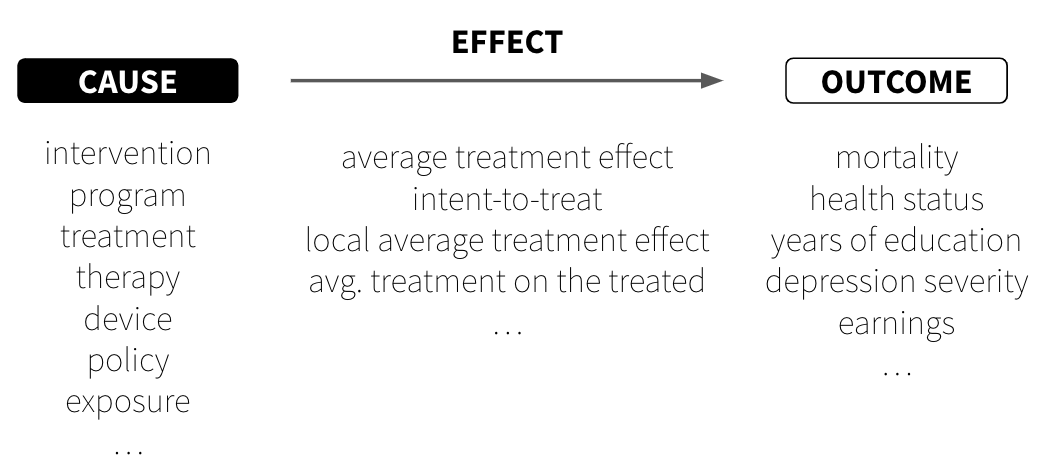
Causes, effects, and outcomes. Reproduced from Chapter 7.
Slide 9
You have likely perfected the art of causal inference in daily life
A hand on a hot stove causes pain; the headache went away because of the ibuprofen
Formalizing that intuition for research turns out to be remarkably challenging
Even core terms like cause and effect are up for debate
Slide 10
Two kinds of causal question, and one is much harder
Effects of causes
What is the effect of X on Y?
Effect of a therapy on depression severity
Intervene on X; estimate the change in Y
Causes of effects
What causes Y?
What causes depression?
Harder to answer
Slide 11
Pearl and Mackenzie, *The Book of Why*, 2018
"X is a cause of Y if Y listens to X"
"...and determines its value in response to what it hears"
Causes come before effects — X speaks, then Y listens
When X happens, Y is more likely to happen — not certain to
Slide 12
A causal relationship can exist even when we can't cleanly identify it
Suppose smoking causes lung cancer, and a gene makes some people both likelier to smoke and more susceptible
Smoking still causes cancer — Y still listens to X
Confounding doesn't change the causal relationship; it makes it harder to measure
Slide 13
Shadish, Cook, and Campbell
Studies that fail to rule out plausible alternatives have low internal validity
The cause preceded the effect
The cause was related to the effect
We can find no plausible alternative explanation for the effect other than the cause
Slide 14
In Closing
The same X, under five different names
Interventions to prevent or treat conditions like depression; programs to improve well-being
Treatments and therapies tested for efficacy; policies studied for health and financial impact
Exposures, such as smoking, estimated against the health status of a target population
Causal deniability
Slide 1This video is about causal inference: what we do when we identify and estimate the causal effect of some proposed cause on an outcome of interest. We'll build up a working definition of a cause, and end on the property a study needs before anyone should believe a causal claim it makes. We start with coffee.
The headline, taken at its word.
"New study suggests coffee could literally be a lifesaver"
A real headline about a real study in Circulation
Pooled hazard ratio for death: 0.95
95% confidence interval, 0.91 to 0.99
Slide 2Extra! Extra! Read all about it. New study suggests coffee could literally be a lifesaver. This is a real headline about a study published in the journal Circulation. Now, I'm as big a coffee fan as the next guy, but literally a lifesaver? Here is what the study authors wrote in their paper. Higher consumption of total coffee, caffeinated coffee, and decaffeinated coffee was associated with lower risk of total mortality. Relative to no consumption of coffee, the pooled hazard ratio for death was zero point nine five, with a ninety-five percent confidence interval of zero point nine one to zero point nine nine, for one cup of total coffee per day or less.
Association
"Associated with" says there is a relationship in the observed data
The sort of people who drink a cup of coffee daily have a 5% lower risk of dying over two to three decades
By the author's back-of-the-envelope math, a 0.7% absolute decrease in the incidence of mortality
Does this mean that coffee prevents death?
Slide 3Associated with tells us that there's a relationship between mortality and coffee consumption in the observed data. The sort of people who drink a cup of coffee daily have a five percent lower risk of dying over two to three decades. That's a hazard ratio, so it's a relative comparison. By my own back of the envelope analysis, it works out to about a zero point seven percent absolute decrease in the incidence of mortality. Does this mean that coffee prevents death? The study authors say no. But also, maybe.
Causal deniability
Two steps, one paper
Step 1 — the disclaimer
Avoid the word "causal"
Warn that correlation is not causation
Could not establish cause and effect
Step 2 — the recommendation
Ignore the warning
Recommend the behavior anyway
"May confer health benefits"
Slide 4Here is how causal deniability works, in two steps, both of them from the same paper. Step one: avoid the word causal, and warn that correlation is not causation. In their words, given the observational nature of the study design, we could not directly establish a cause-effect relationship between coffee and mortality. Step two: ignore the warning, and make policy or health recommendations based on a causal interpretation of the same findings. In their words, coffee consumption can be incorporated into a healthy lifestyle, and moderate consumption of coffee may confer health benefits in terms of reducing premature death. So which is it, a non-causal association or a causal effect?
Hernán, 2018
"We need to stop treating causal as a dirty word"
Observational studies cannot definitively prove causation — but saying so misses the point
The point is to be clear about our scientific goals
And to use language that reflects those goals
Slide 5It has been argued that scientists need to stop the charade. Quote: we need to stop treating causal as a dirty word that respectable investigators do not say in public or put in print. It is true that observational studies cannot definitively prove causation, but this statement misses the point. And the point is that we have to be clear about our scientific goals, and use language that reflects those goals.
So which question do you actually want to answer?
Whether the sort of people who drink a cup of coffee daily have a lower risk of dying
Or whether drinking a cup of coffee daily lowers the risk of dying
It's almost always the latter
Slide 6To riff on that idea a bit. Do we want to determine whether the sort of people who drink a cup of coffee daily have a lower risk of dying, or do we want to determine whether drinking a cup of coffee daily lowers the risk of dying? It's almost always the latter. You might be interested in the first version if you are developing a prediction model. But to answer the second one, we need causal inference.
Causal inference identifies and estimates the causal effect of a proposed cause on an outcome
Do bed nets prevent malaria, and by how much?
Is it better to subsidize bed nets or sell them at full retail cost?
These are questions about health policy and practice
Slide 7Causal inference is what we do when we identify and estimate the causal effect of some proposed cause on an outcome of interest. We use causal inference methods in global health to answer key questions about health policy and practice. Do bed nets prevent malaria, and by how much? Is it better to subsidize bed nets or sell them at full retail cost? And so on.
Causes, effects, and outcomes
Causes, effects, and outcomes. Reproduced from Chapter 7.
Slide 8Causes, effects, and outcomes. The bed net question contains all three. Bed nets are the proposed cause. Malaria is the outcome of interest. And by how much is the effect.
You have likely perfected the art of causal inference in daily life
A hand on a hot stove causes pain; the headache went away because of the ibuprofen
Formalizing that intuition for research turns out to be remarkably challenging
Even core terms like cause and effect are up for debate
Slide 9As someone who has likely perfected the art of causal inference in your daily life, you might be surprised to learn that causal inference in science is still a rapidly evolving field. You already know that putting your hand on a hot stove causes pain, and that your headache went away because you took ibuprofen. We make these kinds of causal judgments constantly, often without much conscious thought. Yet formalizing this intuitive process for scientific research, where we need to be precise about what we mean and defend our conclusions to skeptics, turns out to be remarkably challenging. Even core terms like cause and effect are up for debate.
Two kinds of causal question, and one is much harder
Effects of causes
What is the effect of X on Y?
Effect of a therapy on depression severity
Intervene on X; estimate the change in Y
Causes of effects
What causes Y?
What causes depression?
Harder to answer
Slide 10There are two kinds of causal question, and they are not equally tractable. The most common type we ask is about the effects of causes. What is the effect of X on Y? For instance, what is the effect of a new therapy on depression severity? Given a well-defined cause, X, we can estimate what happens to Y if we intervene to change X. Questions about the causes of effects, what causes Y, are harder to answer. For example, what causes depression?
Pearl and Mackenzie, *The Book of Why*, 2018
"X is a cause of Y if Y listens to X"
"...and determines its value in response to what it hears"
Causes come before effects — X speaks, then Y listens
When X happens, Y is more likely to happen — not certain to
Slide 11So what is a cause? A Turing Award-winning computer scientist and his co-author, a mathematician turned science writer, offered this definition in their two thousand eighteen book. Quote: a variable X is a cause of Y if Y listens to X and determines its value in response to what it hears. That definition has two key implications. First, causes must come before effects. X speaks, and then Y listens. Second, causes and effects are associated, meaning they go together, or covary. When X happens, Y is more likely to happen. More likely, because the effect does not always need to happen for there to be a causal relationship. Smoking increases the probability of developing lung cancer, but not all smokers will develop lung cancer. Most of the relationships we study in global health are like this. Probabilistic in nature, not deterministic.
A causal relationship can exist even when we can't cleanly identify it
Suppose smoking causes lung cancer, and a gene makes some people both likelier to smoke and more susceptible
Smoking still causes cancer — Y still listens to X
Confounding doesn't change the causal relationship; it makes it harder to measure
Slide 12Here is a distinction that trips up a lot of students. A causal relationship can exist even when we can't cleanly identify it. Imagine smoking truly does cause lung cancer, but there's also some genetic factor that makes certain people both more likely to smoke and more susceptible to cancer. In that scenario, smoking still causes cancer. Y still listens to X. The confounding factor doesn't change the underlying causal relationship. It just makes it harder for us as researchers to measure how much of the cancer risk comes from smoking versus genetics. And that brings us to one of the central challenges in causal inference: ruling out plausible alternative explanations. During the smoking debate of the nineteen fifties and sixties, some proponents of smoking asked whether the apparent causal link could be explained by a smoking gene that predisposed people to both. Such a gene was in fact later discovered, and it does not explain the clear relationship between smoking and cancer. The question was never whether smoking could cause cancer; it was whether the evidence proved that it did.
Shadish, Cook, and Campbell
Studies that fail to rule out plausible alternatives have low internal validity
The cause preceded the effect
The cause was related to the effect
We can find no plausible alternative explanation for the effect other than the cause
Slide 13The need to rule out plausible alternative explanations keeps many researchers up at night. The conditions are usually put this way. We can only infer a causal relationship when, one, the cause preceded the effect. Two, the cause was related to the effect. And three, we can find no plausible alternative explanation for the effect other than the cause. Notice what that third condition is about. It's about identifying causal effects, what we need in order to demonstrate causation convincingly. Causation can exist in the world whether or not any particular study manages to demonstrate it. Studies that fail to rule out alternative explanations convincingly are characterized as having low internal validity. There is not a strong justification for inferring that the observed relationship between X and Y is causal, even if such a relationship truly exists.
In Closing
The same X, under five different names
Interventions to prevent or treat conditions like depression; programs to improve well-being
Treatments and therapies tested for efficacy; policies studied for health and financial impact
Exposures, such as smoking, estimated against the health status of a target population
Slide 14One last thing before we go. We study a variety of potential causes in global health research, and we call them by different names. Global mental health researchers develop and test interventions delivered to individuals or groups. Development agencies administer programs to improve people's well-being. Clinical researchers and biostatisticians test the efficacy of drugs and medical devices, generally referred to as treatments or therapies. Policy researchers and health economists study the impacts of policies, such as removing fees to deliver a baby at a public health facility. And epidemiologists estimate the effect of exposures, such as smoking, on the health status of a target population. Different words, same X. Next, we turn from causes to effects.