Chapter 4 · Video 4
How to conduct a systematic review, step by step
Print layout
Slide 1


How to conduct a systematic review, step by step
Slide 2
When do you need to be systematic?
When your goal is to find all the relevant evidence on a question
Everything that exists, and not only enough to make your case
A comprehensive, unbiased synthesis of what the research shows
Slide 3
You cannot cherry-pick convenient studies
Does this intervention work, and to what extent?
What does the totality of evidence suggest? Where are the gaps?
Harder to find, other languages, obscure journals, grey literature
Slide 4
Incomplete searching biases your conclusions
The studies you miss are often systematically different
Null or negative results, or from underrepresented regions
Or studies that challenge dominant narratives
Slide 5
A learnable skill with clear steps
The bad news: it takes time
There are few shortcuts that do not compromise quality
Measured in months and years, and not days and weeks
Slide 6
Step 0
Systematic reviews are a team sport
Your first pick-up should probably be a librarian
Trained in systematic search methods and database quirks
Many universities offer consultations for systematic reviews
Slide 7
Step 0
The rest of the crew
Content experts on the conditions, interventions, and exposures
Methodological experts who can help with critical appraisal
Teammates to screen records and extract data
Slide 8
Step 1
Specific enough to search, broad enough to capture
Too broad
How can we improve health in Africa?
Too narrow
ASHA, vaccination, Uttar Pradesh, 2015–2018
Slide 9
Step 1
Use a framework like PICO
Population: who are you studying?
Intervention or exposure, and the comparison, if any
Outcome: which outcomes matter?
Slide 10
Step 2
A search strategy has two components
The search terms you will look for
And the structured queries you run in specific databases
Start by breaking your question into concepts
Slide 11
Step 2
Every way a concept might be expressed
Primary terms, synonyms, and broader or narrower related terms
British and American spellings, abbreviations, acronyms
And historical terms that appear in older literature
Slide 12
Step 2
Databases also use controlled vocabulary
MeSH in PubMed, Emtree in Embase, its own headings in CINAHL
Standardized terms assigned to articles by indexers
The MeSH term for breast cancer is breast neoplasm
Slide 13
Step 2
A sophisticated search uses both
Keyword searching catches new articles not yet indexed
Controlled vocabulary captures the indexed literature
Breast neoplasm searches more than 30 entry terms
Slide 14
Step 2
Combine your terms with Boolean operators
OR expands: articles with any of the terms
AND narrows: articles with all of the terms
NOT excludes — use it cautiously
Slide 15
Oh hey Boo
Boolean has only two possible values: true or false
The term honors George Boole, an English mathematician
Is malaria present? AND is pregnancy present?
Only records where both are true get returned
Slide 16
Step 2
Database searching alone will not find everything
Trial registries list trials, many of which are never published
Backward citation searching finds older studies; forward, newer
Grey literature, ministry websites, and experts you email
Slide 17
Step 3
Write your criteria before searching
You decide what is in and out before you see the results
Changing criteria after seeing results introduces bias
You might unconsciously exclude inconvenient findings
Slide 18
Step 4
A protocol specifies your methods before you see the results
Research question, eligibility criteria, and search strategy
Screening procedures and data extraction plans
Quality assessment approach and analysis methods
Slide 19
Step 4
Why register?
A public record of the plan you made before you knew the answer
It protects against accusations of cherry-picking
And it prevents two teams working the same question
Slide 20
Step 4
Decisions made in advance are more defensible
Writing a protocol enforces methodological discipline
Many journals now require PROSPERO registration
You may update it, but deviations must be documented
Slide 21
Step 5
Running the searches is the satisfying part
Watching the results pile up
This step requires meticulous documentation
Or you will regret it later
Slide 22
Step 6
Screening happens in two stages
Perhaps 100 citations, perhaps 10,000
Title and abstract screening comes first
Then full-text screening
Slide 23
Step 6
Dual independent screening is the gold standard
Two reviewers screen every citation independently
Then compare, and resolve disagreements with a third reviewer
It catches errors and inconsistencies, and doubles the workload
Slide 24
Step 6
Alternatives exist that divide the work
Split the remaining citations into independent batches
Or screen most independently, with random subsets in duplicate
Both require that reviewers already agree
Slide 25
Step 6
Screening decisions are subjective
Different interpretations of the eligibility criteria
Different thresholds for maybe, and different levels of attention
Without verification, you would never know
Slide 26
Step 6
Pilot the process before dividing the work
Both reviewers screen the same 50 to 100 citations
Compare decisions and calculate agreement with Cohen's kappa
Discuss, refine the guide, and repeat until kappa is above 0.8
Slide 27
Step 6
The first stage identifies what deserves a closer look
Is this potentially about my population, intervention, outcome?
Clearly no, exclude. Yes or maybe, keep it for full text
Speed should not compromise consistency
Slide 28
Steps 7 and 8
Critical appraisal evaluates each study's methodology
Studies that survive full-text screening are included
Extract information from each into a standardized format
Then appraise — also called risk of bias assessment
Slide 29
Step 8
Two studies of the same intervention disagree. Now what?
True heterogeneity in effects, or methodological differences?
Appraisal also informs the synthesis itself
Sensitivity analyses, stratified results, downgraded confidence
Slide 30
Step 9
Meta-analysis is optional
A statistical technique for combining results across studies
It needs studies similar enough to meaningfully combine
And extractable effect estimates and variance
Slide 31
Step 9
When to avoid a meta-analysis
Studies too heterogeneous, or too few of them
Poor data quality — a precise but potentially biased estimate
Incompatible effect measures, like odds ratios and hazard ratios
Slide 32
Every systematic review needs a flow diagram
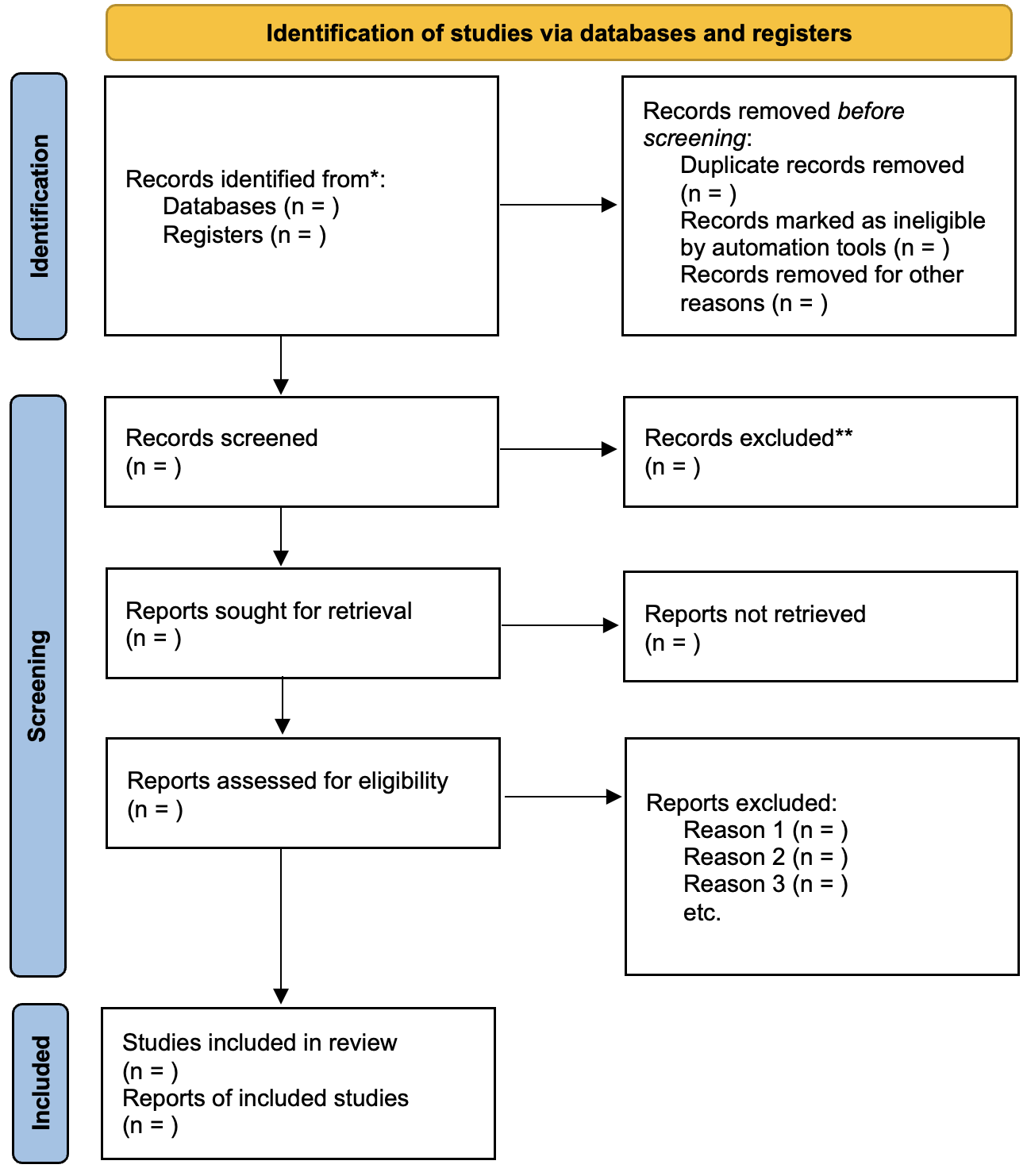
PRISMA 2020 flow diagram for new systematic reviews which included searches of databases and registers only. Source: Page et al. (2021). Licensed under CC BY 4.0.
Slide 33
In Closing
The diagram is what makes the search auditable
Records identified, deduplicated, screened, and excluded
Full-text articles assessed, and excluded with reasons
Readers can judge how you arrived at your included studies
How to conduct a systematic review, step by step
Slide 1This video walks through how a systematic review actually gets conducted, from the team you assemble and the question you frame, through the search, the screening, and the appraisal, to the flow diagram you publish so a reader can check your work.
When do you need to be systematic?
When your goal is to find all the relevant evidence on a question
Everything that exists, and not only enough to make your case
A comprehensive, unbiased synthesis of what the research shows
Slide 2When do you need to be systematic? When your goal is to find all the relevant evidence on a question. Not just enough to orient yourself or support an argument, but everything that exists. This is the foundation of a systematic review: a comprehensive, unbiased synthesis of what the research actually shows.
You cannot cherry-pick convenient studies
Does this intervention work, and to what extent?
What does the totality of evidence suggest? Where are the gaps?
Harder to find, other languages, obscure journals, grey literature
Slide 3Systematic reviews answer questions like: does this intervention work, and to what extent? What does the totality of evidence suggest? Where are the gaps? To answer them fairly, you can't cherry-pick convenient studies. You need to surface all the knowledge, including studies that are harder to find, written in other languages, published in obscure journals, or sitting in grey literature repositories.
Incomplete searching biases your conclusions
The studies you miss are often systematically different
Null or negative results, or from underrepresented regions
Or studies that challenge dominant narratives
Slide 4This matters because incomplete searching biases your conclusions. The studies you miss are often systematically different from the ones you find easily. They may have null or negative results, come from underrepresented regions, or challenge dominant narratives.
A learnable skill with clear steps
The bad news: it takes time
There are few shortcuts that do not compromise quality
Measured in months and years, and not days and weeks
Slide 5The good news is that systematic searching is a learnable skill with clear steps. The bad news is that it takes time, and there are few shortcuts that don't compromise quality. Buckle up, because the systematic review timeline is measured in months and years, not days and weeks.
Step 0
Systematic reviews are a team sport
Your first pick-up should probably be a librarian
Trained in systematic search methods and database quirks
Many universities offer consultations for systematic reviews
Slide 6Step zero. Systematic reviews are a team sport. They are a lot of work to complete, and you need a variety of voices to be a check on the process. If you're Danny Ocean putting together your crack team, your first pick-up should probably be a librarian. Research librarians are trained in systematic search methods and know database quirks you've never heard of. Many universities offer librarian consultations specifically for systematic reviews.
Step 0
The rest of the crew
Content experts on the conditions, interventions, and exposures
Methodological experts who can help with critical appraisal
Teammates to screen records and extract data
Slide 7You'll also need content experts who understand the conditions, interventions, and exposures. Methodological experts who can help with critical appraisal. And eager teammates willing to screen records and extract data. If your systematic review will include a quantitative technique called a meta-analysis, you'll need someone to lead this work.
Step 1
Specific enough to search, broad enough to capture
Too broad
How can we improve health in Africa?
Too narrow
ASHA, vaccination, Uttar Pradesh, 2015–2018
Slide 8Step one. Your starting point is a well-formulated question. It should be specific enough to search but broad enough to capture relevant evidence. Too broad: how can we improve health in Africa? Too narrow: what is the effect of the ASHA program on infant vaccination rates in rural Uttar Pradesh between 2015 and 2018?
Step 1
Use a framework like PICO
Population: who are you studying?
Intervention or exposure, and the comparison, if any
Outcome: which outcomes matter?
Slide 9Just right: what is the effectiveness of community health worker programs for improving childhood vaccination coverage in low-income countries? A good strategy for developing a well-formulated question is to use a framework like PICO. Population: who are you studying? Intervention or exposure: what are you interested in? Comparison: what is the comparison, if any? And outcome: what outcomes matter?
Step 2
A search strategy has two components
The search terms you will look for
And the structured queries you run in specific databases
Start by breaking your question into concepts
Slide 10Step two. With your question formulated and your team assembled, it's time to build the search strategy that will actually find the evidence. A search strategy has two main components: the search terms, meaning the words you'll search for, and the database queries, meaning the structured searches you'll run in specific databases. Start with the terms. Break your question into concepts and identify all the ways those concepts might be expressed in the literature.
Step 2
Every way a concept might be expressed
Primary terms, synonyms, and broader or narrower related terms
British and American spellings, abbreviations, acronyms
And historical terms that appear in older literature
Slide 11For each concept, generate primary terms, the obvious words researchers use. Synonyms. Related terms, broader or narrower concepts that might capture relevant literature. British and American spellings. Abbreviations and acronyms. And historical terms that might appear in older literature. For community health workers, your list might include community health worker, village health worker, lay health worker, health extension worker, barefoot doctor, promotora, and ASHA in India. Do this for each concept in your question.
Step 2
Databases also use controlled vocabulary
MeSH in PubMed, Emtree in Embase, its own headings in CINAHL
Standardized terms assigned to articles by indexers
The MeSH term for breast cancer is breast neoplasm
Slide 12Major databases also use controlled vocabulary: standardized terms assigned to articles by indexers. In PubMed these are called MeSH, or Medical Subject Headings. In Embase they're called Emtree terms. CINAHL has its own headings. Controlled vocabulary thesauruses are helpful because there are many ways to refer to the same phenomenon. The MeSH term for breast cancer is breast neoplasm.
Step 2
A sophisticated search uses both
Keyword searching catches new articles not yet indexed
Controlled vocabulary captures the indexed literature
Breast neoplasm searches more than 30 entry terms
Slide 13A search for breast neoplasm in PubMed actually searches more than 30 entry terms. So a sophisticated search uses both keyword searching, to catch new articles not yet indexed, and controlled vocabulary, to comprehensively capture the indexed literature.
Step 2
Combine your terms with Boolean operators
OR expands: articles with any of the terms
AND narrows: articles with all of the terms
NOT excludes — use it cautiously
Slide 14Once you have your terms, you need to combine them into a search query using Boolean operators. OR expands your search: it finds articles with any of the terms. AND narrows your search: it finds articles with all of the terms. NOT excludes terms, and you should use it cautiously, because you might exclude relevant articles. Use parentheses to group terms and control how the Boolean operators apply.
Oh hey Boo
Boolean has only two possible values: true or false
The term honors George Boole, an English mathematician
Is malaria present? AND is pregnancy present?
Only records where both are true get returned
Slide 15A short aside on where that word comes from. Boolean refers to a data type with only two possible values: true or false. The term honors George Boole, a nineteenth-century English mathematician who developed an algebraic system for logical reasoning. When you search malaria AND pregnancy, you're asking: is malaria present, true or false, AND is pregnancy present? Only records where both are true get returned.
Step 2
Database searching alone will not find everything
Trial registries list trials, many of which are never published
Backward citation searching finds older studies; forward, newer
Grey literature, ministry websites, and experts you email
Slide 16Database searching alone won't find everything. For comprehensive systematic reviews, you'll also need to search trial registries, which list registered trials, many of which are never published. Check reference lists: backward citation searching finds older relevant studies, while forward citation searching finds newer ones. Search grey literature, including UN agency repositories, ministry of health websites, and organizational reports. These often contain evidence that never appears in indexed journals, which is particularly important in global health, where much implementation evidence lives outside academic publishing. And contact experts directly, asking about unpublished work, ongoing studies, or reports you might have missed.
Step 3
Write your criteria before searching
You decide what is in and out before you see the results
Changing criteria after seeing results introduces bias
You might unconsciously exclude inconvenient findings
Slide 17Step three. Before searching, specify exactly which studies you'll include and exclude. Clear criteria prevent bias, because you decide what's in and out before you see the results. Write your criteria before searching, not after. Changing criteria after seeing results introduces bias: you might unconsciously exclude studies with inconvenient findings.
Step 4
A protocol specifies your methods before you see the results
Research question, eligibility criteria, and search strategy
Screening procedures and data extraction plans
Quality assessment approach and analysis methods
Slide 18Step four. A protocol is a detailed plan that specifies your methods before you see the results. It includes your research question, eligibility criteria, search strategy, screening procedures, data extraction plans, quality assessment approach, and analysis methods.
Step 4
Why register?
A public record of the plan you made before you knew the answer
It protects against accusations of cherry-picking
And it prevents two teams working the same question
Slide 19Why register? Registration creates a public record of what you planned to do before you knew what you'd find, which protects against accusations of cherry-picking or post-hoc changes to methods. It also prevents duplication, since other researchers can see your registered protocol and avoid working on the same question. And you can check the registry before you start, to see whether someone else is already on it.
Step 4
Decisions made in advance are more defensible
Writing a protocol enforces methodological discipline
Many journals now require PROSPERO registration
You may update it, but deviations must be documented
Slide 20The act of writing a protocol enforces methodological discipline, by forcing you to think through your methods carefully. Decisions made in advance are more defensible than decisions made after seeing results. Many journals now require registration for systematic reviews, with some funders following suit. The registry allows you to update your registration if you need to make changes, but you must document and justify any deviations from your original protocol.
Step 5
Running the searches is the satisfying part
Watching the results pile up
This step requires meticulous documentation
Or you will regret it later
Slide 21Step five. Now comes the satisfying part: running your searches and watching the results pile up. But satisfying comes with a warning. This step requires meticulous documentation, or you'll regret it later.
Step 6
Screening happens in two stages
Perhaps 100 citations, perhaps 10,000
Title and abstract screening comes first
Then full-text screening
Slide 22Step six. You've collected your search results, perhaps 100 citations, perhaps 10,000. Now you need to identify which ones actually meet your eligibility criteria. This happens in two stages: title and abstract screening, and then full-text screening.
Step 6
Dual independent screening is the gold standard
Two reviewers screen every citation independently
Then compare, and resolve disagreements with a third reviewer
It catches errors and inconsistencies, and doubles the workload
Slide 23The gold standard is dual independent screening. Two reviewers independently screen every citation, then compare decisions and resolve disagreements through discussion or a third reviewer. This catches errors and inconsistencies, but it doubles the workload, and that's a real constraint when you're facing thousands of citations.
Step 6
Alternatives exist that divide the work
Split the remaining citations into independent batches
Or screen most independently, with random subsets in duplicate
Both require that reviewers already agree
Slide 24Alternatives exist that divide the work. Once reviewers demonstrate they apply eligibility criteria consistently, some teams split the remaining citations between reviewers, with each screening independent batches. A hybrid approach has reviewers screen most citations independently but periodically screen random subsets in duplicate, to monitor ongoing agreement.
Step 6
Screening decisions are subjective
Different interpretations of the eligibility criteria
Different thresholds for maybe, and different levels of attention
Without verification, you would never know
Slide 25If you choose an approach that divides citations between reviewers, you must first establish inter-rater reliability. Why? Because screening decisions are subjective. Reviewers bring different interpretations of eligibility criteria, different thresholds for maybe, and different levels of attention depending on fatigue. Without verification, you might have one reviewer applying stricter criteria than another, and you'd never know.
Step 6
Pilot the process before dividing the work
Both reviewers screen the same 50 to 100 citations
Compare decisions and calculate agreement with Cohen's kappa
Discuss, refine the guide, and repeat until kappa is above 0.8
Slide 26So before dividing the work, pilot your process. Both reviewers screen the same 50 to 100 citations independently. Compare decisions and calculate agreement using Cohen's kappa. Discuss disagreements to clarify the eligibility criteria, and refine your screening guide as needed. Repeat until agreement is acceptable, typically a kappa above 0.8. Only then should you divide the remaining citations, and you document your approach and your inter-rater reliability in the methods section.
Step 6
The first stage identifies what deserves a closer look
Is this potentially about my population, intervention, outcome?
Clearly no, exclude. Yes or maybe, keep it for full text
Speed should not compromise consistency
Slide 27In the first stage, you review titles and abstracts to identify citations that are potentially relevant. You're identifying which citations deserve a closer look. For each citation, ask: based on the title and abstract alone, is this study potentially about my population, intervention, comparison, and outcome? If the answer is clearly no, exclude it. If the answer is yes or maybe, include it for full-text review. This stage goes quickly once you get into a rhythm, and it would not be exceptional for an experienced reviewer to screen more than 100 abstracts per hour. But speed shouldn't compromise consistency.
Steps 7 and 8
Critical appraisal evaluates each study's methodology
Studies that survive full-text screening are included
Extract information from each into a standardized format
Then appraise — also called risk of bias assessment
Slide 28Steps seven and eight. Studies that survive full-text screening become your included studies, and you systematically extract information from each one into a standardized format. Then you appraise them. Not all studies are created equal. A well-designed randomized trial provides stronger evidence than a poorly designed observational study, and critical appraisal, also called risk of bias assessment, evaluates the methodological quality of each included study.
Step 8
Two studies of the same intervention disagree. Now what?
True heterogeneity in effects, or methodological differences?
Appraisal also informs the synthesis itself
Sensitivity analyses, stratified results, downgraded confidence
Slide 29Imagine two studies of the same intervention reach opposite conclusions. How do you interpret this? Critical appraisal helps you understand whether the discrepancy reflects true heterogeneity in effects, or methodological differences that make one study more trustworthy than the other. Appraisal also informs your synthesis. You might conduct sensitivity analyses excluding high-risk-of-bias studies, present results stratified by risk of bias, or downgrade your confidence in the conclusions if most of the evidence is low quality.
Step 9
Meta-analysis is optional
A statistical technique for combining results across studies
It needs studies similar enough to meaningfully combine
And extractable effect estimates and variance
Slide 30Step nine, and it's optional. Meta-analysis is a statistical technique for combining results across studies to generate a pooled estimate of effect. It's the meta in systematic review. But meta-analysis isn't always appropriate or possible. It's appropriate when you have multiple studies measuring the same outcome, when the studies are similar enough in population, intervention, and design to meaningfully combine, when effect estimates and variance can be extracted or calculated, and when the resulting pooled estimate would answer a meaningful question.
Step 9
When to avoid a meta-analysis
Studies too heterogeneous, or too few of them
Poor data quality — a precise but potentially biased estimate
Incompatible effect measures, like odds ratios and hazard ratios
Slide 31Don't force a meta-analysis when studies are too heterogeneous. Pooling across substantially different populations, interventions, or outcomes produces an estimate that may be meaningless or misleading. Don't force one when there are too few studies either; with only a handful, meta-analysis provides little benefit and can give false precision. Watch out for poor data quality: meta-analyzing low-quality studies produces a precise but potentially biased estimate. And skip it when effect measures aren't compatible, since combining odds ratios with risk ratios or hazard ratios requires assumptions that may not hold.
Every systematic review needs a flow diagram
PRISMA 2020 flow diagram for new systematic reviews which included searches of databases and registers only. Source: Page et al. (2021). Licensed under CC BY 4.0.
Slide 32Step ten. Your systematic review culminates in a written report that synthesizes what you found, and every systematic review needs a flow diagram showing how you went from initial search results to final included studies.
In Closing
The diagram is what makes the search auditable
Records identified, deduplicated, screened, and excluded
Full-text articles assessed, and excluded with reasons
Readers can judge how you arrived at your included studies
Slide 33The diagram tracks records identified from each source, records after deduplication, records screened on title and abstract, records excluded at screening, full-text articles assessed, full-text articles excluded with reasons, studies included in the review, and studies included in a meta-analysis if applicable. This transparency lets readers assess the comprehensiveness of your search and understand how you arrived at your included studies.