Chapter 3 · Video 3
Description as a research goal
Print layout
Slide 1


Description as a research goal
Slide 2
Deeper dive: Lakens · ghr.link/lak
Studies seek to describe, explain, or predict
Understand which goal you are pursuing with your work
Before you ask a focused research question and design a study
Slide 3
Every study describes — but description can be the goal
Recruit 100 people with the same disorder and run a drug trial
The average age of the group at recruitment describes your sample
Descriptive summaries appear in nearly every article, usually as 'Table 1'
Slide 4
Two different things wear the same word
Descriptive statistics
What is the mean age of these 100 people?
A summary of your sample
Descriptive research
Characterizes a population of interest
Estimated from a sample
Slide 5
The core challenge is the sample
The sample must reflect the population of interest
It must be large enough to say something valid, with useful precision
Slide 6
Fox et al., 2022
Descriptive epidemiology asks about people, place, and time
"Seeks to characterize the distributions of health, disease, and harmful or beneficial exposures"
"In a well-defined population as they exist"
"Including any meaningful differences in distribution, and whether that distribution is changing over time"
Slide 7
Characterize the distributions
To characterize a distribution is to describe how often something occurs
Often a health status, or outcome, like cancer
Or an exposure, such as environmental carcinogens
And it extends to what people know, think, and do
Slide 8
In a well-defined population as they exist
Be clear about who makes up your group of interest
Your target population is the group you want to make a claim about
You recruit a sample from it, and infer from the sample to the group
Slide 9
Including differences, and change over time
Quantify variation across subgroups, geographies, and time
Stratify by ethnicity and race to quantify disparities
Repeat over time: improving, worsening, or staying the same
Slide 10
Nepal DHS, 2011
"What percentage of women of reproductive age in Nepal use a modern method of contraception?"
The DHS Program has answered questions like this in more than 90 countries
Large, nationally representative surveys on population, health, HIV, nutrition
In Nepal: 10,826 households, and 12,674 women aged 15 to 49
Slide 11
43% of married women reported using a modern method
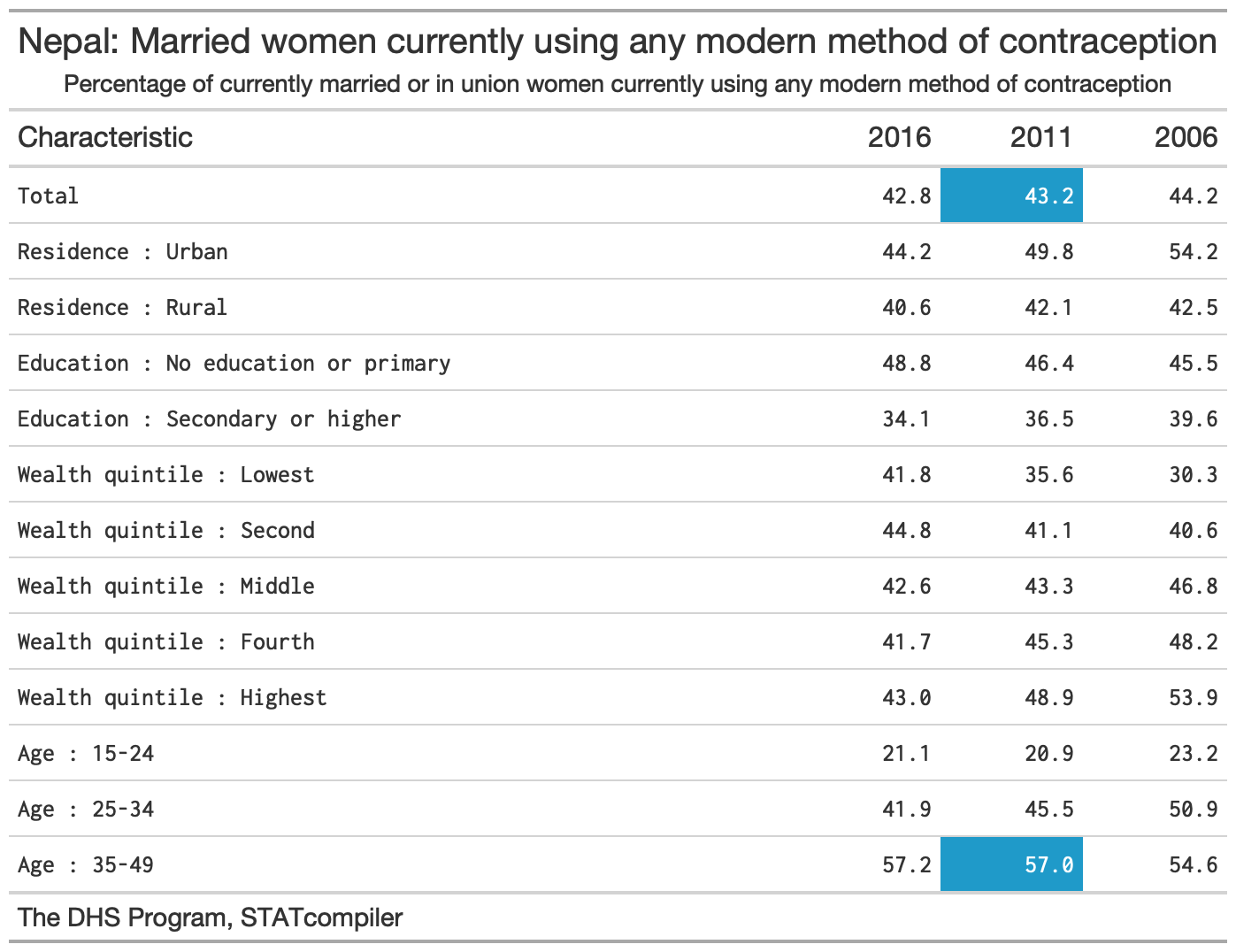
Descriptive summary of modern method use in Nepal. The DHS Program, STATcompiler.
Slide 12
In Closing
Description is essential — and it only gets you so far
More than half of married women were not using a modern method
Description tells you the characteristics of a problem, not its cause
Next: why is uptake lower among younger women, and what happens if we act?
Description as a research goal
Slide 1Studies seek to describe, explain, or predict. This video is about the first of those three goals, and about a distinction that trips up a lot of students.
Deeper dive: Lakens · ghr.link/lak
Studies seek to describe, explain, or predict
Understand which goal you are pursuing with your work
Before you ask a focused research question and design a study
Slide 2It's important to understand which goal you are pursuing with your work before you can ask a focused research question and design a study.
Every study describes — but description can be the goal
Recruit 100 people with the same disorder and run a drug trial
The average age of the group at recruitment describes your sample
Descriptive summaries appear in nearly every article, usually as 'Table 1'
Slide 3Every study uses an element of description, but description itself can be the goal. Let's say you recruit a sample of 100 people who suffer from the same disorder and conduct a trial to estimate the effect of a new drug on a clinical outcome. When you summarize what you know about these 100 people at the time they were recruited, for instance the average age of the group, you're describing your sample. Descriptive summaries appear in nearly every research article, usually as Table 1.
Two different things wear the same word
Descriptive statistics
What is the mean age of these 100 people?
A summary of your sample
Descriptive research
Characterizes a population of interest
Estimated from a sample
Slide 4But we must distinguish between the use of descriptive statistics, like the mean age of those 100 people, and descriptive research questions. Descriptive research aims to characterize, to describe, a population of interest. This is done through quantitative estimation methods, where you recruit or construct a representative sample and use the data from the sample to estimate how common something is in the population.
The core challenge is the sample
The sample must reflect the population of interest
It must be large enough to say something valid, with useful precision
Slide 5The core challenge to this type of descriptive research is recruiting a large enough sample that reflects the population of interest well enough to say something valid about the group, with sufficient precision to be informative.
Fox et al., 2022
Descriptive epidemiology asks about people, place, and time
"Seeks to characterize the distributions of health, disease, and harmful or beneficial exposures"
"In a well-defined population as they exist"
"Including any meaningful differences in distribution, and whether that distribution is changing over time"
Slide 6Descriptive research is important in every discipline, but especially so in epidemiology. Epidemiologists ask descriptive research questions about people, place, and time. Here's how one team defines descriptive epidemiology. It seeks to characterize the distributions of health, disease, and harmful or beneficial exposures in a well-defined population as they exist, including any meaningful differences in distribution, and whether that distribution is changing over time. That's a mouthful. Let's break it down.
Characterize the distributions
To characterize a distribution is to describe how often something occurs
Often a health status, or outcome, like cancer
Or an exposure, such as environmental carcinogens
And it extends to what people know, think, and do
Slide 7To characterize the distribution of something means to describe how often it occurs. The focus of descriptive studies is frequently a health status, referred to as an outcome, like cancer. Or potential exposures, such as environmental carcinogens. But description extends to knowledge, attitudes, and practices, to what people know, think, and do. For instance, a study might ask, what percentage of women of reproductive age in Nepal use a modern method of contraception?
In a well-defined population as they exist
Be clear about who makes up your group of interest
Your target population is the group you want to make a claim about
You recruit a sample from it, and infer from the sample to the group
Slide 8To ask a good descriptive research question, you must be clear about who makes up your group of interest, your target population. Your target population is a specific group that you want to make a claim about, such as women of reproductive age in that country. Typically you'll recruit a sample of individuals from this group and use the data you collect to make an inference from this limited sample to the larger group.
Including differences, and change over time
Quantify variation across subgroups, geographies, and time
Stratify by ethnicity and race to quantify disparities
Repeat over time: improving, worsening, or staying the same
Slide 9In addition to describing the group overall, there are often theoretical or programmatic reasons to quantify variation, or differences, in an outcome or exposure across subgroups, across geographies, and across time. For instance, you might want to stratify an analysis by ethnicity and race to quantify disparities in outcomes or in access to services. Doing this over time tells you whether conditions are improving, worsening, or staying the same.
Nepal DHS, 2011
"What percentage of women of reproductive age in Nepal use a modern method of contraception?"
The DHS Program has answered questions like this in more than 90 countries
Large, nationally representative surveys on population, health, HIV, nutrition
In Nepal: 10,826 households, and 12,674 women aged 15 to 49
Slide 10Here's an example to tie it all together. The Demographic and Health Surveys have answered this question, and many others, in more than 90 countries. The DHS Program designs, conducts, and analyzes large, nationally representative surveys on population, health, HIV, and nutrition. In 2011, DHS researchers surveyed a random sample of 10,826 households across the country and interviewed 12,674 women between the ages of 15 and 49 about their health behaviors and preferences.
43% of married women reported using a modern method
Descriptive summary of modern method use in Nepal. The DHS Program, STATcompiler.
Slide 11They estimated that 43 percent of married women reported using a modern method of contraception. Stratified by age, modern method use was twice as common among married women ages 35 to 49 compared to married women ages 15 to 24.
In Closing
Description is essential — and it only gets you so far
More than half of married women were not using a modern method
Description tells you the characteristics of a problem, not its cause
Next: why is uptake lower among younger women, and what happens if we act?
Slide 12Description is essential to science, and to decision-making related to needs and resources. The result from Nepal suggests that more than half of married women of reproductive age were not using a modern method of contraception. But description only gets you so far. In the next video, we ask why.