Chapter 10 · Video 2
Designing a trial: the question, the participants, and the allocation
Print layout
Slide 1


Designing a trial: the question, the participants, and the allocation
Slide 2
PICO
Using PICO to structure a trial question
Population: who, specific about age, setting, and health status
Intervention: the treatment, program, or exposure being tested
Comparison: usual care, placebo, an alternative, or nothing
Outcome: what we measure to decide whether it worked
Slide 3
Coursey et al., 2024
Improving HPV vaccination among young women in rural India
Low awareness of HPV and cervical cancer
High vaccine costs
Persistent safety concerns
Slide 4
Three PICO questions for the same problem
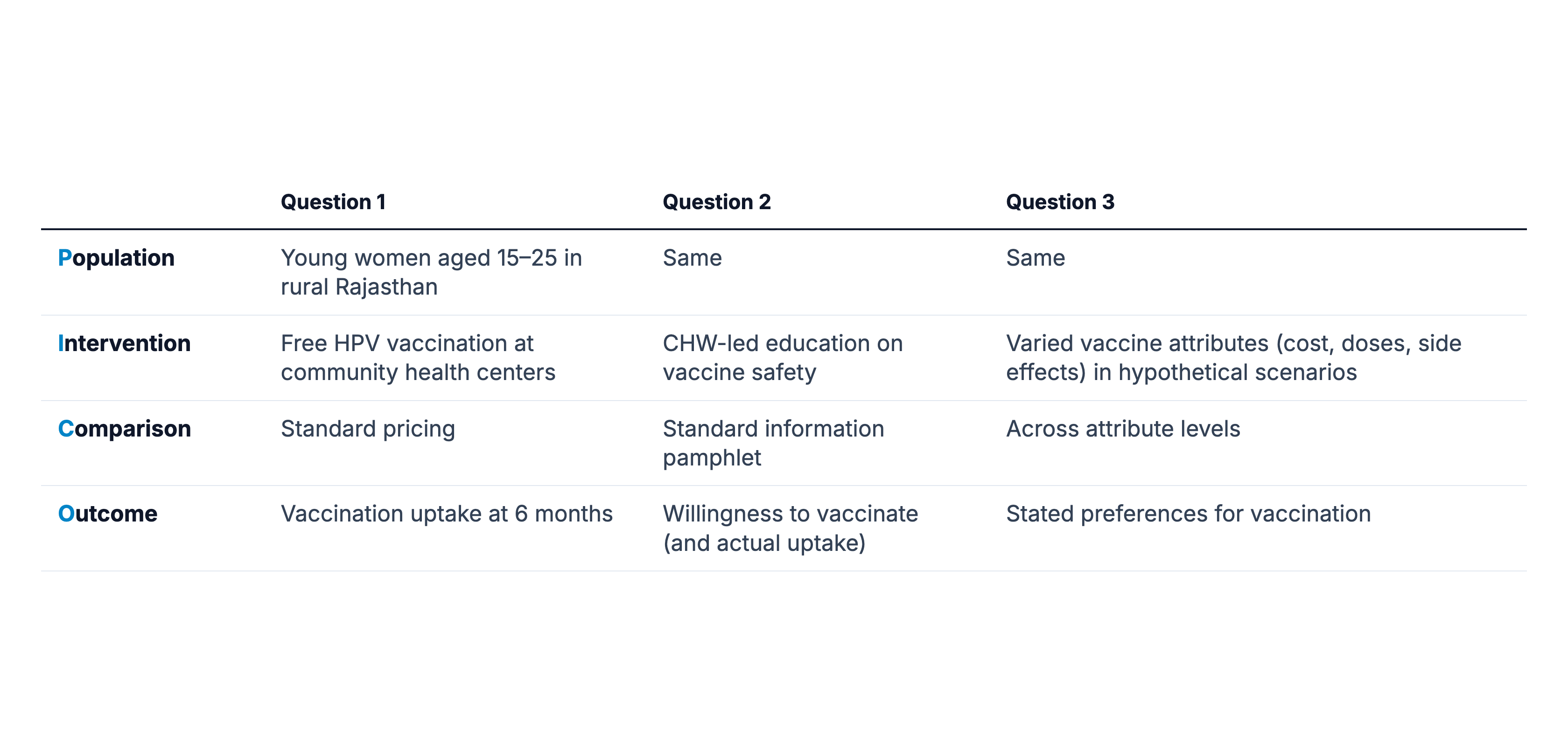
Three candidate research questions about HPV vaccination in rural Rajasthan. Adapted from Chapter 10.
Slide 5
Which of these questions is ready for a trial?
Question 1: a clean comparison and a measurable outcome
Question 2: promising, but the intervention needs more definition
Question 3: might be best answered by a discrete choice experiment
Slide 6
The best question depends on resources, timeline, and evidence gaps
There’s no single right answer, but PICO forces the specificity a feasible trial needs
Slide 7
Trials use random assignment, and rarely random selection
Participants met the eligibility criteria, came to a site, and consented
Randomization protects the comparison between groups
Whether results apply beyond the sample, transportability, is always open
Slide 8
Eligibility criteria
Eligibility criteria define the trial’s target population
They define the population for which the treatment effect is directly estimated
Slide 9
Desai et al., 2015
Who the Addis Ababa oral cholera vaccine trial enrolled
Healthy adults and children
Excluded: serious prior vaccine reactions, immunocompromising conditions, recent febrile illness
The restrictions allowed a cleaner assessment of immunogenicity
Slide 10
Desai et al., 2015
What that trial cannot tell us on its own
How the vaccine performs in people with HIV
In people with malnutrition, or with high comorbidity burdens
Precisely the settings where cholera vaccination is often most needed
Slide 11
Restrictive and inclusive eligibility criteria
Restrictive
Less variability, simpler to interpret
A narrower population for the effect
Inclusive
More heterogeneity
Effect modification can be examined
Slide 12
Recruitment
Recruiting the population the question is about
Enrollment projections are almost always optimistic
Community engagement and trusted local partnerships often work better than flyers
Collect rich baseline data so heterogeneity can be examined later
Slide 13
Simple randomization
Simple randomization, and why small trials need more structure
Like flipping a coin for each participant
Works fine over thousands of participants
In smaller trials it can produce imbalanced groups just by chance
Slide 14
Four approaches to randomization
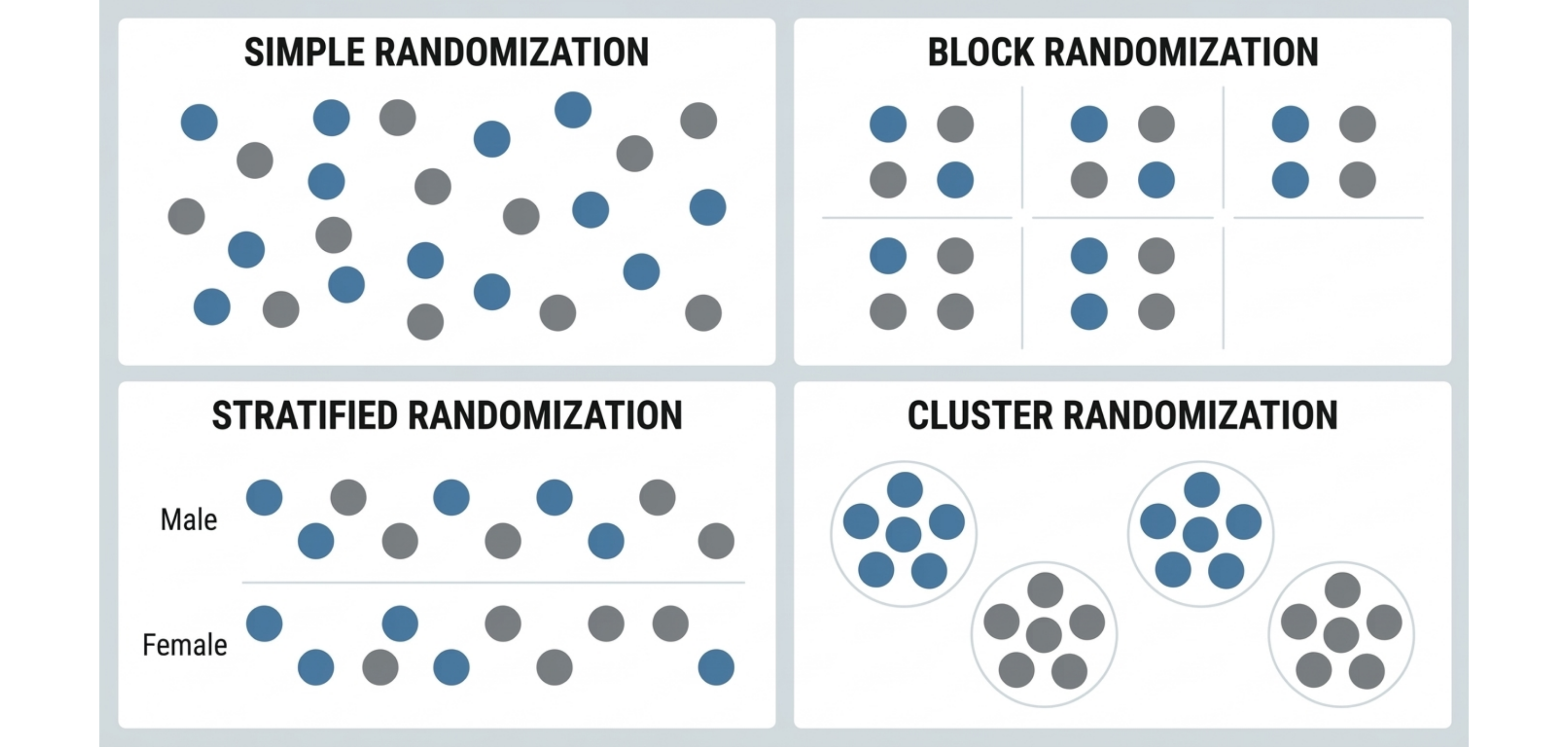
Simple: each participant assigned independently. Block: balanced within small groups. Stratified: balanced within key subgroups. Cluster: entire groups assigned together. Reproduced from Chapter 10.
Slide 15
Block randomization
Block randomization keeps group sizes balanced during rolling enrollment
In blocks of four, two go to intervention and two to control
If the trial stops at any point, the groups are roughly balanced
If the whole pool is known upfront, blocks aren’t needed
Slide 16
Shah et al., 2015
Stratifying by baseline TB case rates in Peru
TB rates vary substantially across health centers in the study area
Stratifying ensures high-burden and low-burden centers appear in both arms
Slide 17
In Closing
Cluster randomization assigns whole groups
Villages, schools, or health facilities
Needed when the intervention is delivered at the community level
Or when contamination between individuals would undermine the design
Designing a trial: the question, the participants, and the allocation
Slide 1Designing a randomized trial means making a series of decisions, and three of them come first: what question the trial will answer, who will be in it, and how they'll be allocated to groups.
PICO
Using PICO to structure a trial question
Population: who, specific about age, setting, and health status
Intervention: the treatment, program, or exposure being tested
Comparison: usual care, placebo, an alternative, or nothing
Outcome: what we measure to decide whether it worked
Slide 2Every RCT begins with a research question, and it has to be a question that's both answerable through randomization and worth the substantial resources an RCT requires. The PICO framework, which we introduced in the chapter on asking research questions, structures it. Population: who are we studying? We should be specific about age, setting, and health status. Intervention: what treatment, program, or exposure are we testing? Comparison: what are we comparing it to? Usual care, placebo, an alternative intervention, nothing? And Outcome: what will we measure to determine whether the intervention worked? For RCTs, clarity about those four things is what separates a vague idea from a testable hypothesis.
Coursey et al., 2024
Improving HPV vaccination among young women in rural India
Low awareness of HPV and cervical cancer
High vaccine costs
Persistent safety concerns
Slide 3Suppose we're interested in improving HPV vaccination rates among young women in rural India. The research literature shows low awareness of HPV and cervical cancer, high vaccine costs, and persistent safety concerns.
Three PICO questions for the same problem
Three candidate research questions about HPV vaccination in rural Rajasthan. Adapted from Chapter 10.
Slide 4We could frame several different PICO questions. All three of these share the same population: young women in rural Rajasthan, aged 15 to 25. The first tests free HPV vaccination at community health centers against standard pricing, with vaccination uptake at 6 months as the outcome. The second tests education on vaccine safety led by community health workers, against a standard information pamphlet. The third varies vaccine attributes like cost, doses, and side effects in hypothetical scenarios, and measures stated preferences.
Which of these questions is ready for a trial?
Question 1: a clean comparison and a measurable outcome
Question 2: promising, but the intervention needs more definition
Question 3: might be best answered by a discrete choice experiment
Slide 5All three are interesting and relevant. So which is ready for an RCT? PICO forces us to be specific. Question 1 has a clean comparison and a measurable outcome, so it's ready for an RCT. Question 2 is promising, but the intervention needs more definition. What exactly does the education session cover, and how long is it? Question 3 might be best answered through a discrete choice experiment, which is a method the book discusses in a later chapter.
The best question depends on resources, timeline, and evidence gaps
There’s no single right answer, but PICO forces the specificity a feasible trial needs
Slide 6There's no single right answer here. The best research question depends on our resources, our timeline, the policy context, and which evidence gaps are most critical to fill. But structuring the question with PICO forces the specificity that turns a good idea into a feasible trial.
Trials use random assignment, and rarely random selection
Participants met the eligibility criteria, came to a site, and consented
Randomization protects the comparison between groups
Whether results apply beyond the sample, transportability, is always open
Slide 7Once we have a research question, we need to figure out who will be in the study. RCTs almost never involve random selection from a population. Random assignment determines which group participants are in, but the people who end up in a trial are rarely a random sample of anyone. They're volunteers who met the eligibility criteria, showed up at a participating site, and consented to participate. So a trial has strong internal validity, because randomization protects the comparison between groups, but whether the results apply beyond that specific sample, which is transportability, is always open. We covered this in depth in our chapter on external validity.
Eligibility criteria
Eligibility criteria define the trial’s target population
They define the population for which the treatment effect is directly estimated
Slide 8Eligibility criteria define the population for which the treatment effect is directly estimated. They're more than a logistical detail, because they determine the trial's target population.
Desai et al., 2015
Who the Addis Ababa oral cholera vaccine trial enrolled
Healthy adults and children
Excluded: serious prior vaccine reactions, immunocompromising conditions, recent febrile illness
The restrictions allowed a cleaner assessment of immunogenicity
Slide 9Consider the Ethiopian oral cholera vaccine trial in Addis Ababa. The investigators enrolled healthy adults and children, and excluded individuals with serious prior vaccine reactions, immunocompromising conditions, or recent febrile illness. Those restrictions improved protocol safety and reduced biological heterogeneity, which allowed a cleaner assessment of immunogenicity.
Desai et al., 2015
What that trial cannot tell us on its own
How the vaccine performs in people with HIV
In people with malnutrition, or with high comorbidity burdens
Precisely the settings where cholera vaccination is often most needed
Slide 10But the effect estimate therefore applies most directly to relatively healthy individuals. The trial can't, on its own, tell us how the vaccine performs in HIV-positive individuals, in people with malnutrition, or in populations with high comorbidity burdens, and those are precisely the settings where cholera vaccination is often most needed.
Restrictive and inclusive eligibility criteria
Restrictive
Less variability, simpler to interpret
A narrower population for the effect
Inclusive
More heterogeneity
Effect modification can be examined
Slide 11Restrictive criteria can reduce variability and simplify interpretation, but they also narrow the population for whom the causal effect is identified. Broader inclusion increases heterogeneity, and it improves our ability to examine effect modification and to assess transportability to real-world populations. In global health research, I generally advocate for inclusive eligibility criteria when it's ethically and operationally feasible. If comorbidities are common in the target population, excluding them at the design stage forces policymakers to extrapolate beyond the evidence.
Recruitment
Recruiting the population the question is about
Enrollment projections are almost always optimistic
Community engagement and trusted local partnerships often work better than flyers
Collect rich baseline data so heterogeneity can be examined later
Slide 12Recruitment is where many trials struggle, and enrollment projections are almost always optimistic. We need a clear plan. Where will we recruit? How will we make sure we're reaching the population our research question is about, and not just the population that's easy to find? Community engagement and trusted local partnerships are often more effective than flyers and advertisements. And we should plan to collect rich baseline data, so we can later examine whether the intervention works differently for, say, men and women, or urban and rural participants. We can only know that if the sample includes those subgroups and we measured the relevant characteristics.
Simple randomization
Simple randomization, and why small trials need more structure
Like flipping a coin for each participant
Works fine over thousands of participants
In smaller trials it can produce imbalanced groups just by chance
Slide 13How do we actually randomize participants to intervention and control groups? Simple randomization is like flipping a coin for each participant. That works fine for large trials. Over thousands of participants, we'll end up with roughly equal groups that are balanced on all characteristics, measured and unmeasured. But in smaller trials, simple randomization can produce imbalanced groups just by chance, and that's why most global health RCTs use more structured approaches.
Four approaches to randomization
Simple: each participant assigned independently. Block: balanced within small groups. Stratified: balanced within key subgroups. Cluster: entire groups assigned together. Reproduced from Chapter 10.
Slide 14This figure compares four approaches. Each dot is a participant, or, in the cluster panel, a site. In simple randomization, each participant is assigned independently. Block randomization balances assignment within small groups. Stratified randomization maintains balance within key subgroups, like sex. And in cluster randomization, entire groups are assigned together. Block and stratified randomization impose more structure to guarantee balance, at the cost of added complexity.
Block randomization
Block randomization keeps group sizes balanced during rolling enrollment
In blocks of four, two go to intervention and two to control
If the trial stops at any point, the groups are roughly balanced
If the whole pool is known upfront, blocks aren’t needed
Slide 15Block randomization ensures equal group sizes. We randomize participants in blocks. For example, in blocks of four, we randomly determine which two of each block go to intervention and which two go to control. It's especially useful when enrollment is rolling, and we're recruiting participants over weeks or months without knowing the final sample size in advance, because blocks guarantee that if the trial stops at any point, the groups are roughly balanced. If we know the entire pool of participants upfront, we can simply randomize with fixed allocation and don't need blocks.
Shah et al., 2015
Stratifying by baseline TB case rates in Peru
TB rates vary substantially across health centers in the study area
Stratifying ensures high-burden and low-burden centers appear in both arms
Slide 16Stratified randomization ensures balance on key characteristics we know beforehand. Suppose we're testing a tuberculosis intervention in Peru, and we know that TB rates vary substantially across health care centers in the study area. We might stratify randomization by baseline TB case rate, so that both high-burden and low-burden centers are represented equally in the intervention and control groups.
In Closing
Cluster randomization assigns whole groups
Villages, schools, or health facilities
Needed when the intervention is delivered at the community level
Or when contamination between individuals would undermine the design
Slide 17Cluster randomization is when we randomize groups: entire villages, schools, or health facilities. That's often necessary when interventions are delivered at the community level, or when contamination between individuals would undermine the design. It introduces important complications for sample size and analysis, and we'll take those up in a later video in this chapter.