Chapter 8 · Video 1
External validity, generalizability, and transportability
Print layout
Slide 1


External validity, generalizability, and transportability
Slide 2
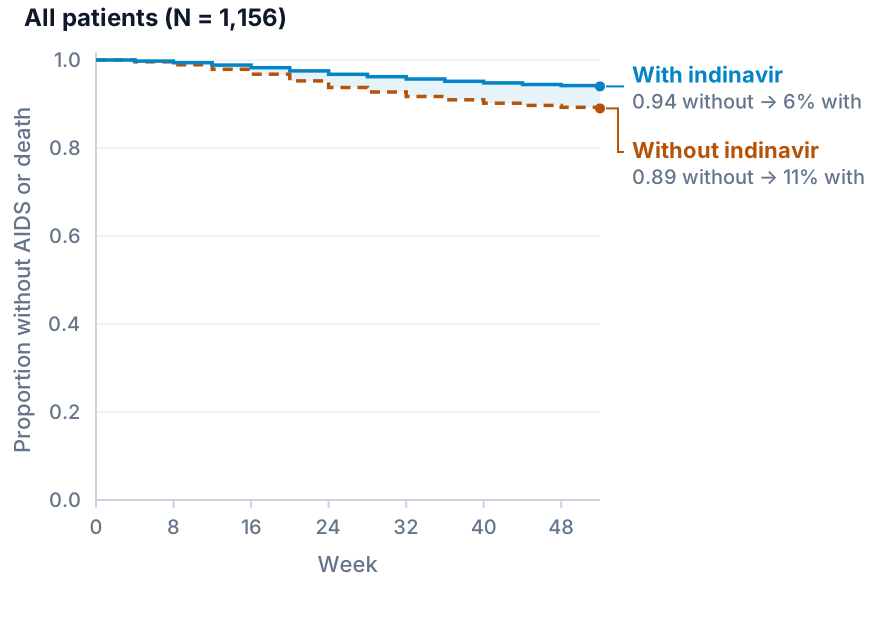
Illustration of Figure 1A, Hammer et al., NEJM 1997.
In 1997, Clinical Trial 320 delivered the news
Three-drug combination therapy
AIDS or death: 6% vs 11%
Slide 3
Cole et al., 2010
Years later, researchers asked a different question
What would that effect have looked like among people newly infected with HIV a decade later?
A population that differed from trial participants in age, race, and disease severity
Slide 4
Cole et al., 2010
Same treatment. Same outcome. Different answer.
In the trial
49% lower risk of AIDS or death
In the target population
43% lower risk of AIDS or death
Slide 5
Effects estimated in one population don't automatically apply to another
Understanding when they do — and when they don't — is the problem of external validity
Three related but distinct concepts: external validity, generalizability, transportability
A framework for when and why research findings travel
Slide 6
External validity asks the question that follows internal validity
Internal validity
Correct for the people we studied?
A causal inference concept
External validity
Applies where we care about it?
Arises more broadly
Slide 7
External validity concerns arise more broadly
A prevalence estimate, an association, a prediction model
Each can be correct for the sample while failing to apply elsewhere
Whenever we extend findings beyond the local study that produced them
Slide 8
Modern Epidemiology, 4th edition
Generalizability and transportability
Generalizability
Sample inside the target
A Kenyan trial, informing Kenya
Selection, nonresponse, attrition
Transportability
Slide 9
Modern Epidemiology, 4th edition
Generalizability and transportability
Generalizability
Sample inside the target
A Kenyan trial, informing Kenya
Selection, nonresponse, attrition
Transportability
Sample outside the target
A Kenyan trial, informing Uganda
A different population entirely
Slide 10
Where external validity bias comes from
An estimate in a study differs from the corresponding quantity in a target population
Because the conditions that generated the estimate do not hold in that population
Slide 11
The problem takes a different shape for each
A prevalence estimate
Relatively straightforward
Weight the sample to look like the target
A causal effect
The problem is more specific
Only differences that modify the effect
Slide 12
Definition
A variable is an effect modifier if it changes the causal effect
Age might modify a blood pressure drug that lowers pressure more in younger patients
Disease severity might modify a behavioral intervention: well for mild cases, poorly for severe ones
Slide 13
Effect modification is why some population differences matter
If a treatment works equally well in everyone, population differences don't threaten external validity
Over-sample young, wealthy, or urban people — and the estimate still applies
If the treatment works differently across groups, those differences become consequential
Slide 14
In Closing
Whichever version you face, the key question is the same
Do the populations differ on characteristics that modify the estimate?
External validity, generalizability, and transportability
Slide 1This chapter is about external validity. We'll distinguish three related but distinct concepts — external validity, generalizability, and transportability — and develop a framework for thinking rigorously about when and why research findings travel.
Illustration of Figure 1A, Hammer et al., NEJM 1997.
In 1997, Clinical Trial 320 delivered the news
Three-drug combination therapy
AIDS or death: 6% vs 11%
Slide 2In 1997, Clinical Trial 320 delivered news that HIV and AIDS researchers and patients had been waiting for. A three-drug combination therapy cut the risk of AIDS or death roughly in half, from 11% to 6%. The findings helped launch the antiretroviral era that would transform HIV from a death sentence to a manageable chronic condition.
Cole et al., 2010
Years later, researchers asked a different question
What would that effect have looked like among people newly infected with HIV a decade later?
A population that differed from trial participants in age, race, and disease severity
Slide 3Years later, researchers asked a different question. What would that treatment effect have looked like in the U.S. population of people newly infected with HIV a decade after the trial — a population that differed from trial participants in age, race, and disease severity?
Cole et al., 2010
Same treatment. Same outcome. Different answer.
In the trial
49% lower risk of AIDS or death
In the target population
43% lower risk of AIDS or death
Slide 4Re-analyzing the trial data, they put the reduction among trial participants at 49%. Standardized to that later population, the estimated benefit shrank to 43%. Same treatment. Same outcome. Different answer.
Effects estimated in one population don't automatically apply to another
Understanding when they do — and when they don't — is the problem of external validity
Three related but distinct concepts: external validity, generalizability, transportability
A framework for when and why research findings travel
Slide 5The later analysis illustrates something important. Causal effects estimated in one population don't automatically apply to another. Understanding when they do, and when they don't, is the problem of external validity. That's what this chapter unpacks.
External validity asks the question that follows internal validity
Internal validity
Correct for the people we studied?
A causal inference concept
External validity
Applies where we care about it?
Arises more broadly
Slide 6In the causal inference chapter, we focused on internal validity. Is the causal effect we estimated correct for the people we actually studied? External validity asks the next question. Does that effect apply to the population or context we care about?
External validity concerns arise more broadly
A prevalence estimate, an association, a prediction model
Each can be correct for the sample while failing to apply elsewhere
Whenever we extend findings beyond the local study that produced them
Slide 7While internal validity is specifically a causal inference concept, external validity concerns arise more broadly. A prevalence estimate, an association, a prediction model — each can be correct for the sample while failing to apply elsewhere, to the target population the sample was drawn from, or to new populations. Whenever we extend findings beyond the local study that produced them, we face an external validity question.
Modern Epidemiology, 4th edition
Generalizability and transportability
Generalizability
Sample inside the target
A Kenyan trial, informing Kenya
Selection, nonresponse, attrition
Transportability
Slide 8External validity concerns take two forms, depending on the relationship between the study sample and the target population. Generalizability applies when the study sample is entirely contained within the target population — when the sample is a subset of the target. A clinical trial conducted at Kenyan hospitals, aiming to inform treatment policy for all Kenyans, faces a generalizability question: Do the trial participants adequately represent the broader target population they were drawn from? A national survey faces the same question: Does the sample reflect the population it was designed to represent? Concerns here arise from selection, nonresponse, eligibility criteria, and attrition.
Modern Epidemiology, 4th edition
Generalizability and transportability
Generalizability
Sample inside the target
A Kenyan trial, informing Kenya
Selection, nonresponse, attrition
Transportability
Sample outside the target
A Kenyan trial, informing Uganda
A different population entirely
Slide 9Transportability applies when the study sample is not contained within the target population — when you want to apply the results to a different population entirely. If we want to know whether the Kenyan trial's results apply in Uganda, or whether a prevalence estimate from urban clinics applies to rural areas that were never sampled, we face a transportability question. The study population is external to the target population.
Where external validity bias comes from
An estimate in a study differs from the corresponding quantity in a target population
Because the conditions that generated the estimate do not hold in that population
Slide 10External validity bias arises when an estimate produced in a study differs from the corresponding quantity in a specified target population, because the conditions that generated the estimate do not hold in that population.
The problem takes a different shape for each
A prevalence estimate
Relatively straightforward
Weight the sample to look like the target
A causal effect
The problem is more specific
Only differences that modify the effect
Slide 11For descriptive findings like prevalence, this is relatively straightforward. If your sample over-represents certain groups, your estimate likely won't match the target population. The solution is familiar: weight the sample to look like the population. For causal effects, the problem is more specific. What matters is not whether the populations differ on any characteristic, but whether they differ on characteristics that modify the effect — variables for which the treatment works differently across levels.
Definition
A variable is an effect modifier if it changes the causal effect
Age might modify a blood pressure drug that lowers pressure more in younger patients
Disease severity might modify a behavioral intervention: well for mild cases, poorly for severe ones
Slide 12A variable is an effect modifier if the causal effect of the treatment changes depending on that variable's value. Age might modify the effect of a blood pressure drug if the drug lowers blood pressure more in younger patients than older ones. Disease severity might modify the effect of a behavioral intervention if it works well for mild cases but poorly for severe ones.
Effect modification is why some population differences matter
If a treatment works equally well in everyone, population differences don't threaten external validity
Over-sample young, wealthy, or urban people — and the estimate still applies
If the treatment works differently across groups, those differences become consequential
Slide 13If a treatment works equally well in everyone, population differences don't threaten external validity. Your trial could over-sample young people, wealthy people, or urban residents — and as long as the treatment effect is the same across those groups, your estimate still applies to your target population. But if the treatment works differently across groups, then differences between your sample and target population become consequential. Effect modification is why some population differences matter for external validity and others do not.
In Closing
Whichever version you face, the key question is the same
Do the populations differ on characteristics that modify the estimate?
Slide 14This logic applies to both generalizability and transportability. Whether you're asking if a trial represents its source population, or whether findings from one country apply in another, the key question is the same: Do the populations differ on characteristics that modify the estimate?