Chapter 1 · Video 4
From efficacy to impact: translation, implementation, and evaluation
Print layout
Slide 1


From efficacy to impact: translation, implementation, and evaluation
Slide 2
It’s a long road from idea to impact, and most ideas don’t complete the trip
Why does so much promising research fail to reach the people who need it?
Translational research points to four key bottlenecks where ideas stall
Slide 3
Four bottlenecks on the road from idea to impact
Where translation began
T1: basic science to clinical research
T2: early trials to Phase 3 and beyond
Bottlenecks we now recognize
T3: efficacy to real-world effectiveness
T4: evidence on delivery to new policies
Slide 4
A research taxonomy
Where the four bottlenecks sit on the map
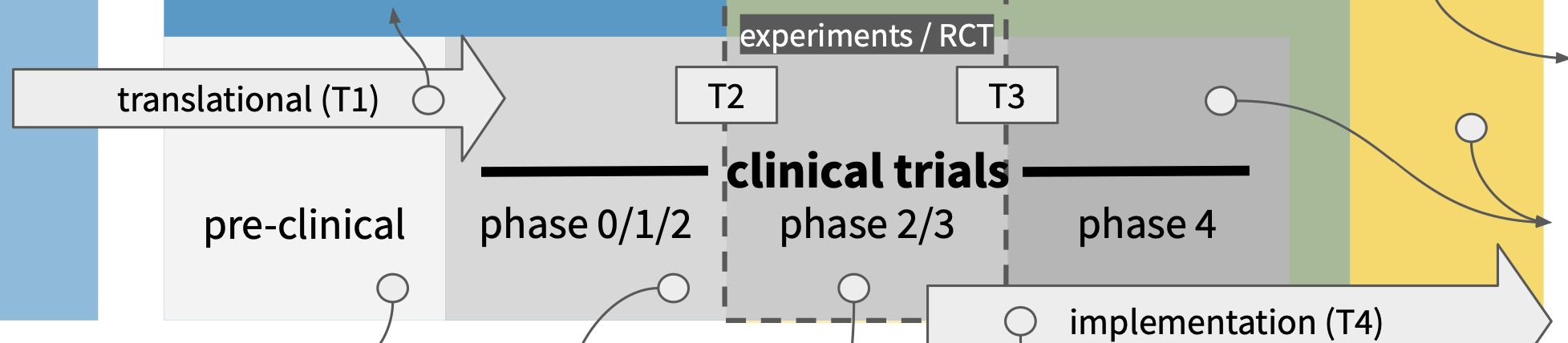
T1 moves basic science into the clinic. T2 carries early trials to Phase 3. T3 pushes efficacy toward real-world effectiveness. T4 turns evidence about delivery at scale into policy.
Slide 5
The delivery gap: the space between what works and what reaches people
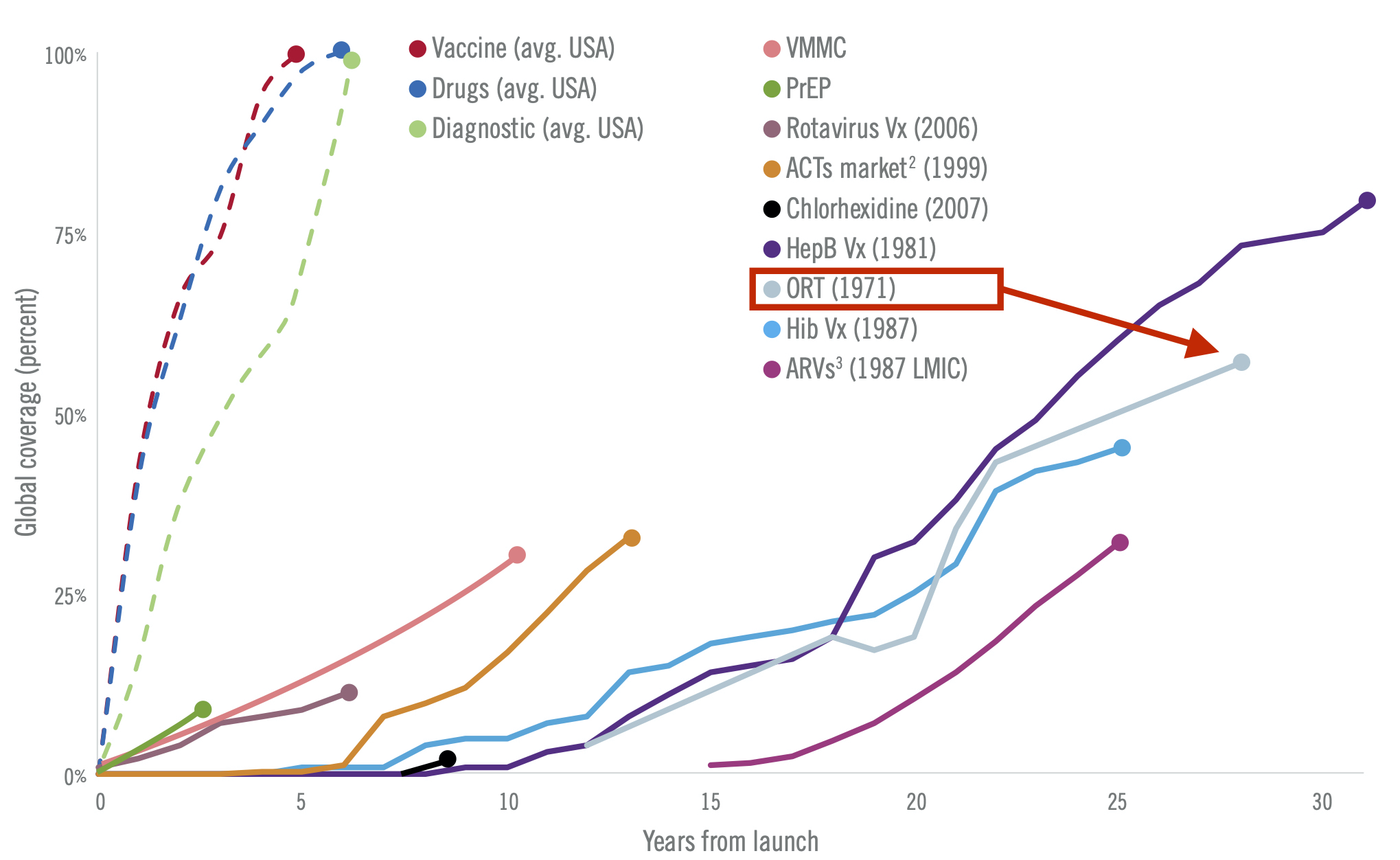
Time from introduction to achievement of public health coverage targets. Source: AVAC Report 2017: Mixed Messages and How to Untangle Them. avac.org/report2017.
Slide 6
Kruk et al., 2016
Policy and implementation research, or PIR, is the science of scale-up
Aims to close delivery gaps in global health
Combines implementation research with health policy and systems research
Slide 7
Implementation research studies strategies for expanding reach and coverage
Tested ideas that could improve population health
A common scenario: a treatment is efficacious, like ORT, but take-up is low and slow
The research question is how best to promote its use
Slide 8
Health policy and systems research shares the goal and widens the view
The same goal of population impact
A broader view of the systemic and policy factors that hinder or facilitate scale-up
Slide 9
Lam et al., 2019
In Uganda, ORT coverage among young children rose 30-fold
Triangulated data on government actions, supply distribution, and treatment with ORT
Young children with diarrhea receiving ORT: from 1% to 30% between 2011 and 2016
The policy analysis concluded that government actions likely made the difference
Slide 10
Monitoring and evaluation is another area of applied work in global health
M&E is also known as program evaluation
Slide 11
Rossi et al., 2003
Program evaluation grew out of a demand for accountability
Commonplace in the United States by the end of the 1950s
Grew dramatically in the 1960s as the federal government expanded social programs
Lawmakers wanted accountability, and the evaluation of social programs took off
Slide 12
Donald Campbell, 1969
But is program evaluation really research?
“…should be ready for an experimental approach to social reform”
“Try out new programs designed to cure specific problems…learn whether or not these programs are effective”
“Retain, imitate, modify or discard them on the basis of their effectiveness”
Slide 13
Cronbach, 1982
Others see evaluation as a service to implementers and funders
Program evaluation is designed for program implementers and funders
The messy nature of implementation requires a loosening of research standards
Slide 14
Rossi et al., 2003
Is program evaluation research? It depends
As rigorous as logistics, ethics, politics, and resources permit — and no less
Some evaluations are rigorous enough to meet the definition of research
A systematic investigation designed to contribute to generalizable knowledge
Slide 15
M&E intersects applied research and extends outside the research boundary
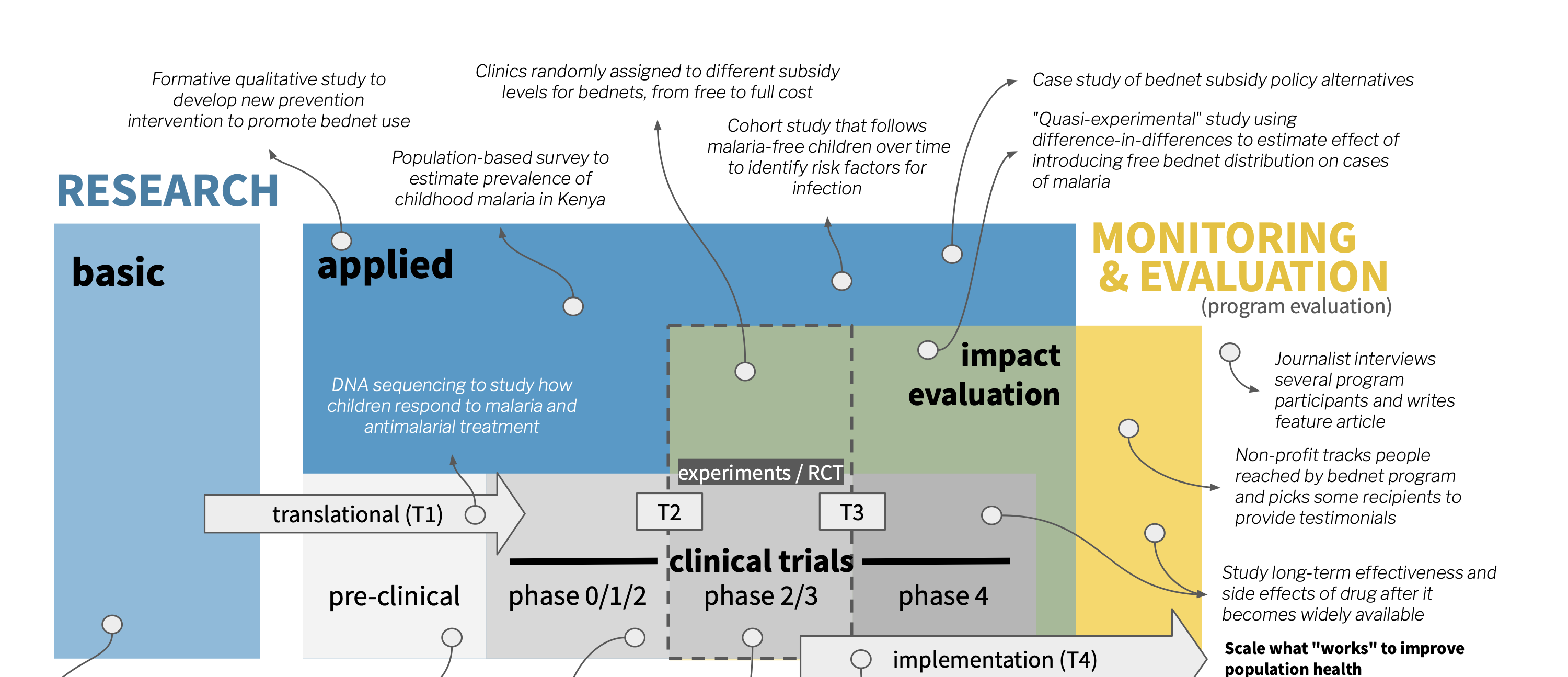
Some of what gets done under the heading of monitoring and evaluation meets the definition of research, and some of it sits outside, so the block straddles the line.
Slide 16
An impact evaluation quantifies the causal effect of a program or policy
A subset of both applied research and program evaluation
Several designs generate evidence of impact; the RCT is one, a mainstay of Phase 2 and Phase 3
Not all randomize, but all share the goal of a cause-and-effect claim
Slide 17
Evaluation and monitoring answer two different questions
Evaluation
“Do they work?”
Documents whether the program had an effect
Not all programs are evaluated
Monitoring
“What happened?”
Resources used, people reached, targets met
Most are monitored for accountability
Slide 18
A process evaluation asks whether a program is delivered as intended
Goes beyond monitoring counts and tallies, largely an administrative task
The question is fidelity of the implementation to the original design
Slide 19
Process evaluations serve impact evaluations
If a program fails to show an impact, why?
Theory failure
The idea behind the program was wrong
Implementation failure
The program never had a chance to succeed
From efficacy to impact: translation, implementation, and evaluation
Slide 1This video follows the road from a good idea to real impact. We look at where ideas stall on the way to scale, at the fields that study those bottlenecks, and at monitoring and evaluation.
It’s a long road from idea to impact, and most ideas don’t complete the trip
Why does so much promising research fail to reach the people who need it?
Translational research points to four key bottlenecks where ideas stall
Slide 2It's a long road from idea to impact, and most ideas don't complete the trip. Why does so much promising research fail to reach the people who need it? Practitioners of translational research point to four key bottlenecks, four places along the way where ideas often stall. They're labeled T1 through T4.
Four bottlenecks on the road from idea to impact
Where translation began
T1: basic science to clinical research
T2: early trials to Phase 3 and beyond
Bottlenecks we now recognize
T3: efficacy to real-world effectiveness
T4: evidence on delivery to new policies
Slide 3T1 is translation from basic science to clinical research, the move from bench to bedside. T2 is translation from early clinical trials to Phase 3 trials and beyond, with larger patient populations. Later we recognized two more. T3 is translation from efficacy trials, meaning Phase 3 trials, to real-world effectiveness through implementation research. And T4 is translation from evidence about delivery at scale to the adoption of new policies. It's these last two that keep good ideas from reaching population health and policy.
A research taxonomy
Where the four bottlenecks sit on the map
T1 moves basic science into the clinic. T2 carries early trials to Phase 3. T3 pushes efficacy toward real-world effectiveness. T4 turns evidence about delivery at scale into policy.
Slide 4Here's the map from the last video, with the translation arrows in view. T1 runs from basic research into the clinical pipeline. T2 and T3 sit inside that pipeline, moving from early trials through Phase 3 and out toward effectiveness. And T4 runs off the right-hand side, from evidence about delivery to the adoption of policy, and to scaling up what works to improve population health.
The delivery gap: the space between what works and what reaches people
Time from introduction to achievement of public health coverage targets. Source: AVAC Report 2017: Mixed Messages and How to Untangle Them. avac.org/report2017.
Slide 5This is an example of what we call a delivery gap, or a know-do gap, in global health. It's the space between discovering what works and delivering the solution at scale. This figure plots years from launch along the horizontal axis and global coverage on the vertical. The three dashed curves are United States averages, for vaccines, for drugs, and for diagnostics. They climb to full coverage within about five years. Every solid line is a product being delivered globally, and the picture there is completely different. Oral rehydration therapy, or ORT, highlighted in the legend, launched in 1971, and nearly thirty years on its curve is still climbing.
Kruk et al., 2016
Policy and implementation research, or PIR, is the science of scale-up
Aims to close delivery gaps in global health
Combines implementation research with health policy and systems research
Slide 6Policy and implementation research aims to close these gaps. It has been called the science of scale up. The gap between what we know and what we do is itself a research problem, and this is the field that takes it on. It combines two things: implementation research, and health policy and systems research. Let's take them one at a time.
Implementation research studies strategies for expanding reach and coverage
Tested ideas that could improve population health
A common scenario: a treatment is efficacious, like ORT, but take-up is low and slow
The research question is how best to promote its use
Slide 7Implementation research is the study of strategies for expanding the reach and coverage of tested ideas, so that they improve population health. The common scenario is the one we just saw. Intervention research has already demonstrated that a treatment is efficacious, ORT for example, but take-up is low and slow, which limits its impact. So the implementation research question is how best to promote its use.
Health policy and systems research shares the goal and widens the view
The same goal of population impact
A broader view of the systemic and policy factors that hinder or facilitate scale-up
Slide 8Health policy and systems research shares that same goal of population impact, but it takes an even broader view, looking at the systemic and policy factors that can hinder or facilitate scale up.
Lam et al., 2019
In Uganda, ORT coverage among young children rose 30-fold
Triangulated data on government actions, supply distribution, and treatment with ORT
Young children with diarrhea receiving ORT: from 1% to 30% between 2011 and 2016
The policy analysis concluded that government actions likely made the difference
Slide 9Here's an example of what that looks like. A retrospective analysis evaluated the impact of policymaking in Uganda on ORT and zinc coverage. The authors triangulated data from various sources on government actions, the distribution of supplies, and treatment with ORT. They estimated that the proportion of young children with diarrhea who received ORT increased thirty-fold between 2011 and 2016, from 1% to 30%. And their policy analysis concluded that government actions likely made the difference.
Monitoring and evaluation is another area of applied work in global health
M&E is also known as program evaluation
Slide 10Another area of applied work in global health is monitoring and evaluation, also known as program evaluation. Whether it counts as research is a question with a long history, so let's start there.
Rossi et al., 2003
Program evaluation grew out of a demand for accountability
Commonplace in the United States by the end of the 1950s
Grew dramatically in the 1960s as the federal government expanded social programs
Lawmakers wanted accountability, and the evaluation of social programs took off
Slide 11Program evaluation became commonplace in the United States by the end of the nineteen fifties, and it grew dramatically in the nineteen sixties as the federal government expanded and introduced new social programs. Lawmakers wanted accountability, and the evaluation of social programs took off.
Donald Campbell, 1969
But is program evaluation really research?
“…should be ready for an experimental approach to social reform”
“Try out new programs designed to cure specific problems…learn whether or not these programs are effective”
“Retain, imitate, modify or discard them on the basis of their effectiveness”
Slide 12But is program evaluation really research? Methods giant Donald Campbell thought so. Writing in 1969, he argued that the United States should be ready for an experimental approach to social reform, an approach in which we try out new programs designed to cure specific problems, in which we learn whether or not these programs are effective, and in which we retain, imitate, modify or discard them on the basis of their effectiveness on the multiple imperfect criteria available.
Cronbach, 1982
Others see evaluation as a service to implementers and funders
Program evaluation is designed for program implementers and funders
The messy nature of implementation requires a loosening of research standards
Slide 13But not everyone agrees. Some have argued that program evaluation is really designed for program implementers and funders, and that the messy nature of program implementation requires a loosening of research standards.
Rossi et al., 2003
Is program evaluation research? It depends
As rigorous as logistics, ethics, politics, and resources permit — and no less
Some evaluations are rigorous enough to meet the definition of research
A systematic investigation designed to contribute to generalizable knowledge
Slide 14One standard introductory text on evaluation strikes a balance on this question. Their answer is perhaps a bit unsatisfying, but it is arguably true nevertheless: it depends. In essence, program evaluations should be as rigorous as logistics, ethics, politics, and resources permit, and no less. Some evaluations are more rigorous than others, and those will meet our definition of research: a systematic investigation designed to develop or contribute to generalizable knowledge.
M&E intersects applied research and extends outside the research boundary
Some of what gets done under the heading of monitoring and evaluation meets the definition of research, and some of it sits outside, so the block straddles the line.
Slide 15That is why, on the map, I represent monitoring and evaluation as a block that intersects applied research but extends outside the research boundary. Some of what gets done under that heading meets the definition of research, and some of it sits outside, so the block straddles the line.
An impact evaluation quantifies the causal effect of a program or policy
A subset of both applied research and program evaluation
Several designs generate evidence of impact; the RCT is one, a mainstay of Phase 2 and Phase 3
Not all randomize, but all share the goal of a cause-and-effect claim
Slide 16Evaluations can take different forms and serve various purposes. A subset of both applied research and program evaluation is the impact evaluation. An impact evaluation is a study that aims to quantify the causal effect, or impact, of a program or policy on some outcome of interest. There are several research designs that can generate evidence of impact. One example is the randomized controlled trial, a mainstay of Phase 2 and Phase 3 clinical trials. Not all impact evaluations use random assignment to make causal inferences, but they all share the goal of making a cause-and-effect claim. And as we'll see in later chapters, the strength of that claim rests on the assumptions of the particular research design.
Evaluation and monitoring answer two different questions
Evaluation
“Do they work?”
Documents whether the program had an effect
Not all programs are evaluated
Monitoring
“What happened?”
Resources used, people reached, targets met
Most are monitored for accountability
Slide 17Evaluation and monitoring answer two different questions. Evaluation asks: do they work? Monitoring asks: what happened? Program monitoring is concerned with documenting the implementation of programs and interventions. How are resources being used? How many people participate? Does the program reach the intended targets? Not all programs are evaluated, but most are monitored to some degree, for accountability to funders. Researchers can also use monitoring data to document participants' exposure to the program, and to conduct economic analyses related to program costs and impacts.
A process evaluation asks whether a program is delivered as intended
Goes beyond monitoring counts and tallies, largely an administrative task
The question is fidelity of the implementation to the original design
Slide 18A related activity is the process evaluation. A process evaluation goes beyond monitoring counts and tallies, largely an administrative task, to ask if a program is being delivered as intended. This gets at the question of fidelity of the implementation to the original design.
Process evaluations serve impact evaluations
If a program fails to show an impact, why?
Theory failure
The idea behind the program was wrong
Implementation failure
The program never had a chance to succeed
Slide 19Process evaluations are essential for impact evaluations. If a program fails to show an impact, the next question is: why? Did the program fail because the idea or theory behind the program was wrong? That's theory failure. Or was the implementation of the program so troubled that there was never a chance for success? That's implementation failure.