Chapter 14 · Video 1
N-of-1 studies
Print layout
Slide 1


N-of-1 studies
Slide 2
N-of-1 studies
What works for this specific person?
Maria has a chronic condition that responds differently than the typical trial patient
The trial evidence says Treatment A should work better than Treatment B
Maria seems to do worse on A
Slide 3
Lobo et al., 2017
In an N-of-1 study, one person serves as their own control
Also called single-case design or single-subject research
Conditions are compared within one individual over time
The same person experiences both conditions in a structured sequence
Slide 4
N-of-1 studies
The ABAB design
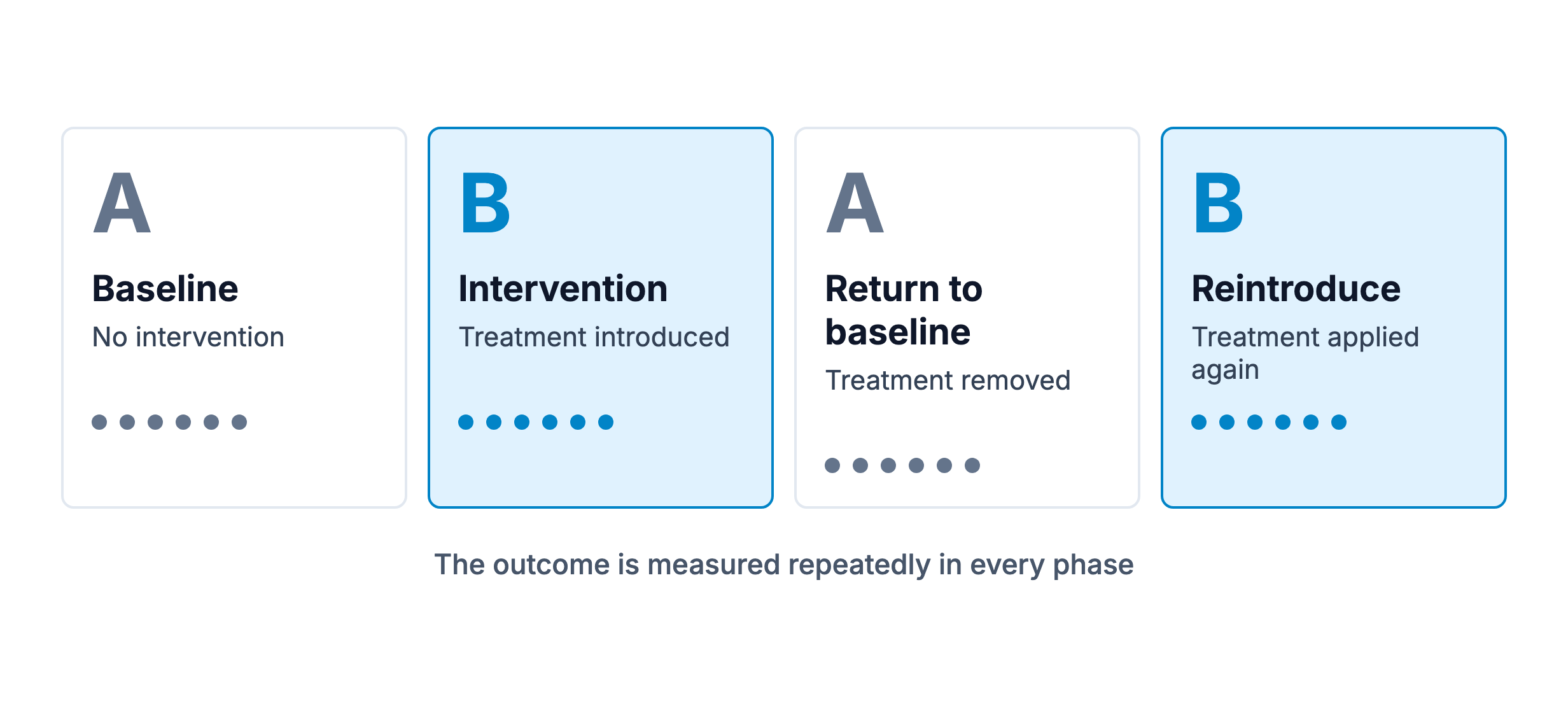
Baseline (A), intervention (B), return to baseline (A), and reintroduction of the intervention (B), with the outcome measured repeatedly in every phase.
Slide 5
N-of-1 studies
What makes a single-case design rigorous
Multiple measurement points in each phase
Replication of the intervention effect across phases
Randomization of when phases occur, when possible
Blinding of outcome assessors
Slide 6
N-of-1 studies
Randomizing the order of the phases
Baseline doesn't always have to come before the intervention
A randomized sequence reduces threats from temporal factors and history effects
Slide 7
N-of-1 studies
The multiple baseline design
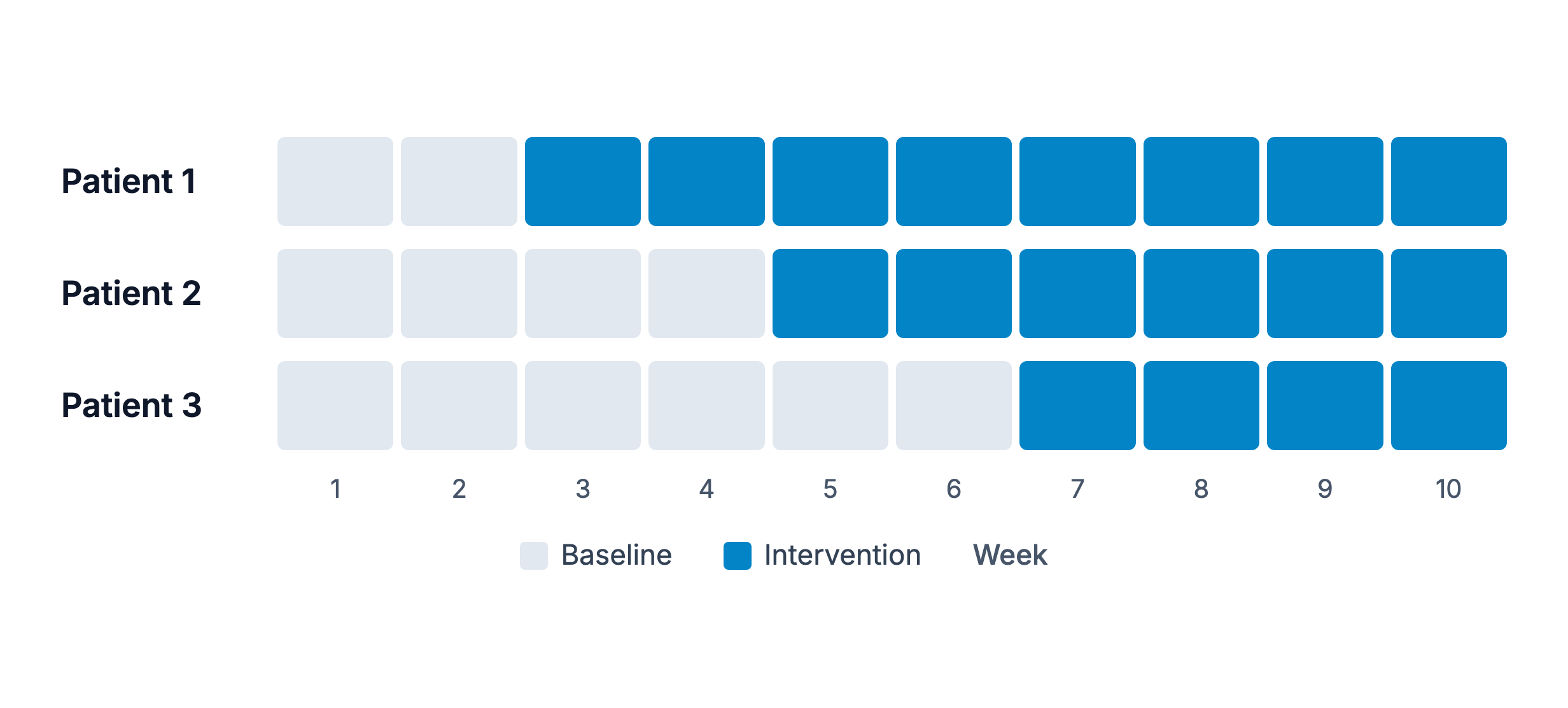
Three patients with similar chronic conditions. The intervention starts after two, four, and six weeks.
Slide 8
N-of-1 studies
When to consider an N-of-1 design
The condition is rare enough that assembling a large trial would take years
Patients show substantial heterogeneity in how they respond to treatment
Resources don't permit a full-scale trial, but rigorous evidence is still needed
The condition is chronic and stable
Slide 9
Giusto et al., 2020
A multiple baseline study of fathers in Eldoret, Kenya
Nine men ages 30 to 48 who screened positive for problem drinking
Randomized to staggered start dates for a five-session lay-counselor intervention
Weekly drinking measured by Timeline Followback, through four weeks of follow-up
Slide 10
Giusto et al., 2020
Drinking after treatment, compared with each man's own baseline
Days without alcohol
Odds of an alcohol-free day 5.1 times higher
95% CI 3.3 to 7.9
Days men drank
Half as much alcohol
95% CI 0.39 to 0.65
Slide 11
Giusto et al., 2020
Why history and maturation are weak explanations in this design
Each baseline drops when that man's own treatment starts
Individual-level evidence where a full randomized trial would have been impractical
Slide 12
N-of-1 studies
Strengths of N-of-1 designs
Strong causal evidence at the individual level
Results directly applicable to the person being studied
Can be more ethical than assigning many patients to potentially inferior treatments
Slide 13
N-of-1 studies
Limitations of N-of-1 designs
Results don't generalize to other individuals without replication
Highly variable conditions make changes impossible to attribute to the intervention
Carryover between phases can confound results, so build in washout periods
A stable baseline takes time to establish
N-of-1 studies
Slide 1This chapter covers a grab bag of designs. They share little with each other, except that each one arose because the standard toolkit couldn't answer the question someone needed to ask. The aim is breadth: recognizing what each design is built to do, so you can spot one in a paper or know when to call someone who specializes in it. We'll start with N-of-1 studies.
N-of-1 studies
What works for this specific person?
Maria has a chronic condition that responds differently than the typical trial patient
The trial evidence says Treatment A should work better than Treatment B
Maria seems to do worse on A
Slide 2Here's a scenario you might face. You're working with a patient, let's call her Maria, who has a chronic condition that responds differently to treatments than the typical patient in clinical trials. The trial evidence says Treatment A should work better than Treatment B, but Maria seems to do worse on A. How do you figure out what's actually best for her? What works for this specific person?
Lobo et al., 2017
In an N-of-1 study, one person serves as their own control
Also called single-case design or single-subject research
Conditions are compared within one individual over time
The same person experiences both conditions in a structured sequence
Slide 3That's the question an N-of-1 study is built to answer. It's also called single-case design, or single-subject research. Instead of comparing outcomes across many people, we systematically compare conditions within a single individual over time, and the same person experiences both conditions in a structured sequence.
N-of-1 studies
The ABAB design
Baseline (A), intervention (B), return to baseline (A), and reintroduction of the intervention (B), with the outcome measured repeatedly in every phase.
Slide 4The classic structure has four phases. We measure the outcome repeatedly with no intervention, then introduce the treatment and keep measuring, then remove it, and then apply it again. This design lets us see if the outcome changes when, and only when, the intervention is present. If Maria's symptoms improve every time Treatment A is introduced and worsen when it's removed, that's pretty good evidence that Treatment A is helping her, regardless of what the population-level trials showed.
N-of-1 studies
What makes a single-case design rigorous
Multiple measurement points in each phase
Replication of the intervention effect across phases
Randomization of when phases occur, when possible
Blinding of outcome assessors
Slide 5You might be thinking, isn't this just trying different things and seeing what happens? Yes, but the key difference is the systematic structure. A well-designed N-of-1 study has multiple measurement points in each phase, replicates the intervention effect across phases, randomizes when phases occur when that's possible, and blinds the outcome assessors. Each transition between phases becomes a mini-test of the hypothesis.
N-of-1 studies
Randomizing the order of the phases
Baseline doesn't always have to come before the intervention
A randomized sequence reduces threats from temporal factors and history effects
Slide 6In a randomized phase-order design, baseline doesn't always have to come first. We randomize the sequence of phases, which reduces threats to validity from temporal factors and history effects. If Maria's symptoms improve every time she's on Treatment A, whether A comes first or second, that's stronger evidence that the treatment is causing the improvement rather than, say, seasonal changes or the natural course of her disease.
N-of-1 studies
The multiple baseline design
Three patients with similar chronic conditions. The intervention starts after two, four, and six weeks.
Slide 7Another variation is the multiple baseline design, where we stagger when the intervention starts. Imagine three patients with similar chronic conditions. The first starts the intervention after two weeks, the second after four, and the third after six. If all three improve precisely when their intervention begins, and only then, we've replicated the effect three times at different time points. That's pretty compelling evidence, even with just three people.
N-of-1 studies
When to consider an N-of-1 design
The condition is rare enough that assembling a large trial would take years
Patients show substantial heterogeneity in how they respond to treatment
Resources don't permit a full-scale trial, but rigorous evidence is still needed
The condition is chronic and stable
Slide 8N-of-1 designs are most useful when the condition is rare enough that assembling a large trial would take years, when patients show substantial heterogeneity in treatment response and we need to optimize care for a specific individual, or when resources don't permit a full-scale trial but we still need rigorous evidence. The condition needs to be chronic and stable enough that changes in the outcome likely reflect the intervention and not natural disease progression, which rules out acute illnesses and rapidly evolving conditions.
Giusto et al., 2020
A multiple baseline study of fathers in Eldoret, Kenya
Nine men ages 30 to 48 who screened positive for problem drinking
Randomized to staggered start dates for a five-session lay-counselor intervention
Weekly drinking measured by Timeline Followback, through four weeks of follow-up
Slide 9A study from Eldoret, Kenya used this design to test whether a brief intervention delivered by lay counselors could reduce harmful drinking and improve family functioning among fathers. No proven intervention existed locally, and the population was too dispersed to assemble easily into a conventional trial. Nine men ages 30 to 48 who screened positive for problem drinking were randomized to staggered start dates for a five-session intervention combining behavioral activation, motivational interviewing, and gender role content aimed at fathers. Each man served as his own control, with weekly alcohol consumption measured across baseline, the intervention, and follow-up.
Giusto et al., 2020
Drinking after treatment, compared with each man's own baseline
Days without alcohol
Odds of an alcohol-free day 5.1 times higher
95% CI 3.3 to 7.9
Days men drank
Half as much alcohol
95% CI 0.39 to 0.65
Slide 10Eight men completed treatment, and the effects replicated across the staggered starts. The odds of any given day being alcohol-free were 5.1 times higher after treatment than at baseline, with a 95% confidence interval from 3.3 to 7.9. On the days men did drink after treatment, they drank half as much. Partners and children independently reported improvements in family functioning, and the men reported fewer depression symptoms, suggesting effects that extended beyond drinking itself.
Giusto et al., 2020
Why history and maturation are weak explanations in this design
Each baseline drops when that man's own treatment starts
Individual-level evidence where a full randomized trial would have been impractical
Slide 11When nine separate baselines all show drops aligned with their individual treatment start dates, history or maturation are weak alternative explanations. The design produced individual-level evidence in a setting where a full randomized trial would have been impractical.
N-of-1 studies
Strengths of N-of-1 designs
Strong causal evidence at the individual level
Results directly applicable to the person being studied
Can be more ethical than assigning many patients to potentially inferior treatments
Slide 12N-of-1 designs can provide strong causal evidence at the individual level, which makes them ideal when large samples aren't feasible and when results need to apply directly to the person being studied. They can also be more ethical than assigning many patients to potentially inferior treatments when we only need to optimize care for one.
N-of-1 studies
Limitations of N-of-1 designs
Results don't generalize to other individuals without replication
Highly variable conditions make changes impossible to attribute to the intervention
Carryover between phases can confound results, so build in washout periods
A stable baseline takes time to establish
Slide 13The trade-offs are real. Results don't generalize to other individuals without replication. The design requires stable chronic conditions, because highly variable conditions make it impossible to attribute changes to the intervention. Carryover effects between phases can confound results if treatments have lingering effects, so we build in washout periods. And establishing a stable baseline before intervening takes time, which means starting the intervention too quickly undermines the entire design.