Chapter 2 · Video 1
Why partnership is a design problem
Print layout
Slide 1


Why partnership is a design problem
Slide 2
Global health research is a team effort
Solo-authored papers are rare, even for secondary analyses
The issues we study are complex, so collaboration is essential
Teams span time zones, disciplines, seniority, nationalities, cultures
Slide 3
Holst, 2020
Some of the lineage runs back to colonial medicine
Through international health and tropical medicine
When the motivation was protecting colonial rulers
And promoting national interests, not equity
Slide 4
Abimbola, 2020
Many collaborations are an unequal venture, not a true partnership
The research agenda is largely set and carried out by the wealthy
An argument that global health has not fully parted ways with its past
Slide 5
WHO · Kyobutungi et al., 2021
Collaborations are often unequal from the start
Funding
Under 1% of biomedical research funding
Going directly to low-income countries
Authorship
Global North authors over-represented
In the scientific publication record
Slide 6
Costello et al., 2000
Calls to decolonize global health are not new
But recent years have brought a new urgency
Students and trainees are often leading the way
Slide 7
Abimbola and Pai
Remove all forms of supremacy within all spaces of global health
Within countries, between countries, and at the global level
Not restricted to White supremacy or male domination
Visible in who runs organizations and who holds the purse strings
And in whose views, histories, and knowledge are taken seriously
Slide 8
Hirsch, 2021 · Pai, 2021
There is an argument about what the path requires
The argument
Radical transformation of institutions
Not adjustment at the edges
The caution
Diversity and inclusion efforts are welcome
But not a substitute for dismantling
Built to benefit those with power
Slide 9
We do not have to wait for institutions to reform
Time will tell whether this moment produces institutional change
As individuals, we can reform how we approach collaborations now
Slide 10
National Cancer Institute, NIH
Team science leverages the strengths and expertise of professionals
A collaborative effort to address a scientific challenge
Drawing on people oftentimes trained in different fields
Slide 11
Teams span a continuum
From small investigator-led labs to large, highly integrated groups sharing leadership
Increasingly, teams bring together different disciplines and different locations
The payoff of a more diverse and skilled team is substantial, and so are the challenges
Slide 12
NIH Field Guide, 2010 · updated 2018
There is research on what makes scientific teams click
The Science of Team Science was established as a field in 2006
Its findings reached Collaboration and Team Science: A Field Guide
The next two videos walk through its top ten takeaways
Slide 13
Community-based participatory research. Israel et al., 1998; Puffer et al., 2013.
Communities can hold the pen
Community defines the vision
Knowledge, and change
Slide 14
In Closing
The chapter's question is who decides
Colonial roots, and the calls to decolonize how we work together
Then vision, trust, communication, leadership, and more
Next: whose vision gets funded
Why partnership is a design problem
Slide 1Global health research is a team effort. This video is about why collaboration is a design problem for the field, and about the history that shapes who gets to collaborate with whom.
Global health research is a team effort
Solo-authored papers are rare, even for secondary analyses
The issues we study are complex, so collaboration is essential
Teams span time zones, disciplines, seniority, nationalities, cultures
Slide 2If you've ever dreaded a group project, you're not alone. But here's the reality. Solo-authored research papers are rare in our field, even for secondary analyses of existing data. The issues that we choose to study are complex, which makes collaboration essential. Teams often span time zones, disciplinary backgrounds, levels of training and seniority, nationalities, cultures, and perspectives. That makes collaboration rewarding, and our science is better for it, but being a good collaborator takes effort and practice.
Holst, 2020
Some of the lineage runs back to colonial medicine
Through international health and tropical medicine
When the motivation was protecting colonial rulers
And promoting national interests, not equity
Slide 3Today's global health emphasizes equity in healthcare access and health outcomes. But we can trace some of its lineage back through international health and tropical medicine to European colonization and colonial medicine — back to a time when the motivation was protecting colonial rulers and promoting national interests, not equity. Global health has come a long way since then, as has the health and wellbeing of people everywhere.
Abimbola, 2020
Many collaborations are an unequal venture, not a true partnership
The research agenda is largely set and carried out by the wealthy
An argument that global health has not fully parted ways with its past
Slide 4But some argue that our approach to collaboration in global health has not fully parted ways with its colonial influences. This is because many collaborations in global health have been, and continue to be, an unequal venture, not a true partnership. In the previous chapter, I noted that the global health research agenda is, in large part, set and carried out by the wealthy.
WHO · Kyobutungi et al., 2021
Collaborations are often unequal from the start
Funding
Under 1% of biomedical research funding
Going directly to low-income countries
Authorship
Global North authors over-represented
In the scientific publication record
Slide 5Less than one percent of funding for biomedical research goes directly to scientists in low-income countries. And consequently, authors from the Global North are over-represented in scientific publications.
Costello et al., 2000
Calls to decolonize global health are not new
But recent years have brought a new urgency
Students and trainees are often leading the way
Slide 6Calls to decolonize global health are not new, but we've witnessed a new urgency in recent years, with students and trainees often leading the way.
Abimbola and Pai
Remove all forms of supremacy within all spaces of global health
Within countries, between countries, and at the global level
Not restricted to White supremacy or male domination
Visible in who runs organizations and who holds the purse strings
And in whose views, histories, and knowledge are taken seriously
Slide 7Some scholars frame the aims of the movement this way. To decolonize global health is to remove all forms of supremacy within all spaces of global health practice — within countries, between countries, and at the global level. Supremacy is not restricted to White supremacy or male domination. It concerns what happens between people from high-income and lower-income countries, and also what happens between groups and individuals within them. It is there, glaringly, in how global health organizations operate, who runs them, where they are located, who holds the purse strings, who sets the agenda, and whose views, histories, and knowledge are taken seriously.
Hirsch, 2021 · Pai, 2021
There is an argument about what the path requires
The argument
Radical transformation of institutions
Not adjustment at the edges
The caution
Diversity and inclusion efforts are welcome
But not a substitute for dismantling
Built to benefit those with power
Slide 8There is a compelling argument that says the only path to decolonization is radical transformation of institutions. Efforts to improve diversity and inclusion are welcome, but they are not a substitute for dismantling a system that was designed to benefit those with power.
We do not have to wait for institutions to reform
Time will tell whether this moment produces institutional change
As individuals, we can reform how we approach collaborations now
Slide 9Time will tell whether this moment will lead to institutional reforms. But as individuals we don't need to wait to reform how we approach collaborations. I suspect student readers wouldn't have it any other way.
National Cancer Institute, NIH
Team science leverages the strengths and expertise of professionals
A collaborative effort to address a scientific challenge
Drawing on people oftentimes trained in different fields
Slide 10It's important to get this right because most modern science, and global health research in particular, is a never-ending series of group projects. The National Cancer Institute of the NIH defines team science as a collaborative effort to address a scientific challenge that leverages the strengths and expertise of professionals, oftentimes trained in different fields.
Teams span a continuum
From small investigator-led labs to large, highly integrated groups sharing leadership
Increasingly, teams bring together different disciplines and different locations
The payoff of a more diverse and skilled team is substantial, and so are the challenges
Slide 11Teams span a continuum, from small investigator-led labs to large, highly integrated groups of professionals sharing leadership responsibilities. Increasingly, given the complexity of today's research problems and a trend toward specialization in research expertise and methods, teams bring together people from different disciplines and different locations. And while the payoff of creating more diverse and skilled teams can be substantial, so are the challenges.
NIH Field Guide, 2010 · updated 2018
There is research on what makes scientific teams click
The Science of Team Science was established as a field in 2006
Its findings reached Collaboration and Team Science: A Field Guide
The next two videos walk through its top ten takeaways
Slide 12Recognizing the growing importance of team science, researchers established a new field of inquiry in 2006 called the Science of Team Science, to study what makes scientific teams click. Many of the findings have made their way into Collaboration and Team Science: A Field Guide, a handbook published by the NIH in 2010 and updated in 2018. In the next two videos, I'll walk you through its top ten takeaways.
Community-based participatory research. Israel et al., 1998; Puffer et al., 2013.
Communities can hold the pen
Community defines the vision
Knowledge, and change
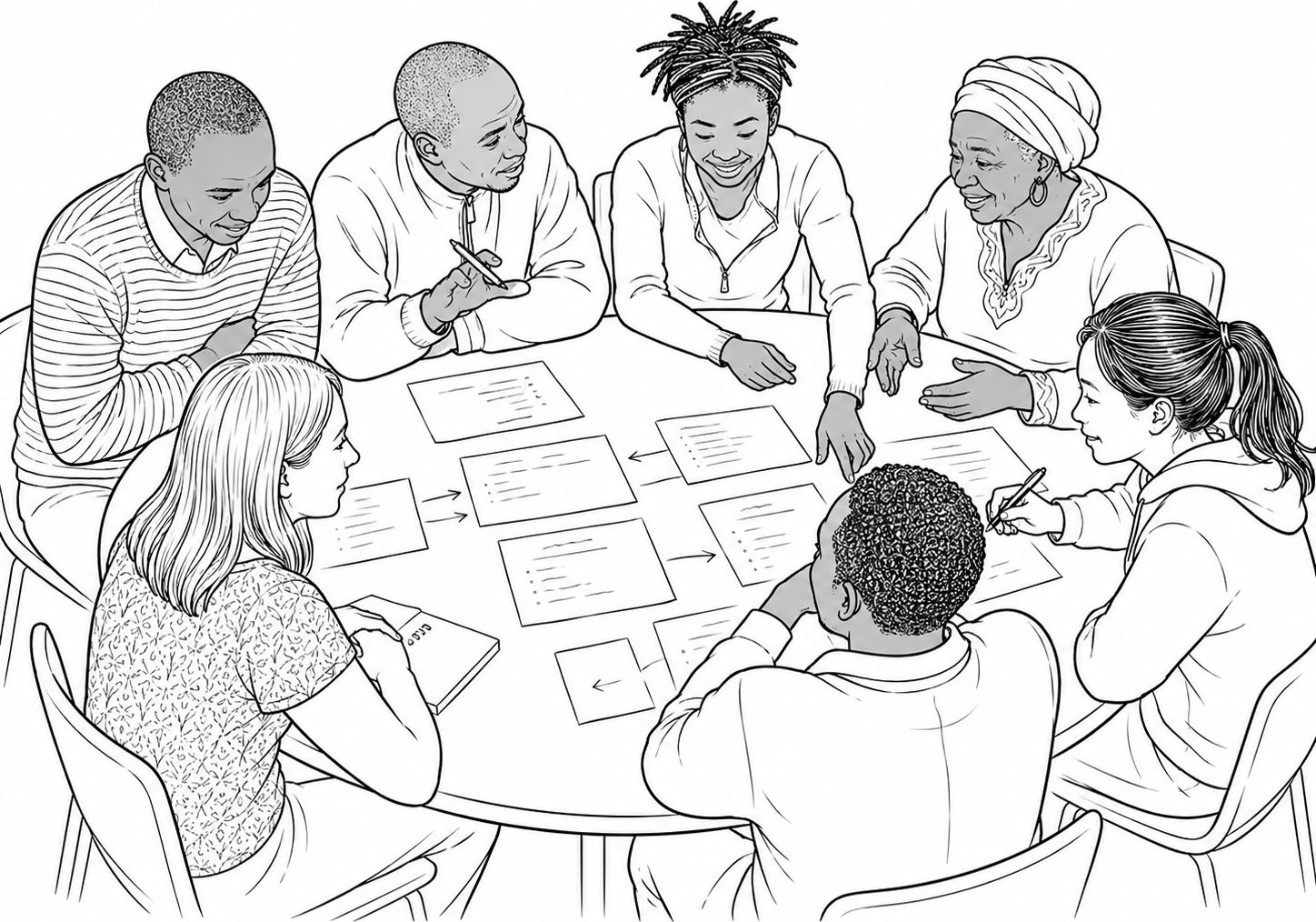
Slide 13The ultimate form of team science might be community-based participatory research. Here, research teams join with community members to define the vision, generate knowledge, and create change. In one example, a US-based team partnered with twenty community members in rural Kenya — church leaders, healthcare staff, teachers, village chiefs — to co-design an HIV prevention intervention, from needs assessment all the way through a pilot trial.
In Closing
The chapter's question is who decides
Colonial roots, and the calls to decolonize how we work together
Then vision, trust, communication, leadership, and more
Next: whose vision gets funded
Slide 14This chapter will help you become a good collaborator. We started with the hard conversation, about global health's colonial roots and the ongoing calls to decolonize how we work together. From here we draw on the science of team science to explore what makes collaborations thrive: vision, trust, communication, leadership, and more. The next video starts with vision, and with the question of whose vision gets funded.