Chapter 1 · Video 1
What global health means, and why equity is in the definition
Print layout
Slide 1

What global health means, and why equity is in the definition
Slide 2
New York County Courthouse, circa 2009
"What is global health, Mr. Green?"
"Well, you see..." — rambles
"Thank you, Mr. Green. You are dismissed."
Slide 3
Skolnik 2019 · Merson et al. 2018
Global health takes a global perspective on public health problems
A useful gloss, and one people recognize after the pandemic
Below the surface, the field has no consensus definition
Slide 4
Koplan et al., 2009
Improving health, and achieving equity in health, for all people worldwide
An area for study, research, and practice
Many disciplines, within and beyond the health sciences
Population-based prevention synthesized with individual clinical care
Slide 5
The search for solutions must span disciplines
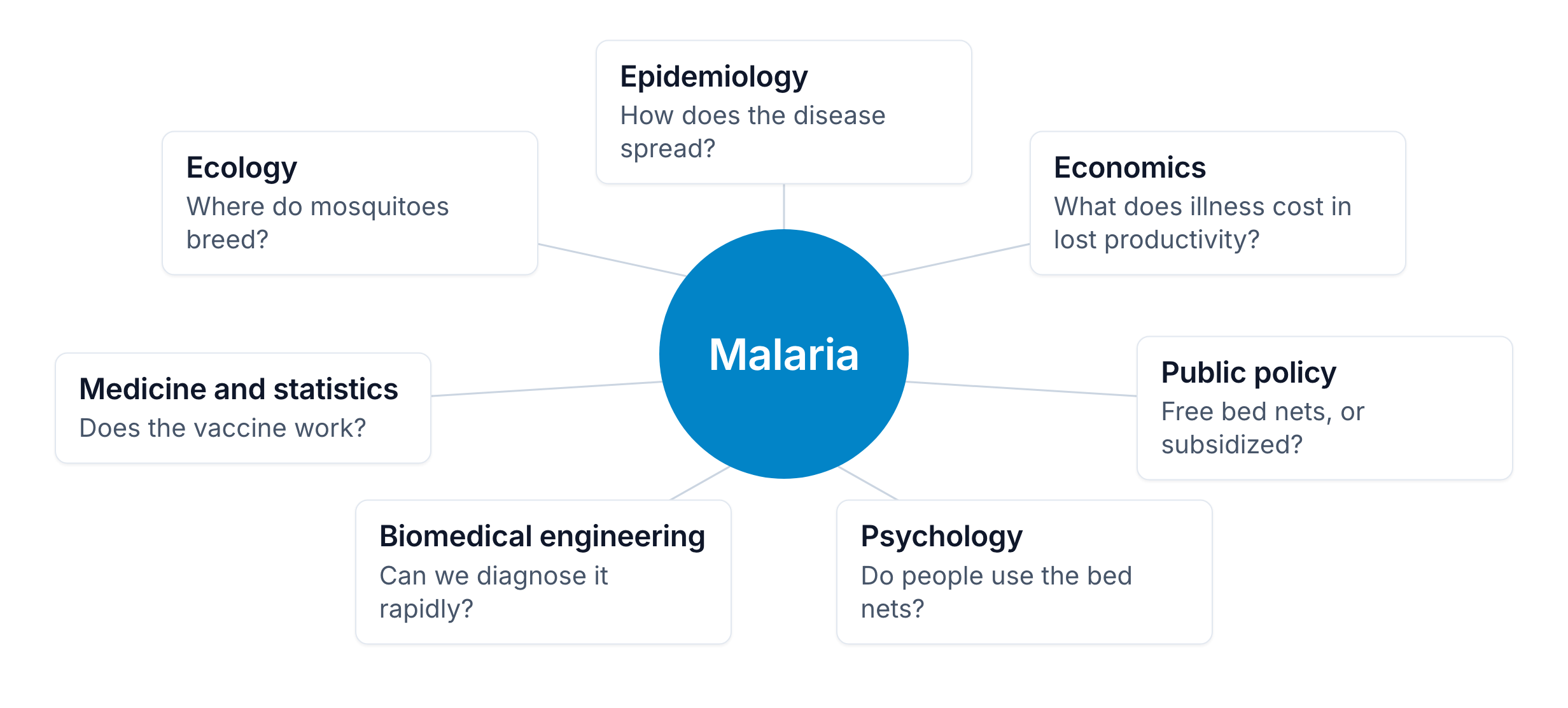
Malaria research spans epidemiology, economics, public policy, ecology, medicine and statistics, biomedical engineering, and psychology. Drawn from the disciplinary examples in Chapter 1.
Slide 6
World Health Organization, 2021
Equity is the absence of unfair, avoidable or remediable differences
Among groups defined socially, economically, demographically, or geographically
Or by other dimensions — sex, gender, ethnicity, disability, sexual orientation
Health equity is achieved when everyone can attain their full potential
Slide 7
The consequence of inequity is often inequality
Inequity
Unfair, unjust differences in access
Can be prevented or fixed
Structural — about who gets access
Inequality, disparity
Unequal health outcomes between groups
Differences in health status
Also called health disparities
Slide 8
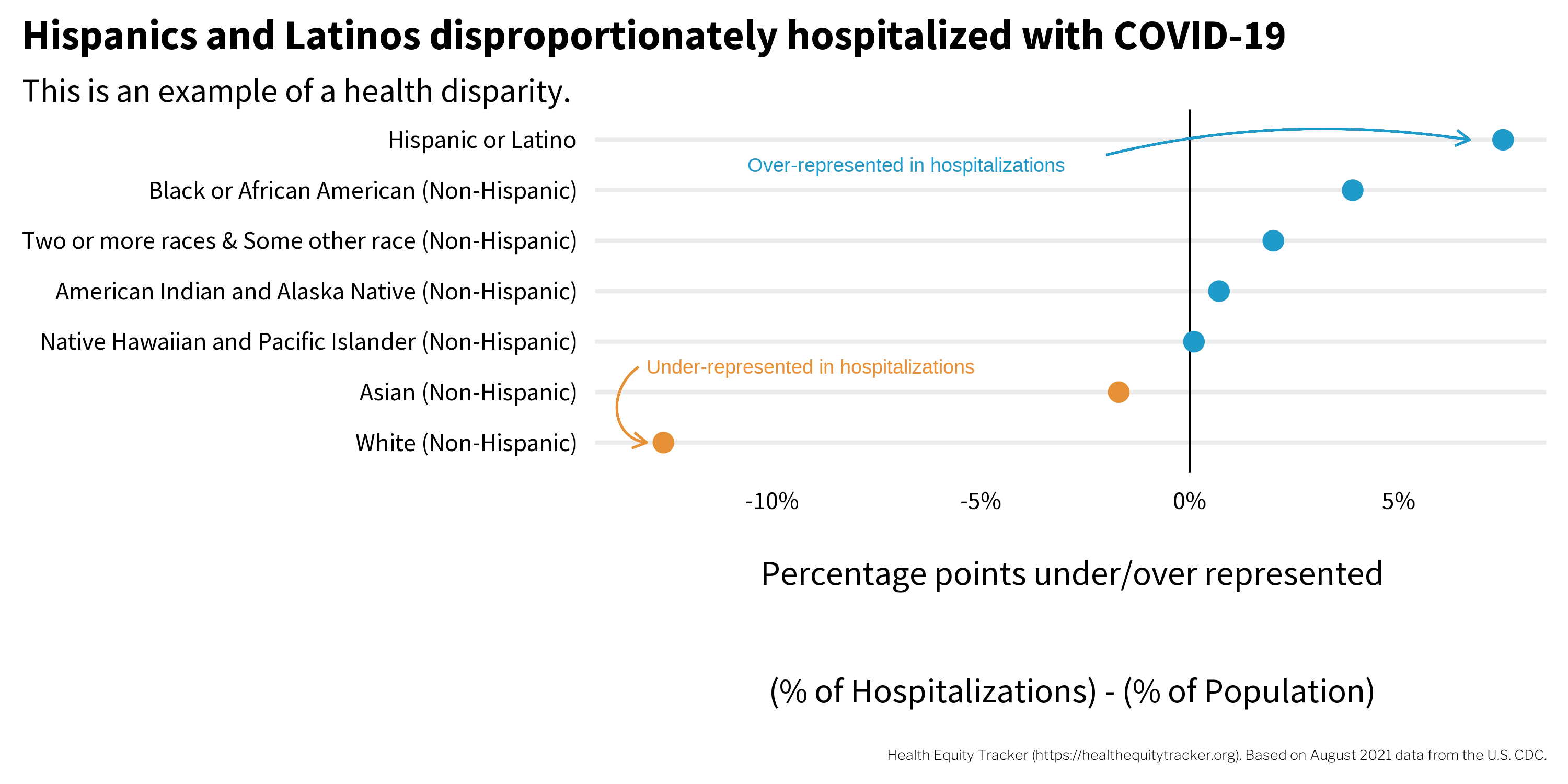
COVID-19 health disparities. Data compiled by the Health Equity Tracker. Reproduced from Chapter 1.
Slide 9
Macias et al., 2020
Factors grouped by exposure and by access
Exposure
Essential jobs, no working from home
Financial pressure to work while unwell
Multigenerational homes, more transmission
Access
Underinsured or uninsured
Undocumented immigration status
Language barriers to reaching services
Slide 10
Social determinants of health — WHO
The circumstances in which people are born, grow up, live, work and age
And the systems put in place to deal with illness
Undocumented immigration status is one example
Slide 11
A DAG is a map of what leads to what
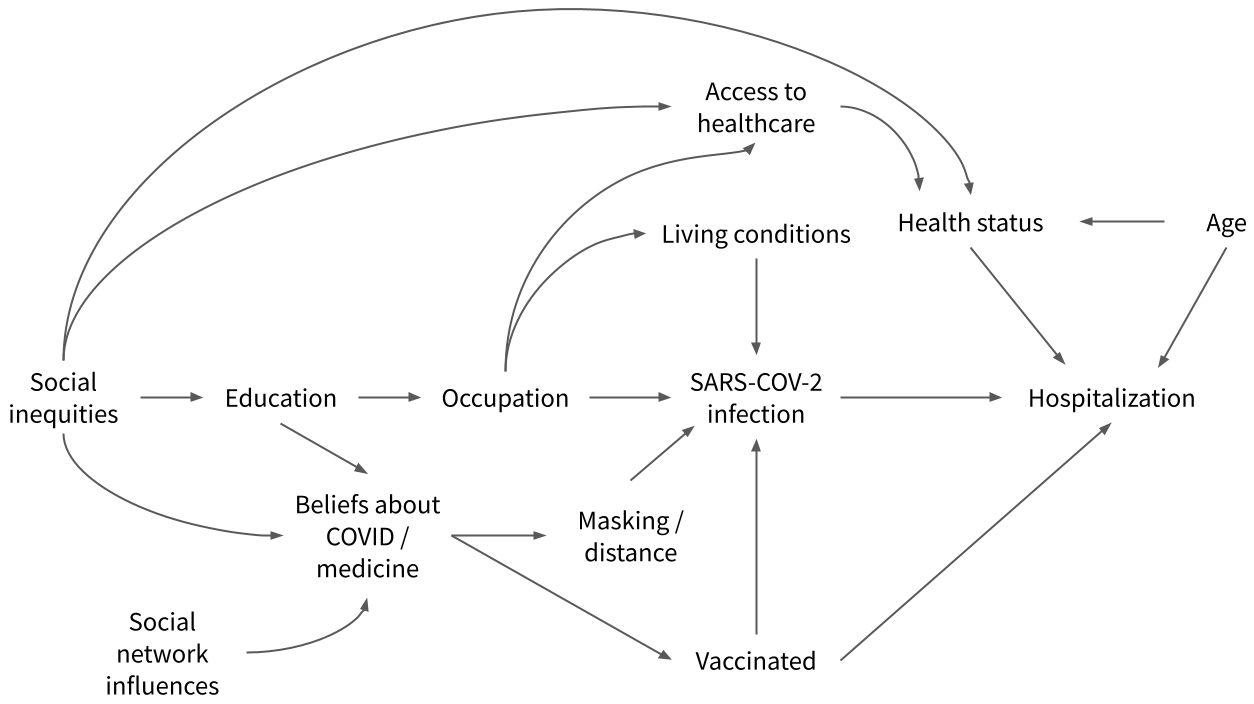
How social determinants of health may have shaped COVID-19 hospitalization. Based on Nafilyan et al., 2021. Reproduced from Chapter 1.
Slide 12
Reading the chain backward
Infectious diseases are social affairs
Hospitalization is directly caused by infection with SARS-CoV-2
Vaccination rates were highest among the most educated
Educational attainment is highest among groups without histories of systematic racism
Slide 13
We have work to do to fix the underlying societal inequities
Understand how social determinants interact with disease risk
Fix the inequities that make certain groups more vulnerable
A vaccine in record time may not be sufficient on its own
Slide 14
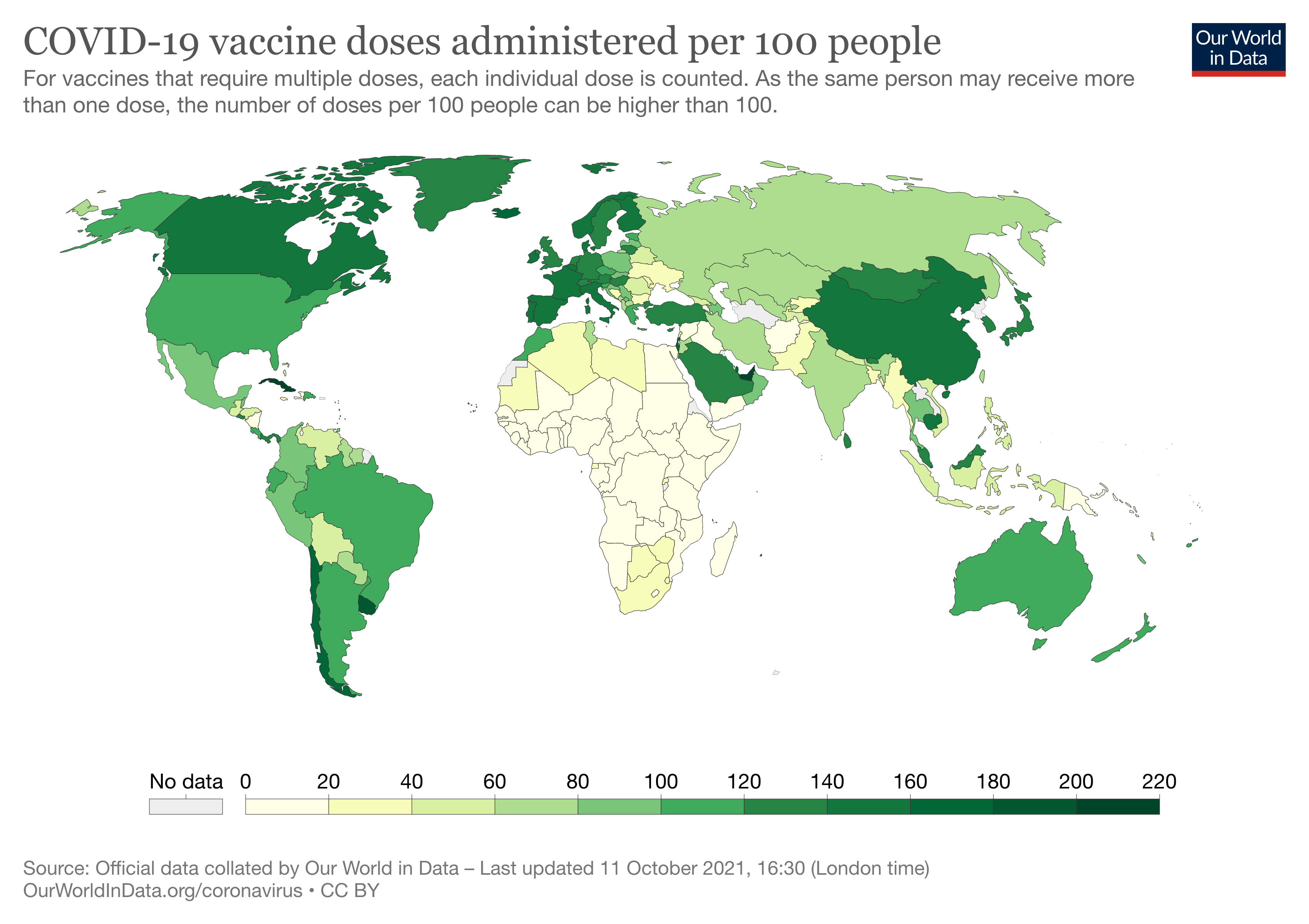
Global access to COVID-19 vaccines. Reproduced from Chapter 1.
Vaccine access was its own inequity
Nearly half the world, by October 2021
Under 3% in low-income countries
Slide 15
Sirleaf and Clark, 2021
Access determined by health criteria, not a country's economic status
Vaccination justice is the first great test of this pandemic era
Timely delivery, not a two-speed world
Failing the test condemns us to a forever crisis
Slide 16
Pause and reflect
Which determinants shaped who got sick in your own community?
Housing, employment, transportation, access to healthcare
Whose vulnerabilities became visible, and whose remained hidden?
What global health means, and why equity is in the definition
Slide 1This video unpacks what global health actually means, including its focus on equity and the social determinants that shape who gets sick and who stays well.
New York County Courthouse, circa 2009
"What is global health, Mr. Green?"
"Well, you see..." — rambles
"Thank you, Mr. Green. You are dismissed."
Slide 2Around 2009 I was in the New York County Courthouse in Lower Manhattan for jury selection. The judge presiding asked what I did for a living. Global health research, I said. He waited. I study access to mental health services. So health policy then, he said. No, mostly intervention research. Globally, he said. Not quite. And then he asked: what is global health, Mr. Green? Well, you see... and I rambled. Thank you, Mr. Green, he said. You are dismissed.
Skolnik 2019 · Merson et al. 2018
Global health takes a global perspective on public health problems
A useful gloss, and one people recognize after the pandemic
Below the surface, the field has no consensus definition
Slide 3I've had that conversation hundreds of times since. Now when asked, I say something like: global health takes a global perspective on public health problems. In the wake of the pandemic, I find that people nod along at this framing. It makes sense to them. But go any deeper below the ontological surface and you find that there is no consensus definition of global health. So this book adopts one.
Koplan et al., 2009
Improving health, and achieving equity in health, for all people worldwide
An area for study, research, and practice
Many disciplines, within and beyond the health sciences
Population-based prevention synthesized with individual clinical care
Slide 4The definition we'll use is this one. Global health is an area for study, research, and practice that places a priority on improving health and achieving equity in health for all people worldwide. It emphasizes transnational health issues, determinants, and solutions. It involves many disciplines within and beyond the health sciences, and promotes interdisciplinary collaboration. And it is a synthesis of population-based prevention with individual-level clinical care. Two key elements of that definition are worth pulling out.
The search for solutions must span disciplines
Malaria research spans epidemiology, economics, public policy, ecology, medicine and statistics, biomedical engineering, and psychology. Drawn from the disciplinary examples in Chapter 1.
Slide 5The first element reflects the reality that global health challenges are complex, so the search for solutions must span disciplines. In the study of malaria, for example, you can read about the spread of the disease — that's epidemiology. The impact of illness on future productivity: economics. The merits of free or subsidized bed nets: public policy. Mosquito habitats: ecology. Whether a vaccine prevents the disease: medicine and statistics. Rapid diagnostic tests: biomedical engineering. And the adoption and use of bed nets: psychology. That is only a few of the areas of inquiry.
World Health Organization, 2021
Equity is the absence of unfair, avoidable or remediable differences
Among groups defined socially, economically, demographically, or geographically
Or by other dimensions — sex, gender, ethnicity, disability, sexual orientation
Health equity is achieved when everyone can attain their full potential
Slide 6The second element is that global health is action-oriented, seeking to achieve health equity for all people worldwide. The World Health Organization defines equity as the absence of unfair, avoidable or remediable differences among groups of people, whether those groups are defined socially, economically, demographically, or geographically, or by other dimensions of inequality. Health is a fundamental human right, and health equity is achieved when everyone can attain their full potential for health and well-being.
The consequence of inequity is often inequality
Inequity
Unfair, unjust differences in access
Can be prevented or fixed
Structural — about who gets access
Inequality, disparity
Unequal health outcomes between groups
Differences in health status
Also called health disparities
Slide 7Put another way, health inequities are unfair and unjust differences in healthcare access or health outcomes that can be prevented or fixed. Health inequities are structural, often resulting from decisions we make about who gets access to resources. The consequence of inequity is often inequality: inequitable access to healthcare services can lead to unequal health outcomes between groups. Those are health inequalities, and differences in health status are also referred to as health disparities.
COVID-19 health disparities. Data compiled by the Health Equity Tracker. Reproduced from Chapter 1.
Slide 8The COVID-19 pandemic has given us many examples of health inequities and disparities. Data compiled by the Health Equity Tracker, shown here, cover COVID-19 hospitalizations in the United States through at least August 2021. Hispanics and Latinos were over-represented in those hospitalizations, while non-Hispanic Whites were substantially under-represented.
Macias et al., 2020
Factors grouped by exposure and by access
Exposure
Essential jobs, no working from home
Financial pressure to work while unwell
Multigenerational homes, more transmission
Access
Underinsured or uninsured
Undocumented immigration status
Language barriers to reaching services
Slide 9A 2020 review points to several factors that might help explain why Latinos and Hispanics were disproportionately affected. On the exposure side: overrepresentation in essential jobs where working from home was not possible, greater financial pressure to show up to work even when unwell, and a higher likelihood of living in multigenerational homes where transmission was more likely. On the access side: being underinsured or uninsured, undocumented immigration status, and language barriers to accessing services. The list also includes higher rates of co-morbid health conditions, which belongs on both sides.
Social determinants of health — WHO
The circumstances in which people are born, grow up, live, work and age
And the systems put in place to deal with illness
Undocumented immigration status is one example
Slide 10Several of these underlying factors, such as undocumented immigration status, fall into the category of social determinants of health. The World Health Organization describes them as the circumstances in which people are born, grow up, live, work and age, and the systems put in place to deal with illness.
A DAG is a map of what leads to what
How social determinants of health may have shaped COVID-19 hospitalization. Based on Nafilyan et al., 2021. Reproduced from Chapter 1.
Slide 11Here is a directed acyclic graph, or DAG, illustrating how social determinants of health might have influenced the pandemic. If you have never seen a DAG before, don't worry — I'll introduce them properly in a later chapter. For now, think of this as a simplified map showing what leads to what: which factors influence which outcomes, and through what pathways.
Reading the chain backward
Infectious diseases are social affairs
Hospitalization is directly caused by infection with SARS-CoV-2
Vaccination rates were highest among the most educated
Educational attainment is highest among groups without histories of systematic racism
Slide 12As represented in this DAG, hospitalization with COVID-19 is directly caused by infection with the novel coronavirus, SARS-CoV-2, but who gets infected is not completely random. Infectious diseases are social affairs, and some people are more vulnerable because of their context. Vaccinated individuals are less likely to get infected, and vaccination rates were highest in the United States among the most educated. Looking further back in the causal chain, educational attainment is highest among groups without historical social inequities such as systematic racism.
We have work to do to fix the underlying societal inequities
Understand how social determinants interact with disease risk
Fix the inequities that make certain groups more vulnerable
A vaccine in record time may not be sufficient on its own
Slide 13A diagram like this suggests two things. First, that to prevent future pandemics we need to gain a deeper understanding of the interaction between social determinants of health and disease risk. Second, and more importantly, that we have work to do to fix the underlying societal inequities that make certain groups more vulnerable. As we saw with COVID-19, technological solutions alone — developing a vaccine in record time — may not be sufficient.
Global access to COVID-19 vaccines. Reproduced from Chapter 1.
Vaccine access was its own inequity
Nearly half the world, by October 2021
Under 3% in low-income countries
Slide 14Another example of a COVID-19 inequity is global access to vaccines. By October 2021, nearly half of the world's population had received at least one dose. But the first six and a half billion doses mostly went into the arms of citizens of wealthy countries. Fewer than three percent of people in low-income countries had received even one. Many low-income countries did escape the worst of the pandemic's first few waves. Even so, the glacial rollout — what some have decried as a vaccine apartheid — left many nations vulnerable to deadly new variants, and that puts everyone at risk.
Sirleaf and Clark, 2021
Access determined by health criteria, not a country's economic status
Vaccination justice is the first great test of this pandemic era
Timely delivery, not a two-speed world
Failing the test condemns us to a forever crisis
Slide 15Ellen Johnson Sirleaf and Helen Clark, the former heads of Liberia and New Zealand, state this plainly in the inaugural issue of PLOS Global Public Health. Achieving vaccination justice, they write, is the first great test of this pandemic era. It requires targets and aspirations for vaccine access to be determined by health criteria, not a country's economic status, and timely delivery, not a two-speed world where high-income populations are fully immunized within months but the poor are denied access for years. Failing the test will condemn us to a forever crisis of insecurity and recrimination.
Pause and reflect
Which determinants shaped who got sick in your own community?
Housing, employment, transportation, access to healthcare
Whose vulnerabilities became visible, and whose remained hidden?
Slide 16Think about your own community during the COVID-19 pandemic. What social determinants — housing, employment, transportation, access to healthcare — shaped who got sick and who stayed well? Whose vulnerabilities became visible, and whose remained hidden? In the next video we turn from what global health is to what research is, and what makes a piece of research scientific.