Chapter 11 · Video 1
What is your identification strategy?
Print layout
Slide 1


What is your identification strategy?
Slide 2
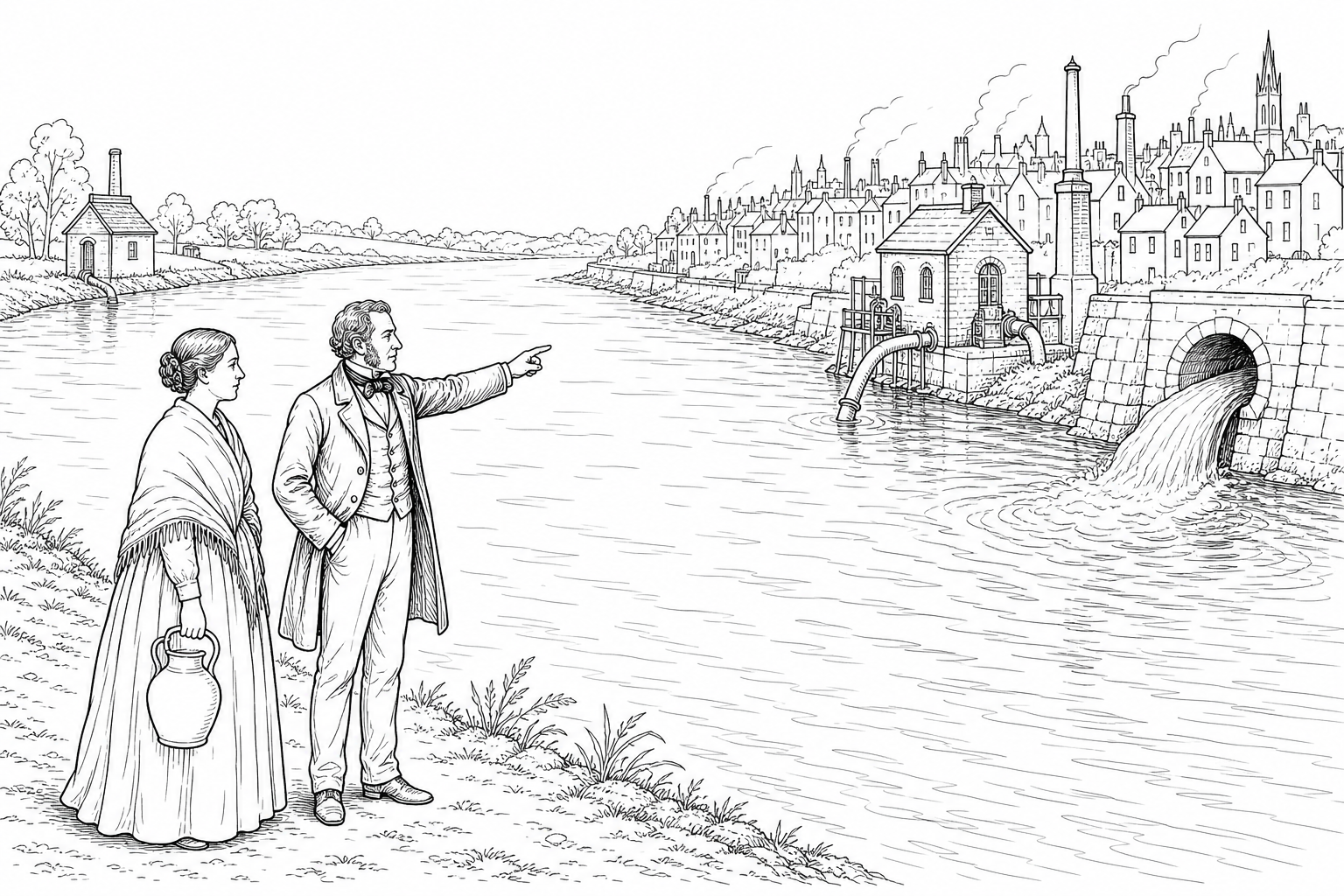
Two water supplies drawn from the Thames. Illustration.
Cholera in London, 1854
Physicians blamed miasma
Snow suspected the water
Slide 3
Two water companies served the same south London streets
Intake moved upstream
Drew water above the sewage outflows
Intake not moved
Drew from the contaminated Thames
Roughly eight times the death rate
Slide 4
Snow's investigation is an early quasi-experimental design
No randomization and no experiment
An accident of infrastructure created the comparison groups
Slide 5
When randomization isn't possible
We can't randomize wars to study child malnutrition
We wouldn't assign families to breathe dirty air
Nobody with decision-making authority will agree to it
The exposure already occurred
Slide 6
Causal inference
Two strategies for causal inference from non-experimental data
Confounder control
Statistical adjustment closes backdoor paths
Design-based approaches
Variation that mimics randomization
The subject of this chapter
Slide 7
Leamer, 1983
“Hardly anyone takes anyone else's data analysis seriously”
Change the specification, the sample, or the set of control variables, and the conclusions changed too
Slide 8
Why regression with control variables was hard to trust
Collect observational data, run a regression, “control for” confounders, call it causal
You could always add another control variable
No principled way to decide which specification was right
Slide 9
Angrist and Pischke, 2010
What is your identification strategy?
What feature of the research design gives a credible claim to causality?
An institutional case: why the variation is plausibly exogenous
An empirical case: the tests that support that claim
Slide 10
Six designs, each with a different counterfactual
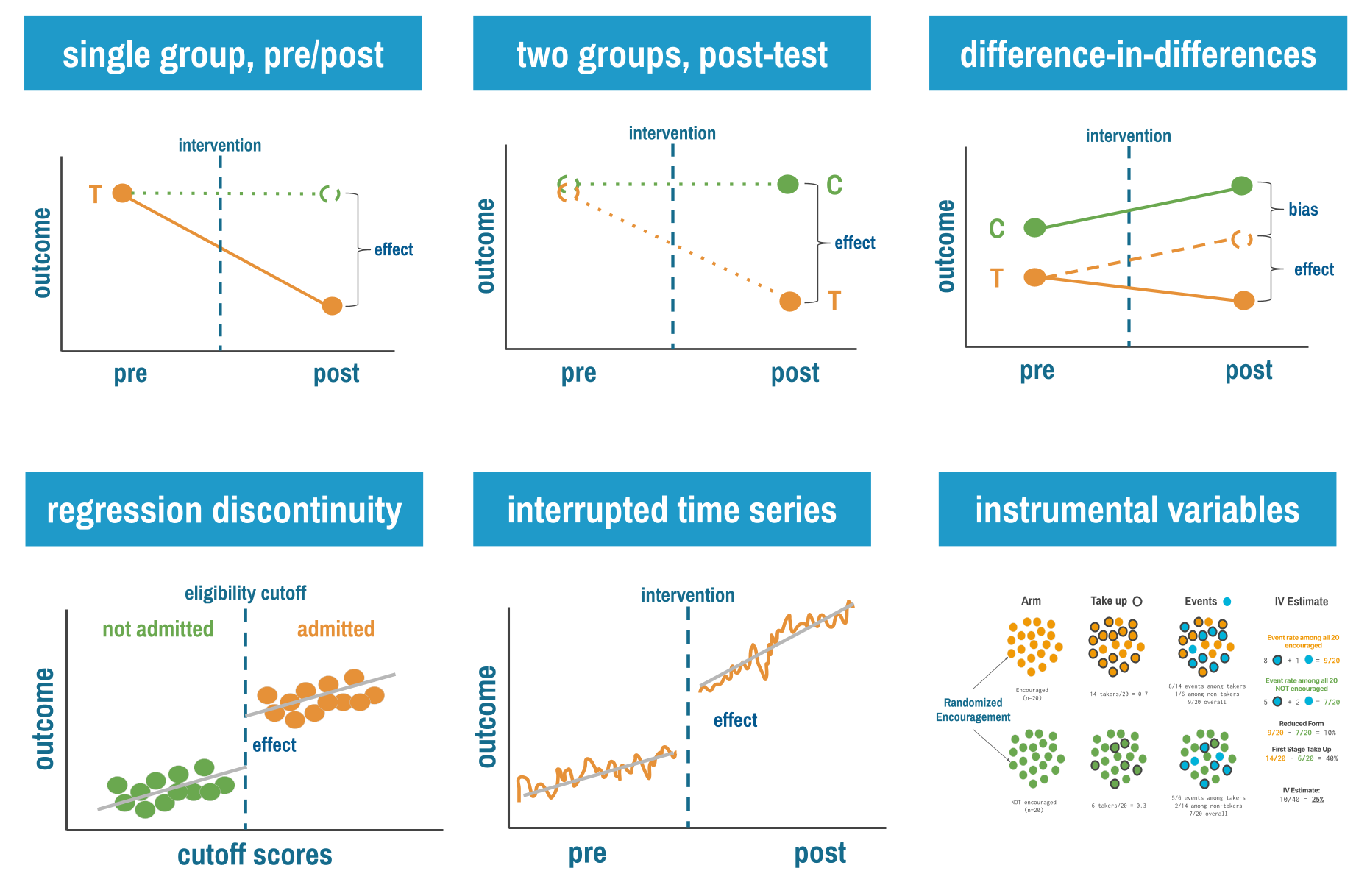
Six quasi-experimental designs covered in this chapter. Each makes different assumptions about what serves as the counterfactual. Reproduced from Chapter 11.
Slide 11
Single group pre-post
The pre-test stands in for the counterfactual
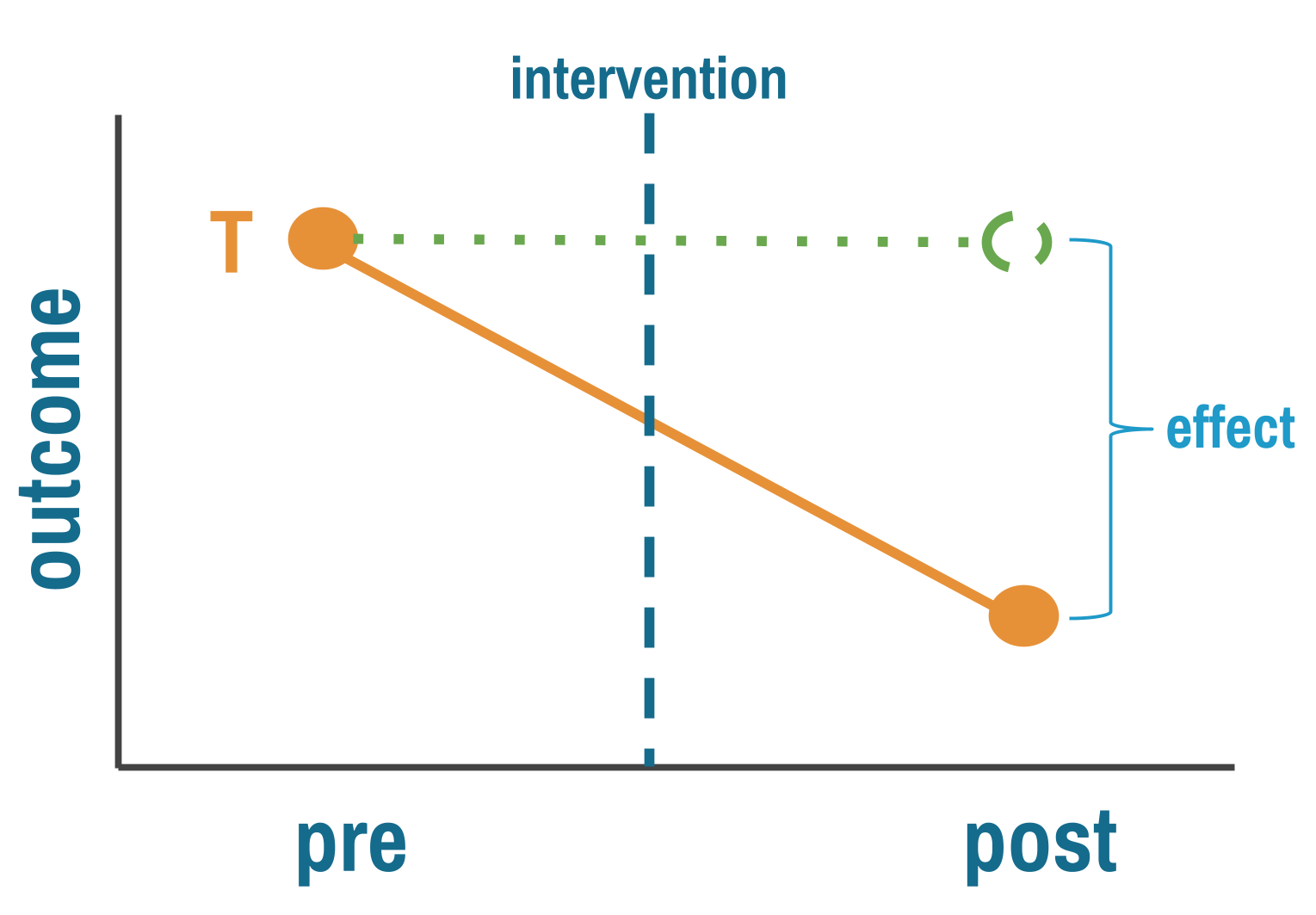
Single group pre-post design. Reproduced from Chapter 11.
Slide 12
Cluver et al., 2016
The Sinovuyo Teen Programme in the Eastern Cape, South Africa
No existing evidence on parenting programs to prevent abuse of adolescents
115 adolescent-caregiver pairs, no exclusion criteria
Delivered by local NGO childcare workers over 12 weeks
Slide 13
Cluver et al., 2016
Reported abuse before and after the program
Adolescent-reported
Before: 4.33
After: 1.33
Caregiver-reported
Before: 11.32
After: 1.68
Slide 14
Cluver et al., 2016
How the researchers described their findings
“Indicative of potential programme results”
A pre-post design “cannot determine causality”
Slide 15
What this pre-post study was designed to do
Establish that the program was safe
Generate effect size estimates to power a future trial
Reveal diffusion: families taught neighbors, in churches, on taxi-buses
The next study used a cluster randomized design
Slide 16
In Closing
Why the team accepted weaker internal validity
Construct validity: standardized measures from adolescents and caregivers
External validity: real-world delivery, no exclusion criteria
A deliberate tradeoff, stated openly
What is your identification strategy?
Slide 1This chapter introduces six quasi-experimental approaches to causal questions. Each one makes different assumptions about what serves as the counterfactual.
Two water supplies drawn from the Thames. Illustration.
Cholera in London, 1854
Physicians blamed miasma
Snow suspected the water
Slide 2London, 1854. Cholera was tearing through the city, and most physicians were sure they knew why: miasma, the foul air rising from the Thames and the city's open sewers. John Snow had a different idea. He suspected cholera spread through contaminated water, but he couldn't run an experiment. He couldn't randomize which Londoners drank from which source.
Two water companies served the same south London streets
Intake moved upstream
Drew water above the sewage outflows
Intake not moved
Drew from the contaminated Thames
Roughly eight times the death rate
Slide 3Two water companies served overlapping neighborhoods in south London. One had recently moved its intake pipe upstream of the city's sewage outflows, and the other hadn't. Households on the same street, in the same conditions, were drinking water from different sources for reasons that had nothing to do with their health. Snow compared death rates and found that households served by the company still drawing from the contaminated section of the Thames died at roughly eight times the rate of those with cleaner water.
Snow's investigation is an early quasi-experimental design
No randomization and no experiment
An accident of infrastructure created the comparison groups
Slide 4There was no randomization and no experiment, but Snow made a powerful causal claim, built on the logic that an accident of infrastructure had created comparison groups almost as good as anything a trial could produce. His investigation is one of the earliest examples of what we now call a quasi-experimental design.
When randomization isn't possible
We can't randomize wars to study child malnutrition
We wouldn't assign families to breathe dirty air
Nobody with decision-making authority will agree to it
The exposure already occurred
Slide 5We often find ourselves in Snow's shoes. We want to estimate the effect of conflict on child malnutrition, but we can't randomize wars. We ask if air pollution causes asthma in children, but we wouldn't randomly assign families to breathe dirty air. Sometimes randomization is technically possible but nobody with decision-making authority will agree to it. And sometimes the question is retrospective: the exposure already occurred, and we're working with the data history left behind.
Causal inference
Two strategies for causal inference from non-experimental data
Confounder control
Statistical adjustment closes backdoor paths
Design-based approaches
Variation that mimics randomization
The subject of this chapter
Slide 6In our session on causal inference, we introduced two broad strategies for causal inference from non-experimental data. Confounder control closes backdoor paths through statistical adjustment. Design-based approaches isolate front-door variation that mimics randomization. This chapter is about the second.
Leamer, 1983
“Hardly anyone takes anyone else's data analysis seriously”
Change the specification, the sample, or the set of control variables, and the conclusions changed too
Slide 7In 1983, the economist Edward Leamer published a critique of his own field. Empirical results, he argued, were fragile. Change the specification, the sample, or the set of control variables, and the conclusions changed too. In his words, “Hardly anyone takes data analysis seriously. Or perhaps more accurately, hardly anyone takes anyone else's data analysis seriously.”
Why regression with control variables was hard to trust
Collect observational data, run a regression, “control for” confounders, call it causal
You could always add another control variable
No principled way to decide which specification was right
Slide 8He was right. For most of the twentieth century, the standard approach to causal questions in the social sciences was to collect observational data, run a regression, control for confounders, and call it causal. Researchers had the statistical tools, but they lacked credible reasons to believe their estimates were causal and not confounded. You could always add another control variable, try another functional form, or argue about logs versus levels. The results often shifted with each choice, and there was no principled way to decide which specification was right.
Angrist and Pischke, 2010
What is your identification strategy?
What feature of the research design gives a credible claim to causality?
An institutional case: why the variation is plausibly exogenous
An empirical case: the tests that support that claim
Slide 9The tools for a different approach already existed. Economists had instrumental variables, others had cataloged threats to validity, and education researchers had formalized regression discontinuity. What changed, in what's been called the credibility revolution, was less about inventing new techniques than about demanding new standards. Researchers began asking a simple question: What is your identification strategy? What feature of your research design, and not your statistical model, gives you a credible claim to causality? The best contemporary design-based studies make both an institutional case, here is why this variation is plausibly exogenous, and an empirical one, here are the tests that support that claim.
Six designs, each with a different counterfactual
Six quasi-experimental designs covered in this chapter. Each makes different assumptions about what serves as the counterfactual. Reproduced from Chapter 11.
Slide 10This chapter covers six designs, arranged roughly from simplest to most sophisticated: single group pre-post designs, multiple group post-test only designs, difference-in-differences, interrupted time series, regression discontinuity, and instrumental variables.
Single group pre-post
The pre-test stands in for the counterfactual
Single group pre-post design. Reproduced from Chapter 11.
Slide 11We'll start with the simplest and weakest design: measure an outcome before an intervention, implement the intervention for everyone, then measure the outcome again. The pre-intervention outcome stands in for what would have happened without treatment. That's the counterfactual. The causal claim rests on a simple subtraction, post minus pre equals effect, and it holds only if nothing else changed between the two measurements. That's the key assumption, and it rarely holds.
Cluver et al., 2016
The Sinovuyo Teen Programme in the Eastern Cape, South Africa
No existing evidence on parenting programs to prevent abuse of adolescents
115 adolescent-caregiver pairs, no exclusion criteria
Delivered by local NGO childcare workers over 12 weeks
Slide 12When one research team set out to study whether a parenting program could reduce child abuse among adolescents in low- and middle-income countries, there was no existing evidence. Designing a full randomized trial would have meant guessing at nearly every parameter, so they chose a pre-post design deliberately. Their program enrolled 115 adolescent-caregiver pairs in rural Eastern Cape, one of the country's poorest provinces, with no exclusion criteria. The program ran for 12 weeks and was delivered by local NGO childcare workers, not trained psychologists.
Cluver et al., 2016
Reported abuse before and after the program
Adolescent-reported
Before: 4.33
After: 1.33
Caregiver-reported
Before: 11.32
After: 1.68
Slide 13Adolescent-reported abuse dropped from an average score of 4.33 to 1.33, and caregiver-reported abuse fell from 11.32 to 1.68. Positive parenting improved, depression decreased in both adolescents and caregivers, and no harmful effects were detected on any outcome.
Cluver et al., 2016
How the researchers described their findings
“Indicative of potential programme results”
A pre-post design “cannot determine causality”
Slide 14But the researchers didn't claim they'd proven the program works. They called their findings “indicative of potential programme results” and were explicit that a pre-post design “cannot determine causality.”
What this pre-post study was designed to do
Establish that the program was safe
Generate effect size estimates to power a future trial
Reveal diffusion: families taught neighbors, in churches, on taxi-buses
The next study used a cluster randomized design
Slide 15The study served three purposes that a pre-post design handles well. It established that the program was safe, it generated the effect size estimates needed to power a future trial, and it revealed an unexpected finding. Families were spontaneously teaching program content to neighbors, in churches, and on shared taxi-buses. That meant an individually randomized trial would be contaminated, so the team pivoted to a cluster randomized design.
In Closing
Why the team accepted weaker internal validity
Construct validity: standardized measures from adolescents and caregivers
External validity: real-world delivery, no exclusion criteria
A deliberate tradeoff, stated openly
Slide 16This is a pre-post study used as intended, as the essential first step in a research program. The team invested in construct validity, with standardized measures from both adolescent and caregiver perspectives, and in external validity, with real-world delivery conditions and no exclusion criteria, rather than internal validity. That was a deliberate tradeoff, and they were transparent about it.