Chapter 10 · Video 4
When is it ethical to randomize?
Print layout
Slide 1


When is it ethical to randomize?
Slide 2
Three ethical questions specific to randomized trials
Withholding treatment from a control group
Why randomization is often more ethical than the alternatives
Testing interventions on people who may never benefit from them
Slide 3
Mai et al., 2018
Is it ethical to assign people to a control group?
A TB meningitis trial in Vietnam: controls still received standard TB treatment
A health worker program where no services exist: controls may receive nothing
Slide 4
Equipoise
Randomizing is ethical when there is genuine uncertainty about which option is better
Expert opinions differ
Prior evidence is mixed
Or a new approach has no prior evidence
Slide 5
Sévère et al., 2016; Desai et al., 2015
Uncertainty can be specific to a setting
The oral cholera vaccine had already been shown to work in Asia
Haiti: effectiveness in a non-endemic setting experiencing an outbreak
Ethiopia: immunogenicity in a population with different baseline immunity
Slide 6
Designs that leave no participant worse off
Standard-of-care control
At least the care they’d get anyway
Waiting-list control
All eventually get the intervention
Slide 7
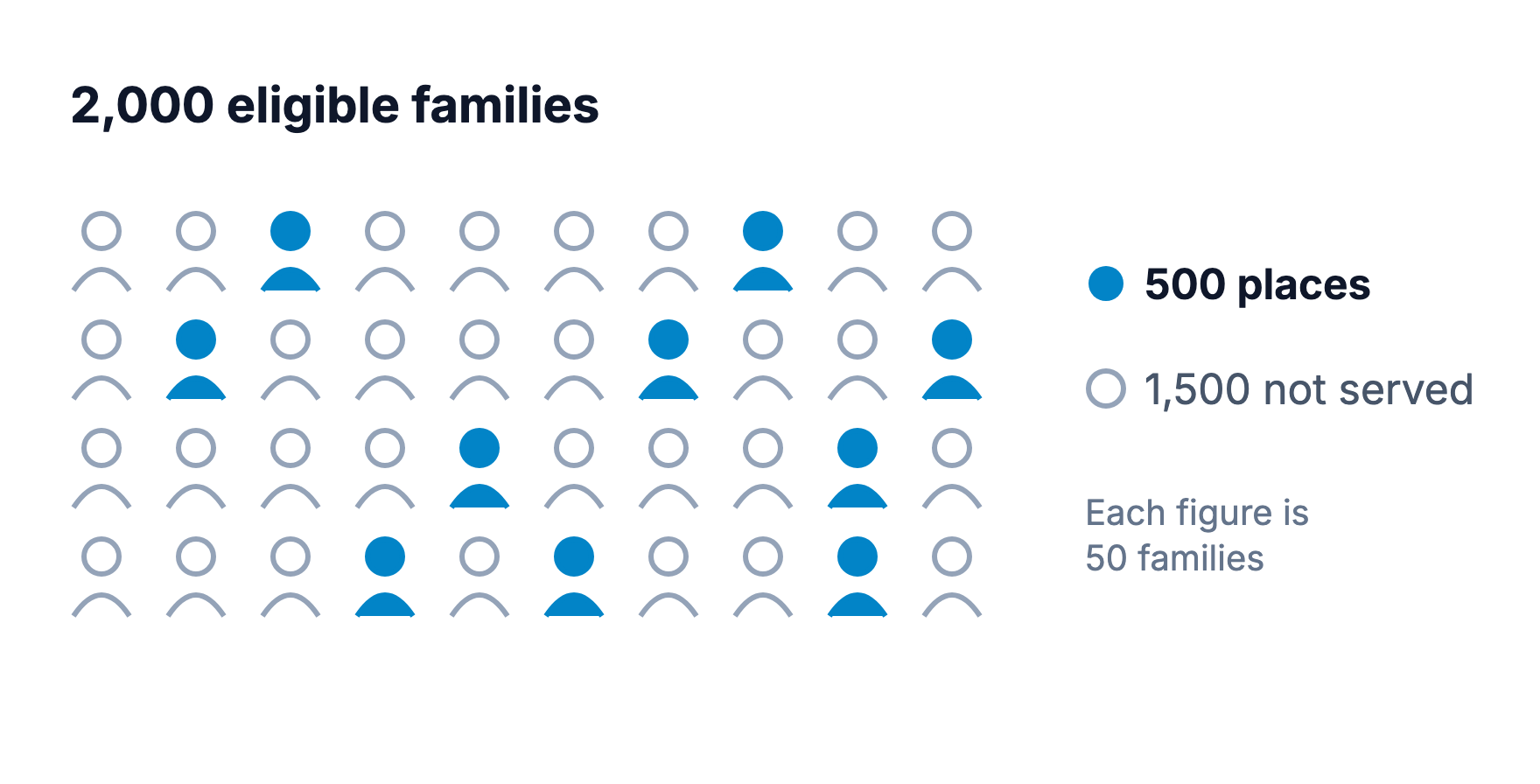
Oversubscription: 2,000 eligible families, 500 places. Example from Chapter 10.
More families are eligible than a program can serve
Fixed budgets, limited staff, capped enrollment
Someone is often left out
Slide 8
How places get allocated when nobody randomizes
Political connections
Geographic convenience
First come, first served, which favors people with transport and information
Staff discretion that may reflect unconscious biases
Slide 9
A lottery as a way to allocate scarce places
Every eligible family has an equal chance of being selected
The process is transparent
Families not selected are no worse off than they would have been
Slide 10
The same constraint applies to health programs
A clinic distributing a limited supply of insecticide-treated bed nets
A government rolling out a new vaccine in phases
Mental health services in a refugee camp
Slide 11
What oversubscription does not settle
Equipoise
Ethical review and informed consent
A genuine research question
Slide 12
Placebo-controlled AZT trials in sub-Saharan Africa in the 1990s
Short-course regimens to prevent mother-to-child HIV transmission
A longer regimen was already standard of care in wealthy countries
The rationale: no treatment was the local standard of care
Slide 13
Who benefits if the intervention works?
An expensive intervention, tested where people can’t afford it
Often the answer is patients in wealthier countries whose regulators needed the evidence
Slide 14
In Closing
If this intervention works, will the people who took part benefit?
Answer questions relevant to the setting
Test interventions that could be implemented there
Plan for post-trial access from the start
When is it ethical to randomize?
Slide 1Randomized trials raise ethical questions that go beyond standard research ethics. The book covers research ethics more fully in a later chapter. Here the focus is on the questions that are specific to randomizing people.
Three ethical questions specific to randomized trials
Withholding treatment from a control group
Why randomization is often more ethical than the alternatives
Testing interventions on people who may never benefit from them
Slide 2There are three issues I want us to look at. The first is the ethics of withholding treatment from a control group. The second is why randomization is often more ethical than the alternatives in resource-constrained settings. And the third is the ethics of testing interventions on people who may never benefit from them. We'll take them in that order.
Mai et al., 2018
Is it ethical to assign people to a control group?
A TB meningitis trial in Vietnam: controls still received standard TB treatment
A health worker program where no services exist: controls may receive nothing
Slide 3Is it ethical to randomly assign people to a control group that won't receive a potentially beneficial intervention? The question becomes particularly acute when standard care is minimal or nonexistent. In the trial of a new treatment for tuberculous meningitis in Vietnam, participants in the control group still received standard TB treatment plus corticosteroids. But if we're testing a community health worker program in a region with no existing health services, participants randomized to the control group may receive nothing.
Equipoise
Randomizing is ethical when there is genuine uncertainty about which option is better
Expert opinions differ
Prior evidence is mixed
Or a new approach has no prior evidence
Slide 4International research ethics guidelines address this through the principle of equipoise. It's ethical to randomize people between treatment options only when there's genuine uncertainty in the scientific community about which option is better. If we already know that an intervention works, it's unethical to withhold it for the sake of research. But if we genuinely don't know whether it will help, because expert opinions differ, or prior evidence is mixed, or we're testing a new approach without prior evidence, then randomization is justified, because we aren't depriving anyone of a known benefit.
Sévère et al., 2016; Desai et al., 2015
Uncertainty can be specific to a setting
The oral cholera vaccine had already been shown to work in Asia
Haiti: effectiveness in a non-endemic setting experiencing an outbreak
Ethiopia: immunogenicity in a population with different baseline immunity
Slide 5Equipoise gets complicated in global health, because there might be uncertainty about whether an intervention works in this particular setting, even if it's proven to work elsewhere. The oral cholera vaccine trials in Haiti and Ethiopia are an example. The vaccine had already been shown to work in Asia, but there was genuine uncertainty about its effectiveness in Haiti, a non-endemic setting experiencing an outbreak, and about its immunogenicity in Ethiopia, a different population with different baseline immunity. So randomization was justified by equipoise specific to those settings, even though the vaccine's efficacy in other contexts was established.
Designs that leave no participant worse off
Standard-of-care control
At least the care they’d get anyway
Waiting-list control
All eventually get the intervention
Slide 6Several design strategies can ease this tension. A standard-of-care control ensures everyone receives, at minimum, whatever care they'd receive outside the study. A waiting-list design ensures everyone eventually receives the intervention. The goal is that research participation doesn't leave anyone worse off than they would be otherwise.
Oversubscription: 2,000 eligible families, 500 places. Example from Chapter 10.
More families are eligible than a program can serve
Fixed budgets, limited staff, capped enrollment
Someone is often left out
Slide 7There's a common objection to RCTs in development and humanitarian settings: how can you randomly deny people access to a program that might help them? But in most of these settings, demand for services vastly exceeds supply. Programs have fixed budgets, limited staff, and capped enrollment, and not everyone who could benefit will be served. The question isn't whether some people will go unserved, because in many cases they will. The question is how we decide who gets access. This situation, where more people are eligible for a program than it can serve, is called oversubscription.
How places get allocated when nobody randomizes
Political connections
Geographic convenience
First come, first served, which favors people with transport and information
Staff discretion that may reflect unconscious biases
Slide 8Without randomization, that decision is usually made through channels that are far less fair: political connections, geographic convenience, first-come-first-served enrollment that favors people with transportation and information, or staff discretion that may reflect unconscious biases. These allocation methods are rarely transparent and almost never evaluated.
A lottery as a way to allocate scarce places
Every eligible family has an equal chance of being selected
The process is transparent
Families not selected are no worse off than they would have been
Slide 9When an agency can only enroll 500 families out of 2,000 who qualify, a lottery is arguably the fairest allocation mechanism. Every eligible family has an equal chance of being selected, the process is transparent, and no one is denied access based on who they know or where they happen to live. The families not selected in the lottery aren't worse off than they would have been without the study. They would have been excluded anyway, just through a less equitable process.
The same constraint applies to health programs
A clinic distributing a limited supply of insecticide-treated bed nets
A government rolling out a new vaccine in phases
Mental health services in a refugee camp
Slide 10The same logic extends to health interventions: a clinic distributing a limited supply of insecticide-treated bed nets, a government rolling out a new vaccine in phases, a humanitarian organization offering mental health services in a refugee camp. All of them face more need than capacity. In each case, randomization converts an unavoidable allocation decision into an opportunity to generate rigorous evidence about whether the intervention works, while treating potential beneficiaries more fairly than the status quo.
What oversubscription does not settle
Equipoise
Ethical review and informed consent
A genuine research question
Slide 11Oversubscription doesn't make every situation appropriate for an RCT. We still need equipoise, ethical review, informed consent, and a genuine research question. What it does is dismantle the assumption that randomization in resource-limited settings is inherently exploitative. Often it's the most transparent and equitable way to distribute scarce resources while learning whether those resources are being used effectively.
Placebo-controlled AZT trials in sub-Saharan Africa in the 1990s
Short-course regimens to prevent mother-to-child HIV transmission
A longer regimen was already standard of care in wealthy countries
The rationale: no treatment was the local standard of care
Slide 12A different ethical problem arises when the populations enrolled in trials won't have access to the interventions being tested, even if those interventions prove effective. In the 1990s, researchers conducted HIV prevention trials in sub-Saharan Africa that tested short-course AZT regimens to prevent mother-to-child transmission. Some trials used placebo controls, even though a longer AZT regimen was already standard of care in wealthy countries. The rationale was that in these African settings, no treatment was the local standard of care. The trials generated valuable evidence, but critics argued that researchers were using a double standard, conducting trials in Africa that would never have been permitted in Western countries.
Who benefits if the intervention works?
An expensive intervention, tested where people can’t afford it
Often the answer is patients in wealthier countries whose regulators needed the evidence
Slide 13That controversy prompted a question that persists today. If a trial demonstrates that an expensive intervention works, but the population where it was tested can't afford it, who benefited from the research? The answer is often patients in wealthier countries whose regulatory agencies needed the evidence for approval.
In Closing
If this intervention works, will the people who took part benefit?
Answer questions relevant to the setting
Test interventions that could be implemented there
Plan for post-trial access from the start
Slide 14The argument here is for designing trials that answer questions relevant to low-resource settings, testing interventions that could actually be implemented there, and planning for post-trial access from the start. When we design an RCT, the question to ask is this one: if this intervention works, will the people who participated in the trial, or people like them, actually benefit?