Chapter 10 · Video 1
Why randomize?
Print layout
Slide 1

Why randomize?
Slide 2
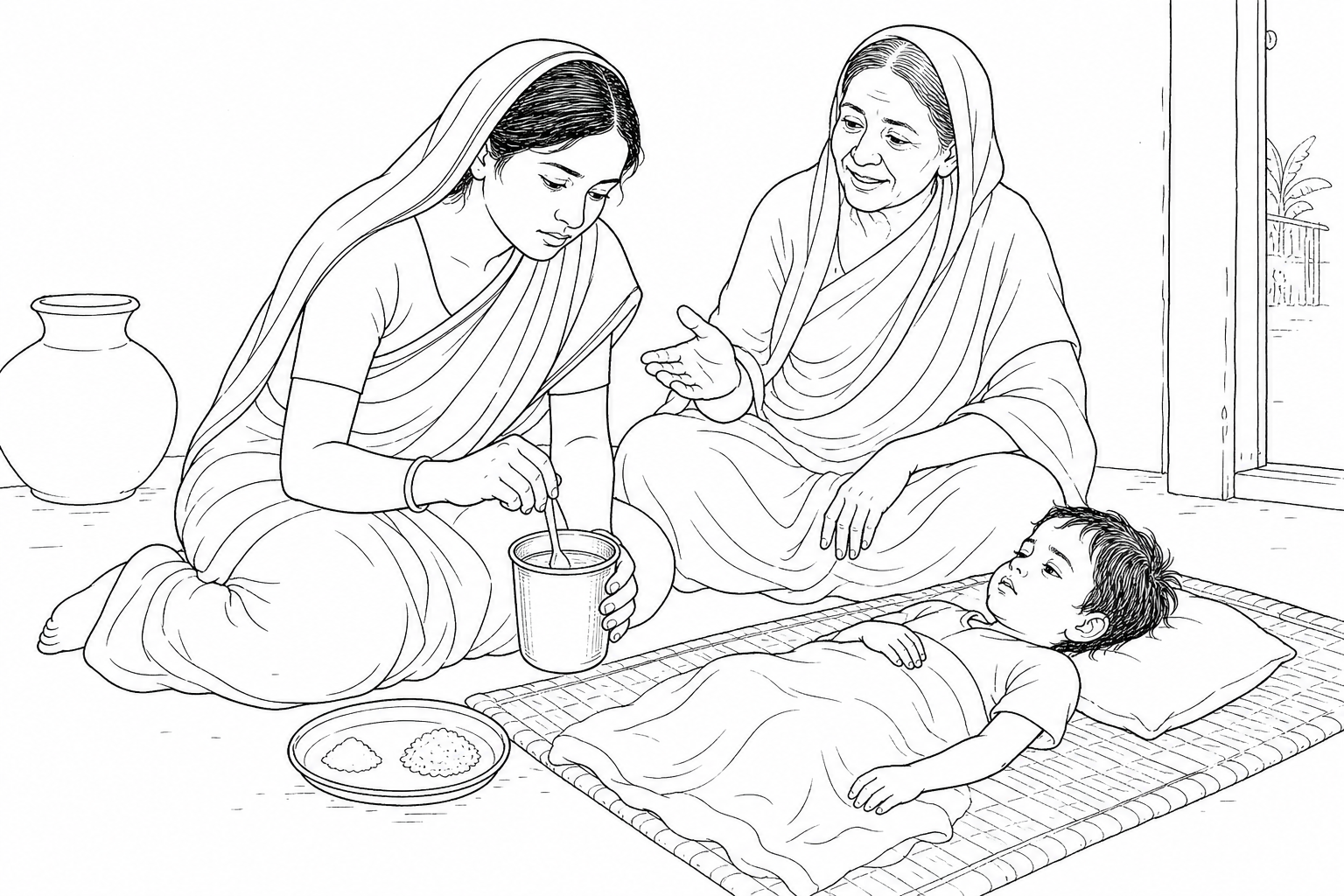
Illustration.
Childhood deaths from diarrheal disease in the 1970s
An estimated 4 to 5 million children died each year
IV fluids worked, but depended on hospitals
Slide 3
Could a solution mixed at home replace intravenous fluids?
Glucose and sodium are co-transported across the intestinal wall
So salt, sugar, and clean water could be absorbed even during active diarrhea
Many clinicians were skeptical
Slide 4
Cholera Research Laboratory, Dhaka
The trials randomly assigned children to ORT or to intravenous treatment
For mild to moderate dehydration, ORT worked remarkably well
Severe dehydration still required IV fluids initially; ORT could sustain children afterward
And ORT could be delivered at home, in refugee camps, and in villages with no hospital
Slide 5
Fontaine et al., 2007; Nalin & Cash, 2018
ORT is credited with saving more than 50 million lives
Mostly children, since its widespread adoption
Slide 6
What randomized trials let us distinguish
What we think might work, and what actually does work in real-world conditions
They help us avoid spending scarce resources on interventions that sound good but don’t deliver
And sometimes the most effective solution isn’t the most technologically sophisticated one
Slide 7
Randomized controlled trial
Participants, or units like villages, are assigned to groups by chance
Usually an intervention group and a control group
The control group receives a placebo, standard care, or no intervention
Assignment is purely by chance, like flipping a coin
Slide 8
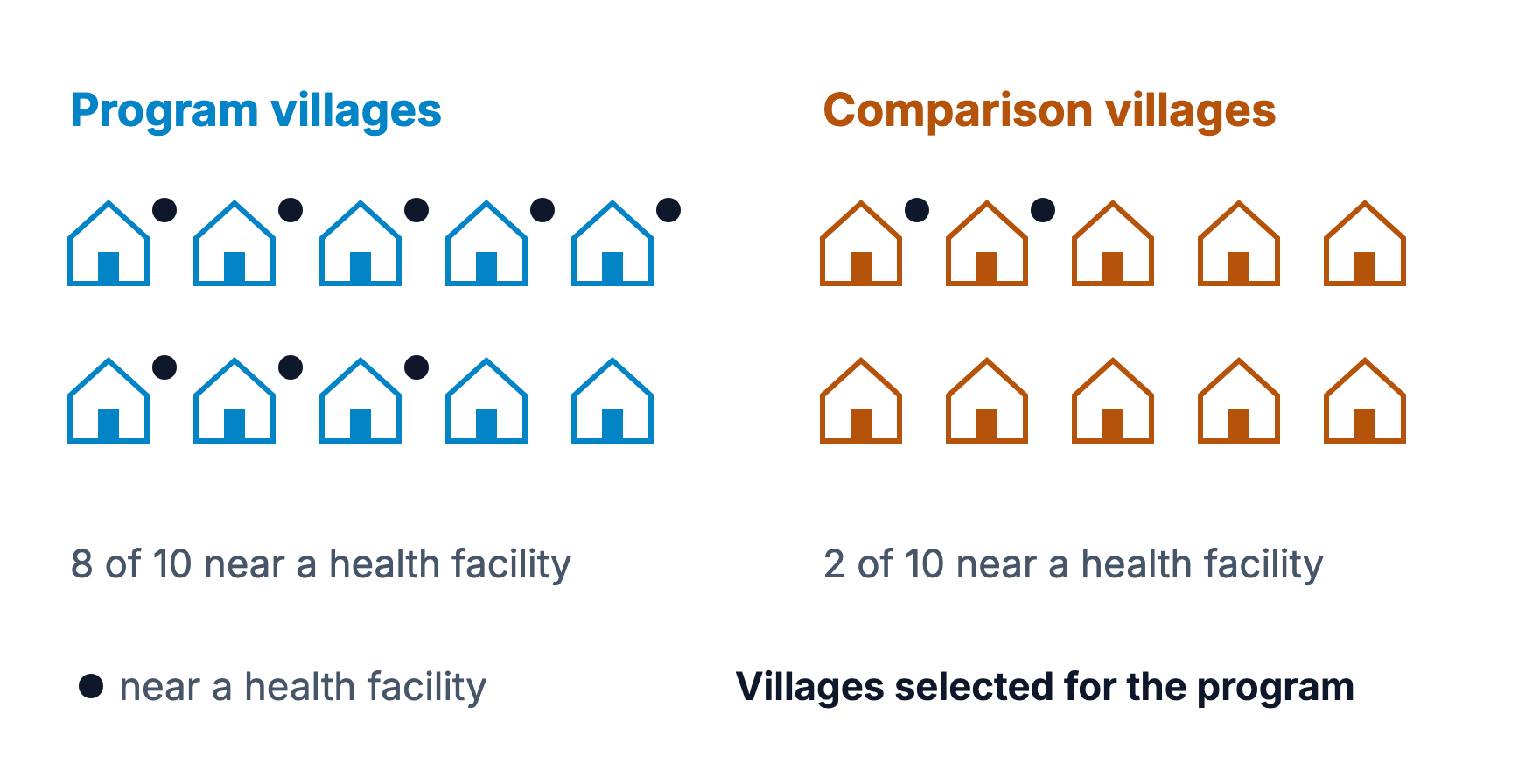
Hypothetical example from Chapter 10. Dots mark villages near a health facility.
A community health worker nutrition program in Ethiopia
Ten program villages, ten villages without the program
Six months later, better nutrition in program villages
Slide 9
Hypothetical
What else could explain the better outcomes?
The program villages were closer to health facilities to begin with
They had better access to markets
Their leaders were motivated enough to improve nutrition without the program
Slide 10
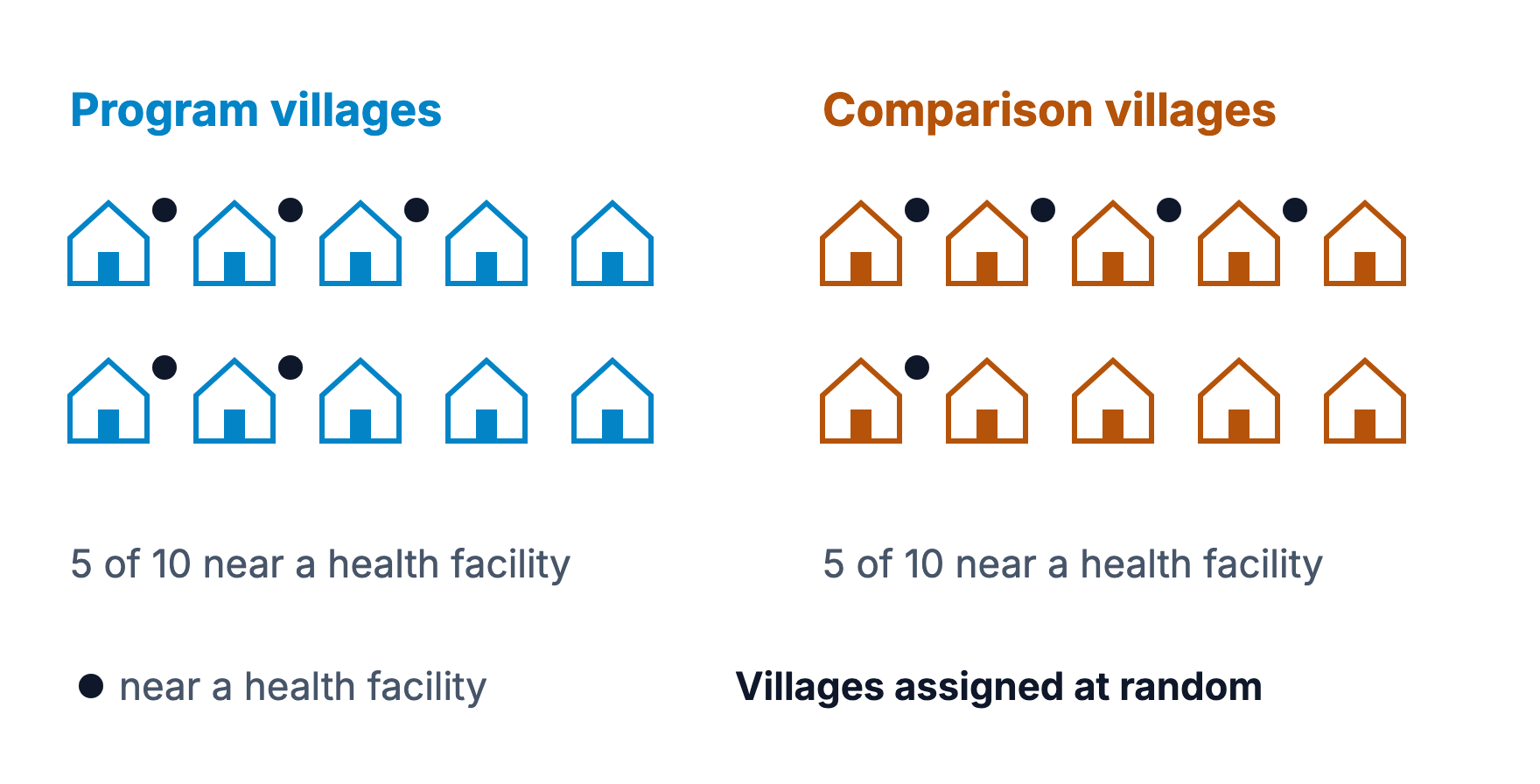
Hypothetical. The same twenty villages, assigned at random.
Random assignment balances groups on average
Distance, markets, leadership, wealth, education
Including factors nobody thought to measure
Slide 11
HMS Salisbury, 1747
Lind’s scurvy comparison was controlled but not randomized
Twelve sailors with similar symptoms, six potential remedies, assigned in pairs
The sailors who received oranges and lemons recovered quickly
Lind tried to match patients on severity, but he chose who got what
Slide 12
Medical Research Council, 1948
The 1948 streptomycin trial set the template for modern RCTs
Centrally generated random allocation in sequentially numbered sealed envelopes
Each envelope opened only after a patient was deemed eligible
Concurrent control groups and systematic outcome assessment
Slide 13
Cohen et al., 2012
RCTs in global health, from ORT to HIV prevention
ORT showed rigorous RCTs could be run in resource-limited settings
HPTN 052, nine countries: early ART reduced HIV transmission in serodiscordant couples
96% among phylogenetically linked infections; 89% including all transmissions
Slide 14
In Closing
Designing a trial begins with the question
Who is in the trial, and how they are allocated
What the control group receives, and whether that is ethical
How the trial is run, and what can go wrong after randomization
Why randomize?
Slide 1Randomized controlled trials are how we test whether an intervention actually works. One set of trials saved millions of lives, through a decision to test a simple idea rigorously, and that's where this chapter begins.
Illustration.
Childhood deaths from diarrheal disease in the 1970s
An estimated 4 to 5 million children died each year
IV fluids worked, but depended on hospitals
Slide 2In the 1970s, diarrheal disease was killing an estimated 4 to 5 million children each year, primarily from dehydration. The standard treatment for severe dehydration was intravenous fluids. That treatment was effective, but it depended on hospitals, trained staff, sterile equipment, and infrastructure that simply didn't exist in most places where children were dying. When a child in a rural Bangladeshi village developed severe diarrhea, the nearest hospital might be hours away by foot, and by the time families could reach help, it was often too late.
Could a solution mixed at home replace intravenous fluids?
Glucose and sodium are co-transported across the intestinal wall
So salt, sugar, and clean water could be absorbed even during active diarrhea
Many clinicians were skeptical
Slide 3The physiological principles for an alternative had been taking shape since the 1960s. Researchers had discovered that glucose and sodium are co-transported across the intestinal wall, which meant that a simple solution of salt, sugar, and clean water could be absorbed even during active diarrhea. But could something a mother mixed at home actually replace hospital IV therapy? Many clinicians were skeptical.
Cholera Research Laboratory, Dhaka
The trials randomly assigned children to ORT or to intravenous treatment
For mild to moderate dehydration, ORT worked remarkably well
Severe dehydration still required IV fluids initially; ORT could sustain children afterward
And ORT could be delivered at home, in refugee camps, and in villages with no hospital
Slide 4Researchers in South Asia, particularly at the Cholera Research Laboratory in Dhaka, which is now ICDDR,B, set out to answer that question with randomized controlled trials. They randomly assigned children with acute diarrhea to receive either oral rehydration therapy, or ORT, or standard intravenous treatment, and they measured outcomes meticulously. For mild to moderate dehydration, ORT worked remarkably well. It dramatically reduced the need for IV therapy and prevented death from dehydration in the vast majority of cases. Severe dehydration still required IV fluids initially, but ORT could sustain children afterward, and it could be delivered at home, in refugee camps, and in villages with no hospital at all.
Fontaine et al., 2007; Nalin & Cash, 2018
ORT is credited with saving more than 50 million lives
Mostly children, since its widespread adoption
Slide 5Today, oral rehydration therapy is credited with saving more than 50 million lives since its widespread adoption, and most of those lives are children's.
What randomized trials let us distinguish
What we think might work, and what actually does work in real-world conditions
They help us avoid spending scarce resources on interventions that sound good but don’t deliver
And sometimes the most effective solution isn’t the most technologically sophisticated one
Slide 6This is the purpose of randomized controlled trials in global health. They let us distinguish between what we think might work and what actually does work when it's implemented in real-world conditions. They help us avoid wasting scarce resources on interventions that sound good but don't deliver results. And sometimes, as with ORT, they reveal that the most effective solution isn't the most technologically sophisticated one.
Randomized controlled trial
Participants, or units like villages, are assigned to groups by chance
Usually an intervention group and a control group
The control group receives a placebo, standard care, or no intervention
Assignment is purely by chance, like flipping a coin
Slide 7A randomized controlled trial is a study design in which participants, or units like classrooms or villages, are randomly assigned to different groups. Typically there's an intervention group that receives the treatment being tested, and a control group that receives either a placebo, standard care, or no intervention. The key word is randomly. Assignment isn't based on which patients arrive first, or on doctor preference, or on disease severity. It's based purely on chance, like flipping a coin.
Hypothetical example from Chapter 10. Dots mark villages near a health facility.
A community health worker nutrition program in Ethiopia
Ten program villages, ten villages without the program
Six months later, better nutrition in program villages
Slide 8Why does randomization matter so much? Because it solves a problem that bedeviled medical research for centuries: how do we know whether an improvement is due to the treatment we gave, or due to something else entirely? Here's a scenario from the chapter. We're evaluating a new community health worker program designed to improve child nutrition in rural Ethiopia. We implement the program in ten villages and compare child growth outcomes to ten other villages that didn't receive it. Six months later, children in the program villages have better nutrition indicators. Success, right?
Hypothetical
What else could explain the better outcomes?
The program villages were closer to health facilities to begin with
They had better access to markets
Their leaders were motivated enough to improve nutrition without the program
Slide 9Not so fast. What if the villages we selected for the program were closer to health facilities to begin with? What if they had better access to markets? What if community leaders in those villages were particularly motivated, and would have implemented nutrition improvements even without our program? Any of these factors, which we call confounding variables, could explain the better nutrition outcomes we observed.
Hypothetical. The same twenty villages, assigned at random.
Random assignment balances groups on average
Distance, markets, leadership, wealth, education
Including factors nobody thought to measure
Slide 10When we randomly assign villages to receive the program or not, all of those potential confounding variables are distributed evenly across program and control villages, on average. That includes distance to health facilities, market access, community leadership, wealth, education, and countless other factors we didn't even think to measure. Some program villages might be close to a health facility and some far away, but the same will be true of the control villages. Careful matching can only account for the variables we know to measure. Randomization makes the groups comparable on everything, measured and unmeasured alike.
HMS Salisbury, 1747
Lind’s scurvy comparison was controlled but not randomized
Twelve sailors with similar symptoms, six potential remedies, assigned in pairs
The sailors who received oranges and lemons recovered quickly
Lind tried to match patients on severity, but he chose who got what
Slide 11The roots of controlled experimentation in medicine are often traced to James Lind, a British naval surgeon who in 1747 tested six potential remedies for scurvy aboard HMS Salisbury. Lind selected twelve sailors with similar symptoms and deliberately assigned pairs to receive cider, sulfuric acid, vinegar, sea water, a medicinal paste, or citrus fruits. The sailors who received oranges and lemons recovered quickly, and the others did not. It was a controlled comparison, and Lind tried to match patients on severity, but it wasn't randomized. He chose who got what.
Medical Research Council, 1948
The 1948 streptomycin trial set the template for modern RCTs
Centrally generated random allocation in sequentially numbered sealed envelopes
Each envelope opened only after a patient was deemed eligible
Concurrent control groups and systematic outcome assessment
Slide 12The first truly randomized clinical trial came two centuries later: the British Medical Research Council's 1948 streptomycin trial for tuberculosis, designed by Austin Bradford Hill. That trial established the template for modern RCTs. Allocation was generated centrally and randomly, using sequentially numbered sealed envelopes that were opened only after a patient was deemed eligible, to prevent foreknowledge of assignment. It had concurrent control groups and systematic outcome assessment.
Cohen et al., 2012
RCTs in global health, from ORT to HIV prevention
ORT showed rigorous RCTs could be run in resource-limited settings
HPTN 052, nine countries: early ART reduced HIV transmission in serodiscordant couples
96% among phylogenetically linked infections; 89% including all transmissions
Slide 13In global health, RCTs emerged somewhat later, initially focused on infectious disease prevention and treatment in low- and middle-income countries. The oral rehydration therapy trials were pivotal, for their public health impact and also for showing that rigorous RCTs could be conducted in resource-limited settings and generate evidence with immediate policy relevance. More recently, RCTs in global health have expanded far beyond pharmaceutical interventions, to test health system innovations, behavioral interventions, community health worker programs, mobile health technologies, and complex implementation strategies. The HPTN 052 study, conducted across nine countries in Asia, Africa, and the Americas, showed that early antiretroviral treatment reduced HIV transmission in serodiscordant couples by 96% among phylogenetically linked infections, and by 89% when all transmissions were included.
In Closing
Designing a trial begins with the question
Who is in the trial, and how they are allocated
What the control group receives, and whether that is ethical
How the trial is run, and what can go wrong after randomization
Slide 14In the videos that follow, we'll work through how randomized controlled trials are designed and run in global health settings. We'll start with the research question, then turn to who is in the trial and how they're allocated, what the control group receives and whether that's ethical, and how trials are run and reported.